Major renewable-energy initiative combines 1,000 MW solar capacity with 4,000 MWh energy storage to strengthen clean-power integration
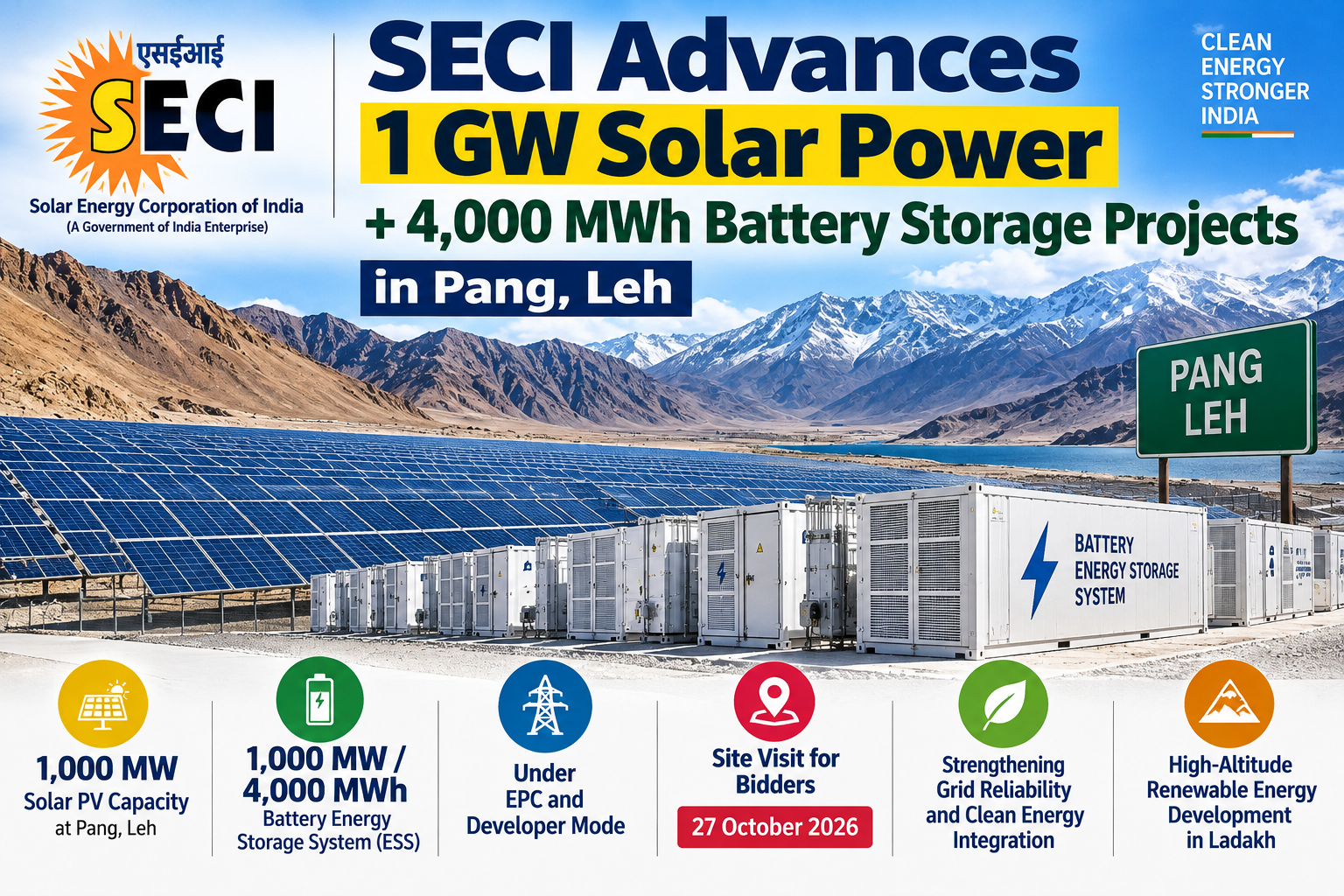
New Delhi, October 27, 2026: The Solar Energy Corporation of India Limited (SECI) is advancing two major renewable-energy projects at Pang in Leh, marking another significant step in India’s effort to expand large-scale solar generation while building adequate energy-storage capacity.
SECI has scheduled a site visit for prospective bidders on 27 October 2026 for the upcoming projects, which involve 1,000 MW of Solar PV capacity paired with 1,000 MW/4,000 MWh of Energy Storage System (ESS). The projects are being pursued through both Engineering, Procurement and Construction (EPC) and developer modes.
Two Projects, One Strategic Objective
The first project involves the design, engineering, supply, construction, erection, testing, commissioning and operation and maintenance of a 1,000 MW AC Solar PV Power Plant with a 1,000 MW/4,000 MWh Battery Energy Storage System at Pang, Leh.
The second initiative involves the selection of solar power developers for setting up 1,000 MW of ISTS-connected Solar PV projects, also supported by a 1,000 MW/4,000 MWh energy-storage system under tariff-based competitive bidding.
The combination of generation and storage is particularly significant because solar power generation varies according to sunlight availability. Large-scale storage can help shift electricity availability beyond the hours of peak solar generation.
Why Energy Storage Matters
India’s renewable-energy expansion is increasingly moving beyond simply adding solar and wind capacity.
As the share of variable renewable energy rises, the power system needs greater flexibility to balance generation and consumption. Battery Energy Storage Systems can help address this challenge by storing electricity and making it available when required.
The Pang project therefore represents a broader shift towards integrated renewable-energy infrastructure, where generation and storage are planned together.
The proposed 4,000 MWh storage component is particularly notable because it gives the project a substantial energy-shifting capability.
Pang, Leh: Strategic Renewable-Energy Location
The location of the project in Pang, Leh adds another dimension to the development.
The high-altitude region has significant solar potential, while developing large renewable-energy projects in such terrain requires careful planning around logistics, construction, accessibility and local conditions.
SECI has accordingly advised prospective bidders visiting the site to reach Leh in advance for high-altitude acclimatisation. A maximum of two representatives from each organisation are permitted for the site visit.
The site visit is an important stage in the project-development process because potential bidders can assess ground conditions and better understand the technical and logistical requirements before submitting bids.
Building Renewable Energy with Storage
India has rapidly expanded its renewable-energy capacity, particularly solar power. However, the next phase of the transition increasingly requires solutions that can provide renewable electricity with greater predictability.
Projects combining solar generation and battery storage can help address this requirement.
Instead of treating solar generation and storage as separate infrastructure assets, integrated projects can potentially provide a more flexible power supply and improve the ability of renewable energy to participate in the wider electricity system.
This makes the SECI initiative relevant not only to the renewable-energy sector but also to India’s broader power-grid modernisation strategy.
Opportunity for Developers and Technology Companies
The project is also expected to create opportunities for solar developers, EPC companies, battery manufacturers, energy-storage system integrators and other infrastructure providers.
Large-scale Battery Energy Storage Systems require sophisticated technology covering battery management, power conversion, thermal management, grid integration and long-term operations and maintenance.
Consequently, projects of this scale can contribute to the development of India’s domestic energy-storage ecosystem.
Beyond Solar Capacity Addition
For SECI, the Pang project represents more than another addition to India’s solar portfolio.
The integration of 1 GW solar generation with 4,000 MWh of storage reflects the increasing importance of dispatchability and flexibility in India’s renewable-energy strategy.
As electricity demand grows and renewable energy becomes a larger component of the generation mix, storage infrastructure is likely to become increasingly important for maintaining grid stability and ensuring that clean electricity can be utilised more effectively.
A New Phase for India’s Renewable-Energy Transition
The Pang initiative comes at a time when India’s renewable-energy sector is moving towards increasingly sophisticated project structures.
Earlier renewable projects focused largely on capacity creation. The emerging model combines generation, transmission, storage and grid integration.
SECI’s latest initiative fits directly into this evolution.
The development also demonstrates the expanding role of public-sector enterprises in creating market opportunities and establishing large-scale renewable-energy infrastructure.
Outlook
The scheduled site visit on 27 October represents an important milestone as SECI moves towards implementation of the Pang projects.
If successfully developed, the initiative could provide a significant demonstration of how large-scale solar generation and battery storage can be integrated in a challenging high-altitude environment.
For India’s clean-energy transition, the significance extends beyond the headline capacity. The project points towards a future in which renewable-energy deployment is increasingly supported by storage, allowing clean power to become more flexible and reliable.
The Worldonomics Times | PSU & Renewable Energy Desk