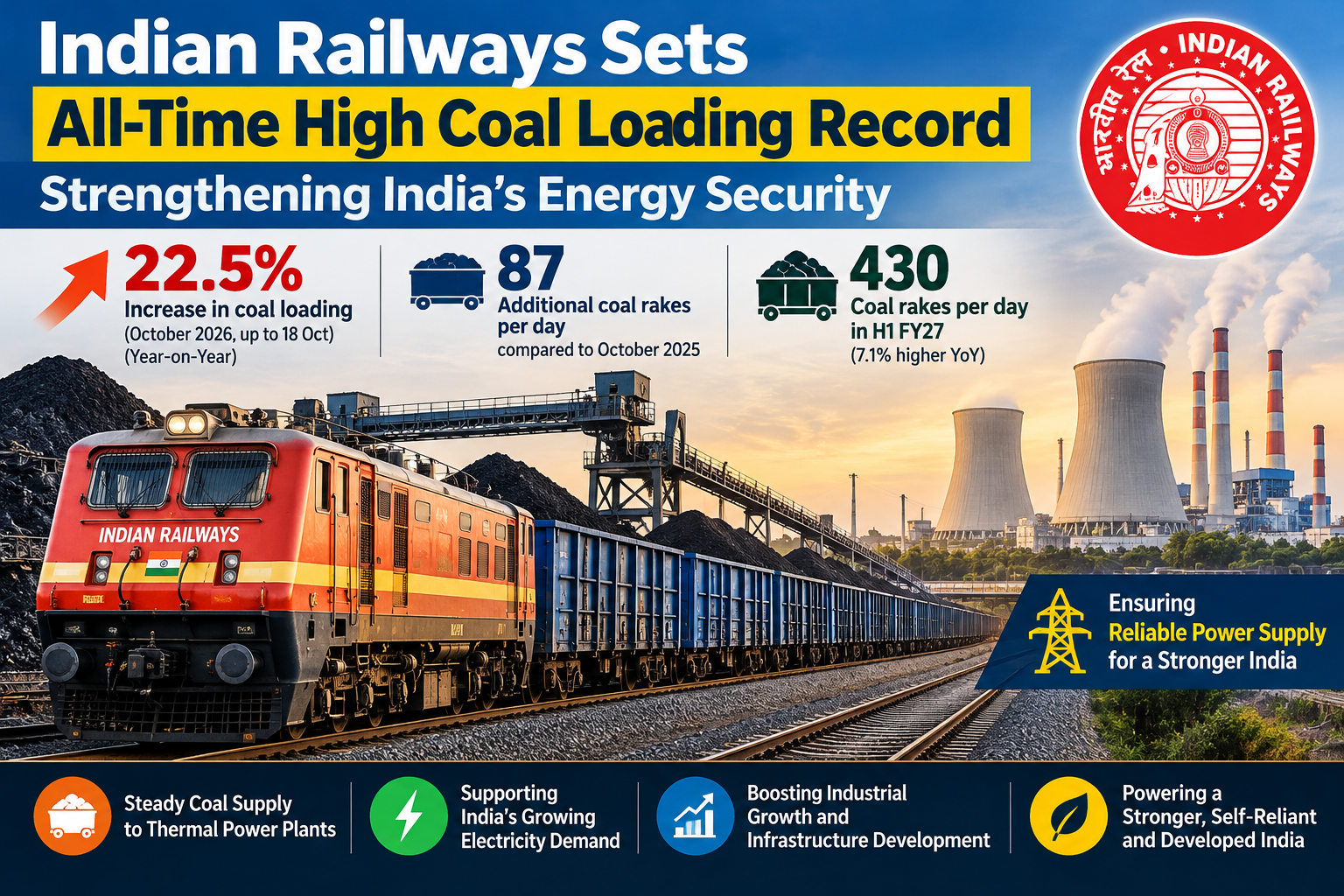
Coal movement rises 22.5% in October; average daily dispatch to thermal power plants reaches 430 rakes in H1 FY27
New Delhi, October 27, 2026: Indian Railways has achieved a significant milestone in coal transportation, recording its highest-ever coal loading performance during October 2026, reinforcing its role as a critical backbone of India’s energy-security infrastructure.
According to the Ministry of Railways, coal loading increased by 22.5% year-on-year during October up to October 18, 2026. During this period, Indian Railways transported 87 additional coal rakes per day compared with October 2025.
The development assumes significance as India’s electricity demand continues to remain closely linked to industrial activity, infrastructure expansion and seasonal variations in power consumption.
430 Coal Rakes a Day in H1 FY27
The strong October performance builds on the momentum achieved during the first half of the financial year.
During April–September 2026, Indian Railways dispatched an average of 430 coal rakes every day to thermal power plants, representing a 7.1% increase over the corresponding period of the previous year.
The growth accelerated further in September, when coal rake dispatches increased by 14% per day year-on-year.
The figures highlight the growing importance of railway logistics in maintaining the fuel supply chain for India’s thermal power sector.
Supporting Reliable Power Generation
Coal remains an important component of India’s electricity-generation mix. Consequently, uninterrupted transportation from coal-producing regions to power-generation centres is critical for maintaining adequate coal stocks at thermal power plants.
The Ministry of Railways said sustained coal evacuation has contributed to maintaining stable coal stocks at thermal power plants, supporting reliable electricity generation.
The railway system is coordinating closely with the Ministry of Coal and Ministry of Power to maintain the flow of coal and respond to the country’s energy requirements.
This coordination is particularly important during periods of high electricity demand, when even temporary disruptions in fuel transportation can place pressure on power-generation capacity.
Logistics Becomes a Strategic Energy Asset
The latest figures underline a broader transformation taking place in India’s infrastructure ecosystem.
Railways is not merely a passenger and freight transportation system; it is increasingly functioning as a strategic logistics platform supporting critical sectors such as power, coal, steel, cement and manufacturing.
The ability to increase coal transportation without a corresponding disruption in supply chains demonstrates the importance of railway capacity, route planning, wagon availability and coordination between different government agencies.
For the power sector, efficient coal logistics can reduce the risk of supply bottlenecks and improve the predictability of fuel availability.
October Momentum Important for Energy Security
The October increase comes at a time when energy demand remains closely associated with industrial production and economic activity. The Ministry of Railways has also noted that higher industrial production and deficient rainfall in some regions have contributed to increased demand for coal-based power generation.
Against this backdrop, the increase in railway coal movement provides an important buffer for the power sector.
The 22.5% growth in coal loading during the first 18 days of October is therefore more than a transportation statistic. It reflects the ability of a major public-sector infrastructure network to respond rapidly to changing requirements in another strategic sector.
Inter-PSU Coordination Gains Importance
The coal supply chain involves multiple public-sector stakeholders, including Indian Railways, Coal India and its subsidiaries, the Ministry of Coal and power-generation companies.
Improved coordination among these organisations can help optimise the movement of coal from mines to power plants, reduce logistical bottlenecks and ensure that generation assets receive adequate fuel.
The latest performance also demonstrates how India’s public-sector institutions can contribute collectively to national infrastructure objectives rather than operating in isolated silos.
A Strong Signal for India’s Infrastructure Network
The record coal-loading performance comes at a time when India’s infrastructure investment is expanding across multiple sectors.
Railway capacity enhancement, freight corridor development, digital monitoring and improved logistics planning can potentially create additional capacity for the movement of essential commodities.
For Indian Railways, coal remains one of the largest and most strategically important freight segments. Maintaining strong performance in this area therefore has implications not only for railway revenues and freight efficiency but also for national energy security.
Looking Ahead
The challenge will now be to sustain this momentum while simultaneously improving freight efficiency and expanding railway capacity for other sectors.
With coal dispatches to thermal power plants already averaging 430 rakes per day in H1 FY27, the October record provides evidence of strong operational momentum.
For India’s public-sector ecosystem, the development offers an important example of how transport infrastructure, energy security and industrial growth are increasingly interconnected.
As India pursues its long-term objective of becoming a developed economy, the ability of PSUs to coordinate across sectors and deliver reliable infrastructure will remain a critical competitive advantage.
The Worldonomics Times – PSU & Infrastructure Desk