New Delhi: India’s MSME ecosystem is increasingly moving beyond traditional small-business models towards innovation, technology and knowledge-driven entrepreneurship. For an entrepreneur with a promising idea, however, converting an idea into a commercially viable product can be challenging. Limited funding, lack of technical expertise, inadequate infrastructure, market access and absence of experienced mentors can prevent innovative ideas from reaching the market.
This is where MSME incubation programmes can play an important role.
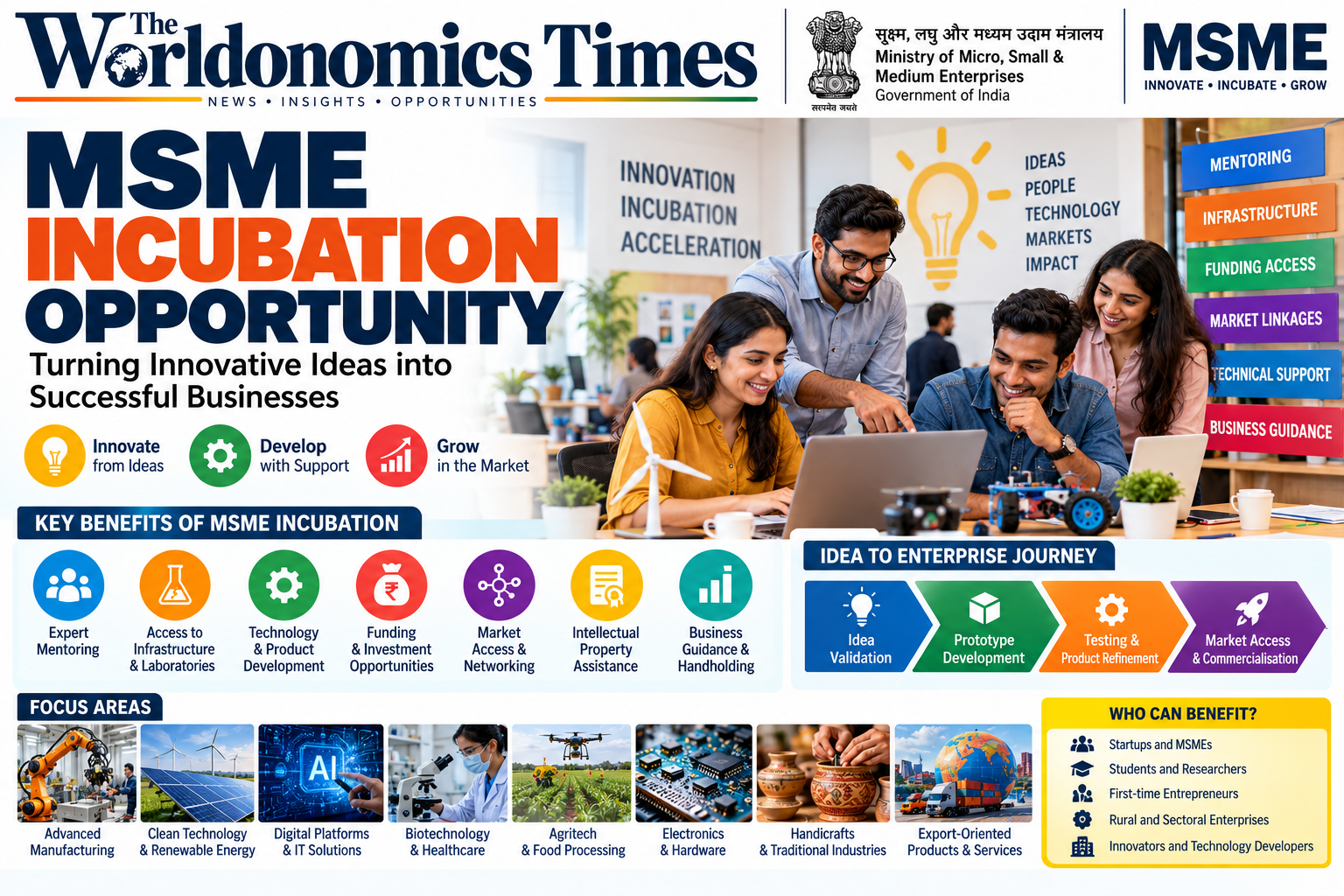
Incubation provides entrepreneurs with an ecosystem where they can develop, test and commercialise innovative products and services. Through incubators, startups and MSMEs can gain access to mentoring, technical support, laboratories, infrastructure, business guidance, networking and potential funding opportunities.
What is MSME Incubation?
MSME incubation is a structured process that helps entrepreneurs transform an innovative concept into a viable business.
An incubator can provide support at different stages—from validating the original idea and developing a prototype to testing the product, understanding customer requirements, establishing a business model and entering the market.
For a first-time entrepreneur, this support can significantly reduce the risks associated with launching a new product.
The Ministry of Micro, Small & Medium Enterprises has promoted incubation and innovation as important components of the MSME development ecosystem. The objective is to encourage innovative ideas, support new enterprises and help commercialise technologies and products.
From Idea to Prototype
One of the biggest challenges for innovators is moving from an idea on paper to a working prototype.
An entrepreneur may identify a problem in agriculture, manufacturing, healthcare, logistics, energy or consumer products but may not possess the machinery, laboratory facilities or technical expertise required to develop a solution.
Incubation centres can bridge this gap by providing access to technical facilities, equipment, experts and mentors.
For example, an entrepreneur developing a new manufacturing component may require design assistance, testing facilities and engineering expertise before approaching customers. An incubator can help the entrepreneur undertake these activities in a structured environment.
Support for Technology and Innovation
Modern MSME incubation is not limited to traditional manufacturing.
Innovative businesses working in areas such as artificial intelligence, robotics, Internet of Things, clean technology, renewable energy, biotechnology, electronics, digital platforms, advanced manufacturing and Industry 4.0 can also benefit from incubation ecosystems.
Technology-focused incubators can help entrepreneurs understand technical feasibility, intellectual property protection, product development and commercialisation.
This is particularly important because many innovators are technically strong but may have limited knowledge of business management, marketing, finance or regulatory requirements.
Mentoring and Business Guidance
A good business idea alone does not guarantee commercial success.
Entrepreneurs need to understand customers, pricing, competition, distribution, financial planning and regulatory requirements. Incubators can connect entrepreneurs with experienced mentors and industry professionals who can help them make better business decisions.
Mentoring can cover areas such as:
- Business model development
- Product-market fit
- Financial planning
- Marketing strategy
- Intellectual property
- Legal and regulatory compliance
- Technology development
- Fundraising
- Customer acquisition
- Export readiness
Such guidance can be particularly valuable for first-generation entrepreneurs.
Funding and Financial Opportunities
Access to finance remains a major challenge for innovative MSMEs because banks may find it difficult to evaluate an untested product or early-stage business.
Incubation can improve an entrepreneur’s preparedness for fundraising by helping develop a business plan, financial projections, prototype and market validation.
Depending on the programme and incubator, entrepreneurs may also be connected with government support programmes, investors, financial institutions, venture capital funds, angel investors and other sources of funding.
However, entrepreneurs should distinguish between incubation support and guaranteed funding. Participation in an incubator does not automatically mean that an entrepreneur will receive investment or a government grant. Eligibility, selection criteria and the applicable programme rules must always be checked.
Intellectual Property and Commercialisation
Innovation can create valuable intellectual property.
An entrepreneur developing a new product or technology may need to consider patents, trademarks, designs, copyrights or other forms of intellectual property protection.
Incubators can help innovators understand the importance of protecting their intellectual assets before entering into commercial arrangements.
The next challenge is commercialisation. A technically successful product still needs customers. Incubation programmes can therefore help entrepreneurs move from prototype to market, including through industry connections, exhibitions, demonstrations, networking and business partnerships.
Opportunities for Students and Young Entrepreneurs
MSME incubation also creates opportunities for students, researchers and young professionals.
Universities, technical institutions, research organisations and incubation centres can become platforms where students transform academic projects into commercial ventures.
For young entrepreneurs, this can provide an alternative pathway from education to entrepreneurship.
A student who develops a technology solution for agriculture, financial services, logistics, manufacturing or sustainability can potentially use an incubation ecosystem to validate the idea before creating a formal enterprise.
Rural and Sectoral Entrepreneurship
Incubation does not have to be restricted to large cities.
India’s rural and semi-urban regions have significant entrepreneurial potential in food processing, handicrafts, textiles, agriculture, renewable energy, rural services and traditional industries.
Local incubation networks can help entrepreneurs combine traditional knowledge with modern technology, branding, packaging, digital marketing and e-commerce.
This can create opportunities for local employment and strengthen regional MSME ecosystems.
How Entrepreneurs Can Prepare
Entrepreneurs interested in incubation should prepare a concise business proposal explaining the problem, proposed solution, target customer, market opportunity, competitive advantage and revenue model.
If a prototype already exists, entrepreneurs should document its technical specifications, testing results and customer feedback.
They should also prepare basic financial projections and clearly explain what support they require—such as technology development, laboratory facilities, mentoring, market access, intellectual property assistance or investment readiness.
The Road Ahead
India’s ambition to build a competitive and innovation-driven economy will depend significantly on the ability of MSMEs to adopt new technologies and develop globally competitive products.
Incubation can serve as a bridge between innovation and enterprise.
For entrepreneurs, the message is simple: a good idea should not remain only an idea. With the right mentoring, infrastructure, technology support and market connections, an innovative concept can become a product, a company and eventually a scalable business.
As India’s MSME ecosystem evolves, incubation centres can play a crucial role in creating the next generation of entrepreneurs, technology companies and innovative small businesses.
For aspiring entrepreneurs, the incubation ecosystem offers an important opportunity—not just to start a business, but to build it on a stronger foundation.