The Worldonomics Times | Business, Economy & Taxation
New Delhi | October 28, 2026
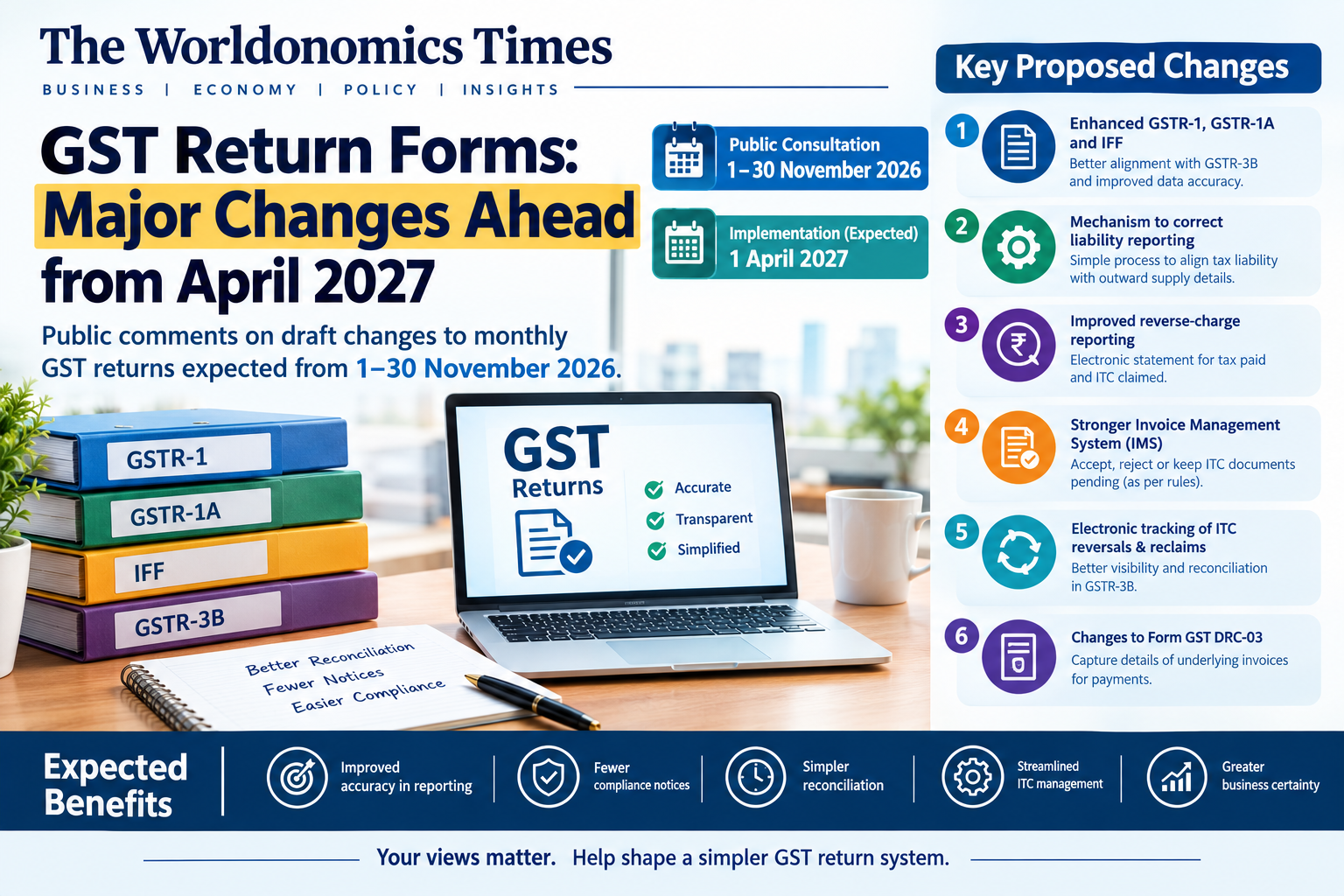
India’s Goods and Services Tax (GST) return filing system is set for a significant procedural review, with the Finance Ministry expected to invite public comments on proposed changes to monthly GST return forms from November 1 to November 30, 2026. The proposed reforms aim to improve reconciliation between sales declarations, tax liabilities and input tax credit (ITC), while reducing avoidable notices and compliance difficulties faced by businesses.
According to reports quoting officials from the Central Board of Indirect Taxes and Customs (CBIC), the draft return forms, rules and related guidance are expected to be published on the MyGov portal for a 30-day consultation. The revised mechanism is proposed to take effect from April 1, 2027, subject to the finalisation and notification of the applicable changes. Source: Mint
Why Is GST Return Reform Needed?
Under the existing GST framework, businesses report outward supplies through GSTR-1 and discharge their tax liability through GSTR-3B. Input tax credit claims also require reconciliation with the relevant supplier-reported information and system-generated statements.
Differences between sales reported in GSTR-1, tax paid through GSTR-3B and ITC reflected in relevant statements can lead to system-generated intimations, notices and additional reconciliation work. Such differences may arise from reporting errors, credit notes, timing differences, amendments or incorrect classification of transactions.
The government’s objective is to address these issues at the reporting stage rather than relying primarily on post-filing corrections and subsequent correspondence between taxpayers and tax authorities.
The GST Council, at its 57th meeting held on October 8, 2026, recommended several measures intended to improve the accuracy of return information and strengthen the integrity of the ITC chain. The proposals include enhancements to GSTR-1, GSTR-1A and the Invoice Furnishing Facility (IFF), alongside mechanisms to improve alignment with GSTR-3B. Source: Press Information Bureau
Key Proposed Changes to GST Returns
1. Improved GSTR-1, GSTR-1A and IFF
The proposed enhancements are intended to improve the consistency of outward-supply information furnished through these forms with the tax liability reported in GSTR-3B. Better reconciliation could help businesses identify discrepancies earlier and reduce the need for repeated adjustments.
2. A mechanism to correct liability reporting
The GST Council has recommended an alternative mechanism for correcting or rectifying tax liability reported in GSTR-3B so that it aligns with the relevant outward-supply details furnished in GSTR-1, GSTR-1A or IFF. The practical operation of this mechanism will depend on the final rules and forms.
3. Better reporting of reverse-charge transactions
A proposed electronic statement covering tax paid under the reverse-charge mechanism and ITC claimed is intended to support more accurate reporting. This could help taxpayers reconcile reverse-charge liabilities with eligible credit and maintain clearer supporting records.
4. Improved Invoice Management System
The proposed changes also include enhancements to the Invoice Management System (IMS), allowing recipients, subject to prescribed conditions, to accept, reject or keep relevant inward-supply documents pending for ITC reporting. This is intended to improve the quality of information used in generating ITC statements.
5. Electronic tracking of ITC reversals and reclaims
A proposed Electronic Credit Reversal and Reclaim Statement would facilitate the correct reporting of credit reversed and subsequently reclaimed in GSTR-3B. Clearer tracking could help businesses avoid inconsistencies in their credit balances and supporting reconciliations.
The Council has also recommended changes to Form GST DRC-03 to capture details of the underlying invoices against which payments are made. These proposals are designed to make reporting more transparent and easier to verify. Source: PIB — GST Return Reforms
What Does the Consultation Mean for Businesses?
The November consultation provides an opportunity for businesses, tax professionals, industry associations and software providers to review the proposed changes and identify practical concerns before implementation.
Businesses should examine how the proposed forms may affect their accounting systems, ERP software, invoice-management procedures, tax reconciliations and monthly closing processes. Particular attention should be given to credit notes, amendments to earlier-period transactions, reverse-charge supplies, ITC reversals and reclaims, and differences caused by timing.
Industry participants may also consider whether the proposed system provides clear instructions for genuine errors, transactions spanning different tax periods and cases in which supporting documents are received after the original return has been filed.
For small and medium-sized enterprises, the success of the reforms will depend on whether the new procedures simplify compliance without creating additional reporting requirements or requiring extensive changes to existing accounting systems.
Recommended Preparations for Taxpayers
Businesses need not wait until implementation to strengthen their internal controls. They can begin by reviewing the reconciliation between GSTR-1 and GSTR-3B, matching purchase records with available ITC statements, maintaining invoice-level documentation and identifying recurring discrepancies.
Tax teams should also review their accounting software and coordinate with technology providers to assess the potential impact of revised return fields and reporting mechanisms. During the consultation period, taxpayers should examine the draft documents and submit practical suggestions through the official channel, where applicable.
A Step Towards More Predictable GST Compliance
The proposed GST return reforms represent an effort to move towards better data consistency, stronger ITC controls and fewer avoidable disputes. Their effectiveness will depend on clear drafting, practical correction procedures, reliable portal functionality and adequate preparation time for taxpayers.
While the consultation is expected to run from November 1 to November 30, 2026, businesses should treat the proposals as subject to finalisation until the relevant legal provisions, notifications and forms are officially issued.
If implemented effectively from April 1, 2027, the revised framework could help businesses spend less time resolving routine mismatches and more time on productive financial and commercial activities.