For Micro, Small and Medium Enterprises (MSMEs), improving productivity is often the difference between simply surviving and becoming a competitive, scalable business. Rising input costs, intense competition, changing customer expectations and pressure for faster delivery make operational efficiency increasingly important.
Recognising this need, the Ministry of Micro, Small and Medium Enterprises (MSME) has implemented the MSME Competitive (Lean) Scheme under the broader MSME Champions framework. The scheme aims to help MSMEs improve productivity, efficiency and competitiveness by reducing waste and improving processes, inventory, space and energy utilisation. MSME RAMP Portal
What is the MSME Lean Scheme?
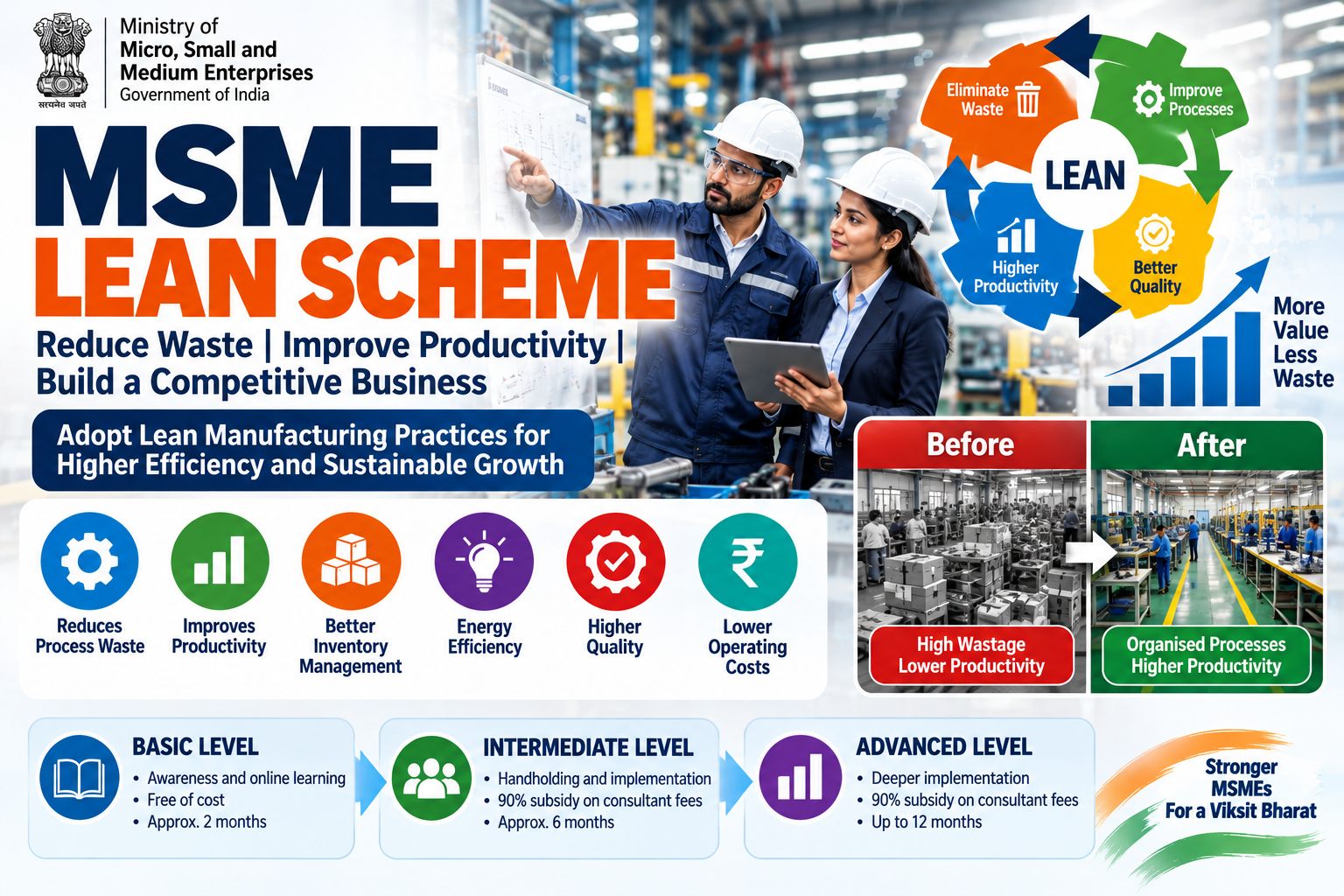
Lean management is a business approach focused on creating maximum value for customers while using minimum resources. It identifies activities that consume time, money, materials or manpower without adding sufficient value to the final product or service.
The MSME Lean Scheme seeks to help enterprises adopt Lean Manufacturing principles and tools so that they can reduce wastage, improve productivity and establish a culture of continuous improvement.
The programme includes awareness programmes, training, handholding, incentives and digital support for participating MSMEs. MSME RAMP Portal
The underlying objective is straightforward: produce better, faster and more efficiently while reducing unnecessary costs.
Why Lean Manufacturing is Important for MSMEs
Many MSMEs operate with limited financial and human resources. Even small inefficiencies can therefore have a significant impact on profitability.
For example, excessive inventory can block working capital. Poor workplace organisation can increase employee movement and production time. Defective products can result in material losses and customer complaints. Unplanned production can cause delays and idle capacity.
Lean practices help entrepreneurs identify such problems systematically.
The scheme focuses on areas including:
- Reduction of process waste
- Productivity improvement
- Inventory management
- Better utilisation of manufacturing space
- Energy efficiency
- Process improvement
- Cost reduction
- Quality improvement
- Better management systems
- Continuous improvement
The ultimate objective is to create more competitive MSMEs that can participate effectively in domestic and global value chains. MSME RAMP Portal
Lean and the MSME Champions Framework
The Lean Scheme is one of the key components associated with the MSME Champions approach.
The broader MSME Champions framework seeks to modernise MSME processes, reduce wastage, improve competitiveness and facilitate national and global market opportunities. Its major interventions include ZED, Lean and Innovative components. MSME
While ZED focuses strongly on quality and sustainable manufacturing, Lean focuses on productivity and operational efficiency.
This makes the two approaches complementary. An MSME can work towards better quality while simultaneously improving the efficiency of the processes used to produce that quality.
How Does the Lean Scheme Work?
The Lean Scheme follows a structured journey.
According to the scheme guidelines, an MSME begins by taking the Lean Pledge and registering on the dedicated Lean platform. It can then proceed through different levels of Lean implementation. Lean MSME
Basic Level
The Basic Level is designed primarily to create awareness and introduce MSMEs to Lean principles.
It can be completed through self-paced online learning and is available free of cost under the scheme framework. The guidelines specify a duration of approximately two months for the Basic Level. Lean MSME
The objective is to help entrepreneurs and employees understand Lean concepts and identify opportunities for improvement within their organisation.
Intermediate Level
After developing basic awareness, MSMEs can move towards practical implementation of Lean tools and techniques.
This stage involves greater intervention and handholding, helping enterprises identify operational problems and implement improvements.
The scheme catalogue specifies a six-month duration for the Intermediate Level and a 90% subsidy on consultant fees, subject to the applicable scheme conditions and limits. Lean MSME
Advanced Level
The Advanced Level represents a deeper Lean transformation.
It focuses on strengthening Lean practices throughout the enterprise and embedding continuous improvement into the organisation’s operating culture.
The scheme catalogue specifies a duration of up to 12 months for the Advanced Level, with a 90% subsidy on consultant fees, subject to applicable conditions. Lean MSME
Financial Support Under the Scheme
Financial assistance is an important attraction of the Lean programme.
The scheme catalogue indicates that the Basic Level is free, while the Intermediate and Advanced Levels receive substantial Government support towards eligible consultant fees. The catalogue also provides for additional incentives in certain cases, including participation through industry associations or OEMs and qualifying women-, SC- and ST-owned enterprises and MSMEs located in specified regions. Lean MSME
However, entrepreneurs should always check the latest official guidelines and portal information before applying because financial assistance, eligibility conditions and implementation procedures can be revised.
Who Can Benefit from the Lean Scheme?
The programme is particularly relevant to manufacturing MSMEs that want to improve their operational efficiency.
Businesses can benefit when they face challenges such as:
- High production costs
- Excessive inventory
- Material wastage
- Low productivity
- Production delays
- Poor workplace organisation
- High energy consumption
- Repeated defects
- Inefficient processes
- Low capacity utilisation
Lean principles can be applied across different manufacturing sectors, including engineering, automobiles, textiles, food processing, packaging, electronics, furniture and other industrial activities.
Practical Example
Consider a small engineering manufacturer that regularly experiences production delays.
A Lean assessment may reveal that workers spend excessive time searching for tools, materials are stored far from the production line, defective components require rework and excess inventory occupies valuable space.
Through Lean interventions, the enterprise could reorganise the workplace, improve material flow, standardise processes, reduce defects and optimise inventory.
The result could be lower costs, faster production, better quality and improved customer satisfaction.
The important point is that Lean does not necessarily mean buying expensive machinery. Often, significant improvements can come from changing the way existing resources are organised and used.
Building a Culture of Continuous Improvement
One of the most important benefits of Lean is the development of a continuous-improvement mindset.
Instead of waiting for a major problem to occur, employees are encouraged to regularly identify small inefficiencies and find ways to eliminate them.
This can create long-term benefits because operational improvement becomes part of the organisation’s culture rather than a one-time project.
For an MSME, this can ultimately lead to better productivity, stronger profitability and improved ability to compete with larger businesses.
How MSMEs Can Get Started
An interested enterprise should first ensure that it meets the applicable eligibility requirements and has the necessary MSME registration.
The entrepreneur can then visit the official Lean Scheme platform, understand the current guidelines, take the required Lean Pledge and proceed with registration and implementation.
The official MSME Lean portal provides scheme information, implementation details and relevant resources. MSME RAMP Portal
Conclusion
The MSME Competitive (Lean) Scheme is an important initiative for Indian enterprises seeking to improve productivity and operational efficiency.
For an MSME, competitiveness is not only about increasing sales. It is also about producing efficiently, reducing wastage, controlling costs, improving quality and delivering greater value to customers.
By adopting Lean principles, small businesses can make better use of their people, materials, machinery, space and energy. Over time, these improvements can strengthen profitability and prepare enterprises to compete in increasingly demanding domestic and international markets.