The Government’s decision to extend the Production Linked Incentive (PLI) Scheme for Textiles and reduce the minimum turnover requirement to ₹100 crore is expected to encourage greater participation from MSMEs and mid-sized manufacturing enterprises. The move aims to strengthen domestic manufacturing, attract fresh investments and improve India’s competitiveness in the global textile market.
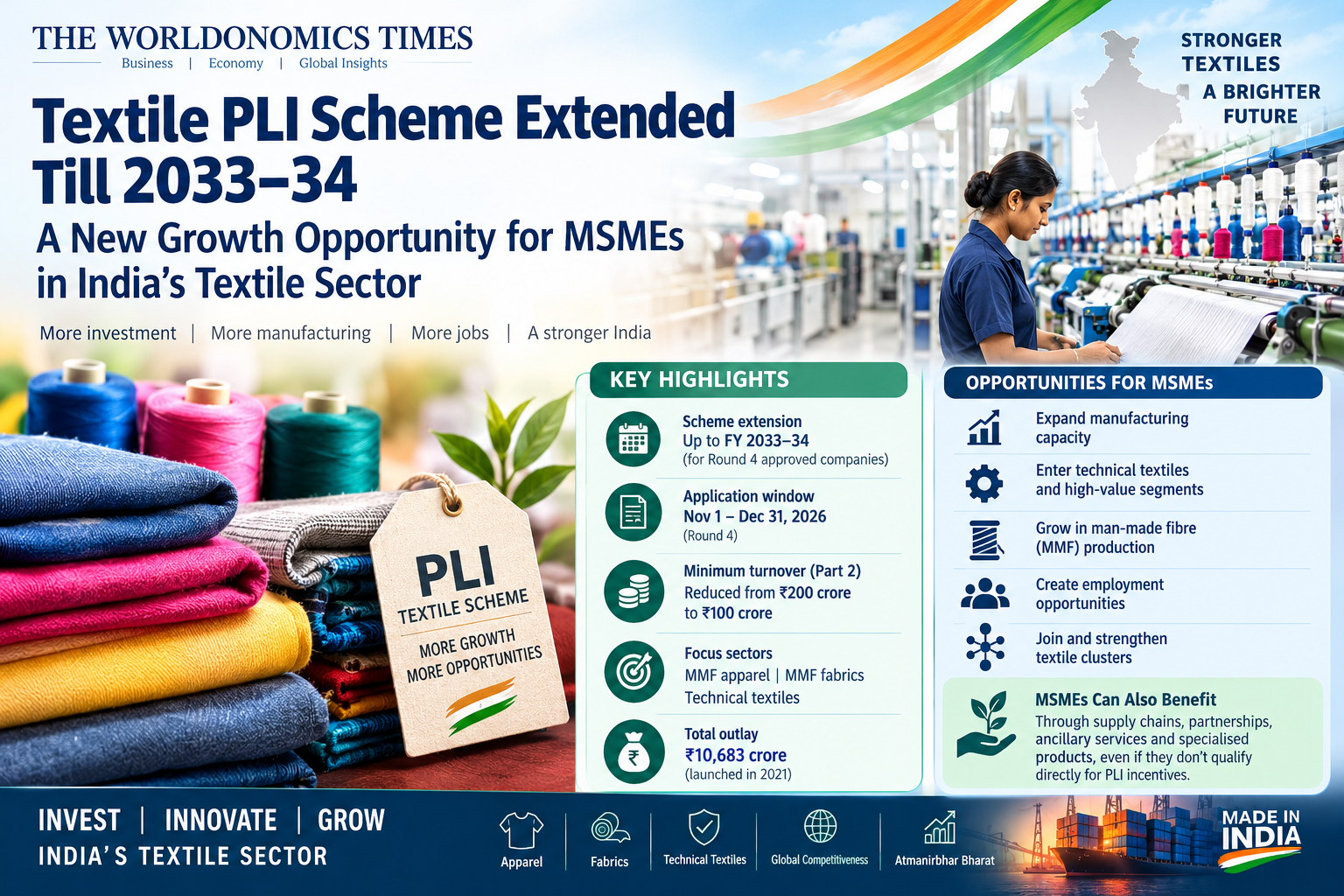
The Indian textile industry has received a significant policy boost with the Ministry of Textiles announcing an extension of the Production Linked Incentive (PLI) Scheme for Textiles up to the financial year 2033–34 for companies approved under its fourth round. The announcement, made on 28 October 2026, is particularly important for micro, small and medium enterprises (MSMEs), as the government has also reduced the minimum turnover requirement under Part 2 of the scheme from ₹200 crore to ₹100 crore.
The revised provisions are intended to widen industry participation, provide a longer investment horizon and encourage more companies to establish and expand manufacturing facilities in India.
Understanding the Textile PLI Scheme
Launched in September 2021 with a financial outlay of ₹10,683 crore, the PLI Scheme for Textiles aims to promote large-scale manufacturing of Man-Made Fibre (MMF) apparel, MMF fabrics and technical textile products.
The scheme seeks to reduce dependence on imports, encourage domestic production, attract investment, generate employment and strengthen India’s position in international textile value chains.
The focus on man-made fibres and technical textiles is especially relevant because global demand for performance-based, specialised and innovative textile products continues to grow. These segments offer opportunities for Indian manufacturers to diversify beyond traditional cotton-based products.
Key Changes: Greater Opportunities for MSMEs
One of the most important developments is the reduction in the minimum turnover criterion under Part 2 of the scheme from ₹200 crore to ₹100 crore.
This change is expected to make the scheme more accessible to mid-sized manufacturing enterprises that previously found the financial eligibility requirements difficult to meet. Although the revised threshold does not make every micro or small enterprise automatically eligible, it broadens the potential participation base.
The second major change is the extension of the scheme tenure up to FY 2033–34 for applicants approved under Round 4. A longer operational horizon can help businesses plan investments, establish production facilities, expand capacity and manage the initial gestation period associated with manufacturing projects.
The government has also allowed existing participants from Rounds 1, 2 and 3, who have not claimed or received any incentive, to migrate to Round 4. Such companies must withdraw their existing applications under the earlier rounds, wherever applicable.
Application Window for Round 4
The Ministry of Textiles has announced that the online application portal will reopen from 1 November 2026 to 31 December 2026 for fresh applications under Round 4.
Eligible companies interested in manufacturing MMF apparel, MMF fabrics and technical textiles should examine the revised scheme guidelines and assess their eligibility before submitting applications.
Businesses should carefully review the investment, turnover, product eligibility and other applicable conditions before applying.
How Can MSMEs Benefit?
The revised scheme can create several opportunities for India’s textile manufacturing ecosystem.
1. Expansion of manufacturing capacity: Eligible mid-sized enterprises can explore investments in modern machinery, production facilities and advanced manufacturing technologies.
2. Diversification into technical textiles: MSMEs can consider entering specialised segments such as industrial textiles, medical textiles, protective fabrics and other value-added products, subject to the notified product categories.
3. Improved competitiveness: Access to incentives can support eligible manufacturers in improving productivity, achieving economies of scale and competing in domestic and international markets.
4. Employment generation: Expansion of textile manufacturing facilities can create employment opportunities across production, processing, quality control, logistics and related activities.
5. Stronger supply chains: Greater domestic manufacturing capacity can strengthen linkages between fibre producers, yarn manufacturers, fabric processors, garment manufacturers and technical textile companies.
Challenges and the Road Ahead
Despite the positive policy developments, smaller enterprises may continue to face challenges relating to investment requirements, access to institutional finance, technology upgradation, skilled manpower and compliance.
Therefore, the benefits of the revised PLI framework will depend on effective implementation, timely information dissemination and the ability of eligible businesses to prepare commercially viable investment proposals.
MSMEs should also remember that the reduction in turnover threshold applies specifically to Part 2 of the scheme. It does not mean that all MSMEs automatically qualify for incentives.
Conclusion
The extension of the Textile PLI Scheme up to FY 2033–34 for Round 4 applicants, combined with the reduction in the minimum turnover requirement to ₹100 crore under Part 2, represents an important step towards widening participation in India’s textile manufacturing sector.
For eligible MSMEs and mid-sized enterprises, the revised framework offers an opportunity to consider capacity expansion, technology adoption, product diversification and participation in global textile supply chains.
With the Round 4 application window scheduled from 1 November to 31 December 2026, interested businesses should review the official guidelines and take timely steps to assess their eligibility.
The success of this initiative will ultimately depend on how effectively the policy translates into fresh investments, stronger manufacturing capabilities, employment generation and sustainable growth for India’s textile industry.