India’s Micro, Small and Medium Enterprises (MSMEs) are emerging as an important force in the country’s international trade. With their growing contribution to merchandise exports, the government is strengthening export promotion policies to help small businesses access international markets, improve product quality, secure affordable finance and compete with established global manufacturers.
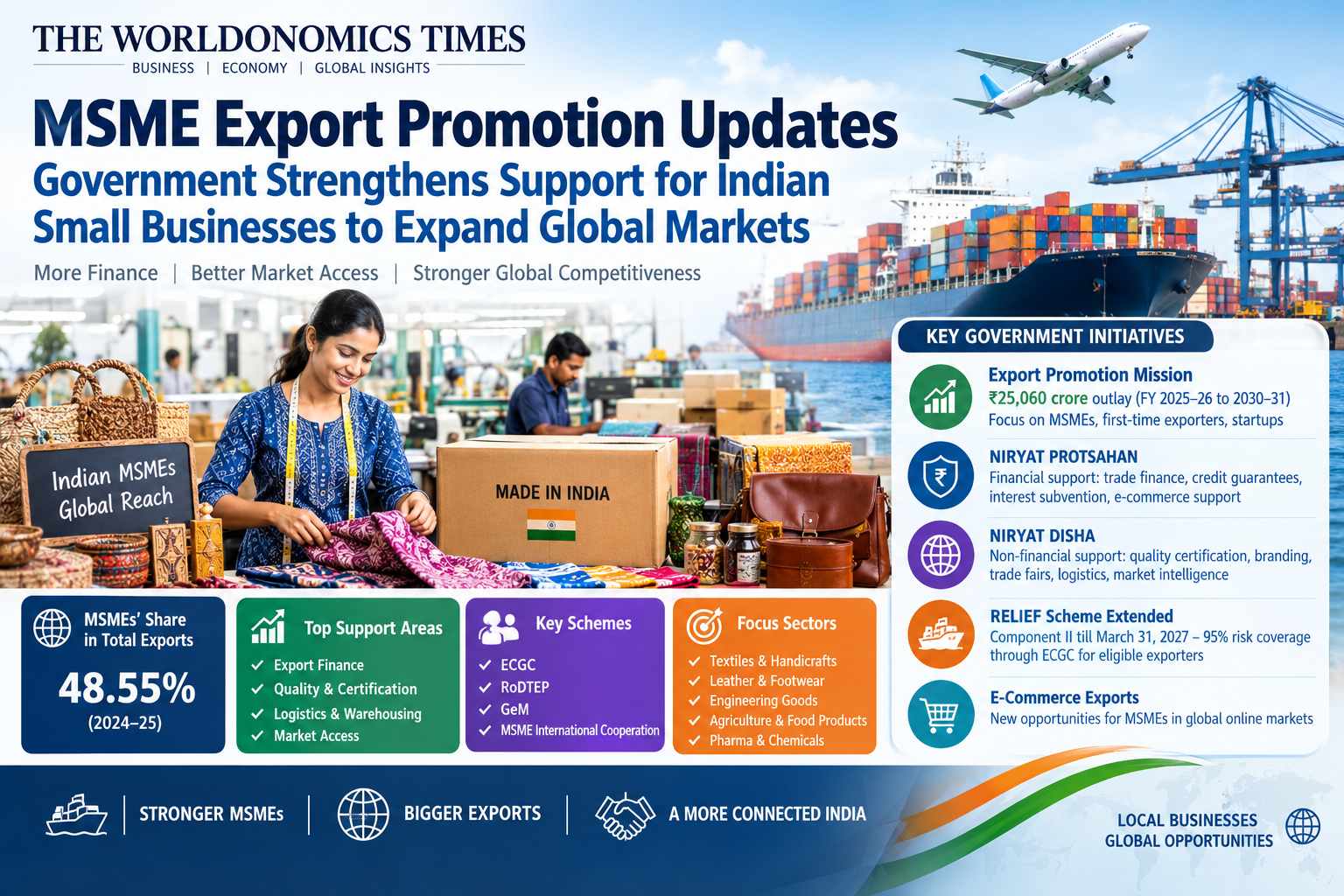
The government’s Export Promotion Mission (EPM), approved in November 2025 with a financial outlay of ₹25,060 crore for FY 2025–26 to FY 2030–31, represents a significant step towards building a stronger export ecosystem. The mission places special emphasis on MSMEs, first-time exporters, startups and labour-intensive industries.
According to the Ministry of Commerce and Industry, MSME-related products accounted for 48.55% of India’s total merchandise exports in 2024–25, compared with 45.74% in 2023–24. This growing contribution highlights the importance of small businesses in India’s international trade and economic development.
Export Promotion Mission: A Major Opportunity for MSMEs
The Export Promotion Mission has been designed to address several challenges faced by Indian exporters, particularly smaller enterprises that struggle with financing, international certifications, logistics costs and access to overseas buyers.
The mission operates through two integrated sub-schemes: NIRYAT PROTSAHAN and NIRYAT DISHA.
1. NIRYAT PROTSAHAN: Improving Access to Export Finance
NIRYAT PROTSAHAN focuses on improving access to affordable trade finance for MSMEs. Small businesses frequently face difficulties obtaining working capital, export credit and financial assistance when entering new international markets.
The initiative covers financial instruments such as:
- Interest subvention support.
- Export factoring facilities.
- Collateral guarantee support for export credit.
- Credit facilities for e-commerce exporters.
- Credit enhancement for entering new export markets.
- Support for emerging export opportunities.
These measures are intended to improve the financial capacity of smaller businesses and encourage more enterprises to participate in international trade.
2. NIRYAT DISHA: Strengthening Export Competitiveness
NIRYAT DISHA focuses on non-financial support to make Indian products more competitive in international markets.
Its major areas include:
- International quality standards and certification.
- Product branding and packaging.
- Participation in international trade fairs.
- Overseas warehousing and logistics.
- Inland transportation support.
- Export market intelligence.
- Training and capacity building.
These interventions can help Indian MSMEs understand international market requirements, improve product presentation and establish relationships with overseas buyers.
RELIEF Scheme Extended Until March 31, 2027
Another important development for Indian exporters is the extension of the RELIEF (Resilience & Logistics Intervention for Export Facilitation) initiative under the Export Promotion Mission.
On October 26, 2026, the Department of Commerce announced the extension of Component II of RELIEF until March 31, 2027.
The initiative addresses challenges arising from geopolitical disruptions in West Asia and their impact on maritime logistics, freight costs and export insurance.
Under Component II, eligible exporters can receive 95% risk coverage through the Export Credit Guarantee Corporation of India (ECGC), encouraging them to obtain insurance protection for upcoming shipments to specified regions.
The benefit applies to eligible Standalone Policies and Whole Turnover Policies obtained on or after March 16, 2026. Covered cargo categories include Full Container Load (FCL), Less than Container Load (LCL) and refrigerated shipments, excluding energy shipments.
Exporters must follow the prescribed eligibility requirements and submit supporting documents through the ECGC customer portal.
The extension is particularly relevant for businesses facing higher insurance premiums and shipping uncertainties in the Gulf and wider West Asian maritime corridor.
New Opportunities for E-Commerce Exporters
Cross-border e-commerce is creating new opportunities for Indian small businesses to sell products directly to international customers.
MSMEs involved in handicrafts, textiles, leather products, jewellery, home furnishings, traditional products and specialised manufacturing can explore online international marketplaces.
The Export Promotion Mission includes financial and non-financial support intended to strengthen e-commerce exports, improve access to trade finance and help smaller businesses reach overseas customers.
Digital platforms can reduce traditional market-entry barriers, although exporters must comply with customs, taxation, product standards and destination-country regulations.
Government Support for MSME Exporters
Apart from the Export Promotion Mission, several government initiatives support MSME exporters.
These include:
ECGC: Provides export credit insurance to protect eligible exporters and lending institutions against specified commercial and political risks.
RoDTEP: The Remission of Duties and Taxes on Exported Products scheme provides eligible exporters with remission of specified embedded duties and taxes that are not otherwise refunded.
GeM: The Government e-Marketplace helps registered businesses access government procurement opportunities.
MSME International Cooperation: Supports eligible MSME participation in international exhibitions, trade fairs and buyer-seller meetings, subject to scheme guidelines.
Together, these initiatives can strengthen the ability of Indian businesses to develop domestic manufacturing and international market connections.
Challenges Facing MSME Exporters
Despite government support, Indian MSMEs continue to face several challenges in international trade.
Limited access to affordable finance, expensive logistics, international certification requirements, fluctuating currency rates, complex customs procedures and competition from established global manufacturers can affect export growth.
Smaller enterprises also need better awareness of international market opportunities and regulatory requirements.
Industry associations, export promotion councils, banks and government agencies have an important role in helping businesses overcome these barriers.
What Should MSME Entrepreneurs Do?
Businesses planning to enter international markets should take the following steps:
- Obtain Udyam registration, where eligible.
- Obtain an Importer Exporter Code (IEC) from the Directorate General of Foreign Trade.
- Identify products with international demand.
- Study the quality and certification requirements of target countries.
- Explore export finance and ECGC insurance facilities.
- Participate in international trade fairs and buyer-seller meetings.
- Examine the eligibility requirements under NIRYAT PROTSAHAN and NIRYAT DISHA.
- Develop a digital marketing and international distribution strategy.
Entrepreneurs should consult the relevant official guidelines before applying for financial assistance or export promotion benefits.
Conclusion: MSMEs Can Become a Stronger Force in India’s Global Trade
India’s Export Promotion Mission represents an important policy initiative to strengthen the country’s export ecosystem and improve the competitiveness of smaller businesses.
With a ₹25,060 crore financial outlay, integrated financial and non-financial assistance, and targeted interventions for export logistics and market access, the government is creating new opportunities for MSMEs to expand internationally.
The extension of the RELIEF initiative until March 31, 2027, further demonstrates the importance of protecting exporters against extraordinary international trade disruptions.
For Indian MSMEs, the next phase of growth will depend on innovation, product quality, technology adoption, affordable finance and stronger international business connections.
If effectively implemented, these initiatives can help transform more local manufacturers into global suppliers, create employment and strengthen India’s position in international trade.
The message for Indian entrepreneurs is clear: MSMEs should look beyond domestic markets and prepare to become an integral part of the global supply chain.