Industrial Development: The Backbone of Economic Growth
Introduction
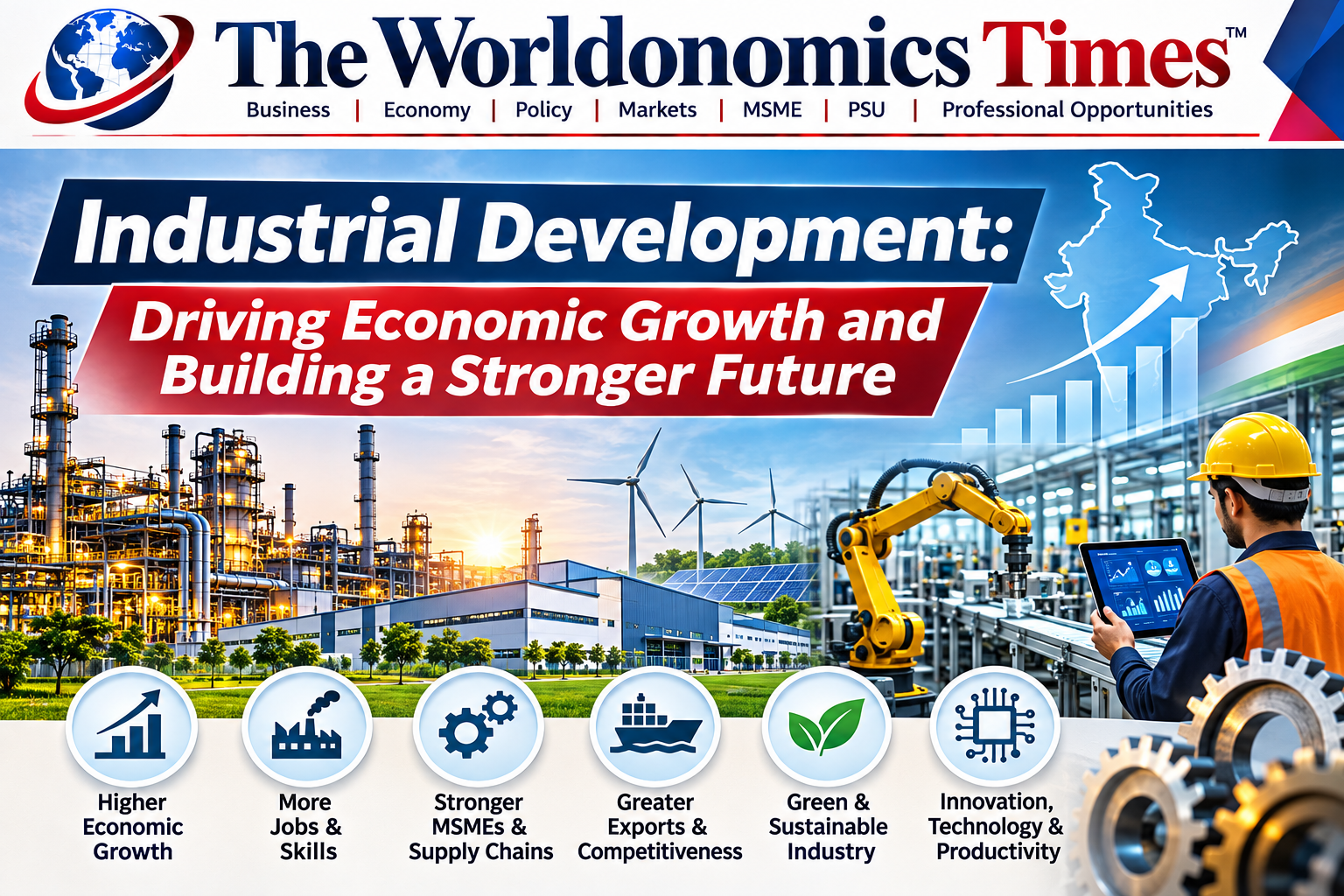
Industrial development is one of the most important pillars of economic growth and national development. It refers to the expansion and modernisation of industries through increased production, investment, technology adoption, infrastructure development and employment generation. A strong industrial sector enables a country to make better use of its natural resources, human capital and financial resources while creating opportunities for businesses and communities.
For a developing economy such as India, industrial development has an even greater significance. It supports economic expansion, strengthens domestic manufacturing, creates employment and improves the standard of living. In an increasingly competitive global economy, a strong industrial base can also help India reduce import dependence, increase exports and move towards greater economic self-reliance.
Importance of Industrial Development
Industrial development contributes to almost every major aspect of economic progress. Industries manufacture essential products such as medicines, automobiles, electronics, machinery, textiles, construction materials and consumer goods. At the same time, industrial activity creates demand for transportation, logistics, banking, insurance, professional services and other supporting sectors.
A growing industrial ecosystem therefore creates a multiplier effect across the economy.
1. Employment Generation
One of the most significant contributions of industrial development is employment generation. Manufacturing units, factories, infrastructure projects and industrial service companies create employment for skilled, semi-skilled and unskilled workers.
Industrial growth also creates opportunities for engineers, accountants, managers, technicians, financial professionals, researchers and entrepreneurs. Increased employment improves household incomes and purchasing power, which in turn stimulates demand for goods and services.
For India, where a large and growing workforce needs productive employment opportunities, industrial expansion can play a crucial role in creating sustainable livelihoods.
2. Economic Growth and National Income
Industrial production contributes significantly to economic activity and national income. When industries expand, investment increases, production rises and supply chains become more active. This creates business opportunities across manufacturing, logistics, finance, technology and professional services.
Industrialisation also contributes to government revenues through taxes, duties and other economic activities. These revenues can support investments in infrastructure, healthcare, education, skill development and public welfare.
A competitive industrial sector can therefore strengthen both the productive capacity of the economy and the government’s ability to invest in development.
3. Technology and Innovation
Modern industrial development is increasingly driven by technology. Automation, artificial intelligence, robotics, Internet of Things (IoT), data analytics and digital manufacturing are transforming traditional production systems.
Technology helps industries improve productivity, reduce operational costs, minimise errors and enhance product quality. It also enables companies to compete more effectively in international markets.
The adoption of advanced technologies can help Indian industries move from traditional production models towards high-value manufacturing, innovation and globally competitive products.
4. Growth of MSMEs
Micro, Small and Medium Enterprises (MSMEs) are an essential component of India’s industrial ecosystem. They contribute to employment, entrepreneurship, local economic development and supply-chain growth.
MSMEs often operate as suppliers, distributors, service providers and component manufacturers for larger industrial companies. Their development therefore strengthens the broader industrial value chain.
Improved access to finance, technology, government schemes, digital platforms, skill development and markets can enable MSMEs to become more productive and competitive.
5. Industrial Development in India
India has developed significant capabilities across sectors such as automobiles, pharmaceuticals, textiles, steel, cement, electronics, chemicals, engineering and information technology.
Government initiatives such as Make in India, Startup India, Digital India and the Production Linked Incentive (PLI) programme have sought to encourage investment, innovation, entrepreneurship and domestic manufacturing.
The development of industrial corridors, logistics infrastructure, renewable energy capacity and digital connectivity can further strengthen India’s position as a manufacturing and investment destination.
India’s large domestic market, growing workforce and expanding digital economy provide significant opportunities for industrial expansion.
6. Challenges Facing Industrial Development
Despite its potential, industrial development faces several challenges. These include inadequate infrastructure in certain regions, high logistics and production costs, shortage of specialised skills, access-to-finance constraints and increasing global competition.
Environmental concerns are another major challenge. Industrial activity can generate emissions, waste and pressure on natural resources if not managed responsibly.
For MSMEs in particular, limited access to affordable finance, modern technology and organised markets can restrict their ability to scale.
Addressing these challenges requires coordinated efforts from governments, industries, financial institutions, educational institutions and other stakeholders.
7. Role of Government
Government policy plays a critical role in creating an environment conducive to industrial growth. Investment in roads, railways, ports, power, digital infrastructure and industrial parks can reduce the cost of doing business.
Governments can also support industries through appropriate incentives, easier regulatory procedures, skill-development programmes, technology support and access to finance.
Stable policies, transparent regulations and efficient approvals are important for attracting both domestic and international investment. Encouraging research and development can further help Indian companies develop globally competitive products and technologies.
8. Sustainable Industrial Development
Industrial development must be aligned with environmental sustainability. Economic growth based solely on increased production cannot be considered complete development if it causes long-term environmental damage.
Industries increasingly need to focus on renewable energy, energy efficiency, waste reduction, recycling, cleaner production processes and responsible use of natural resources.
Sustainable industrialisation can help businesses reduce costs, improve resource efficiency and meet growing expectations from consumers, investors and global markets.
The Road Ahead
India has the potential to become one of the world’s leading industrial economies. Achieving this objective will require continued investment in infrastructure, technology, skills, innovation and entrepreneurship.
The future of industrial development will increasingly depend on the integration of manufacturing, technology, sustainability and human capital. Industries that adopt digital transformation and environmentally responsible practices will be better positioned to compete in global markets.
Conclusion
Industrial development is much more than the expansion of factories and manufacturing units. It is a foundation for employment, innovation, entrepreneurship, exports, infrastructure development and higher living standards.
For India, a strong industrial sector can accelerate economic growth while creating opportunities for millions of workers, entrepreneurs and businesses. However, industrial expansion must be supported by skilled human resources, modern infrastructure, technological innovation, access to finance and responsible environmental practices.
A strong and sustainable industrial ecosystem can help India become more competitive, self-reliant and resilient. Industrial development is therefore not only a business priority—it is a national development imperative and a critical foundation for building a stronger economic future.
The Worldonomics Times
Business | Economy | Policy | Markets | MSME | PSU | Professional Opportunities