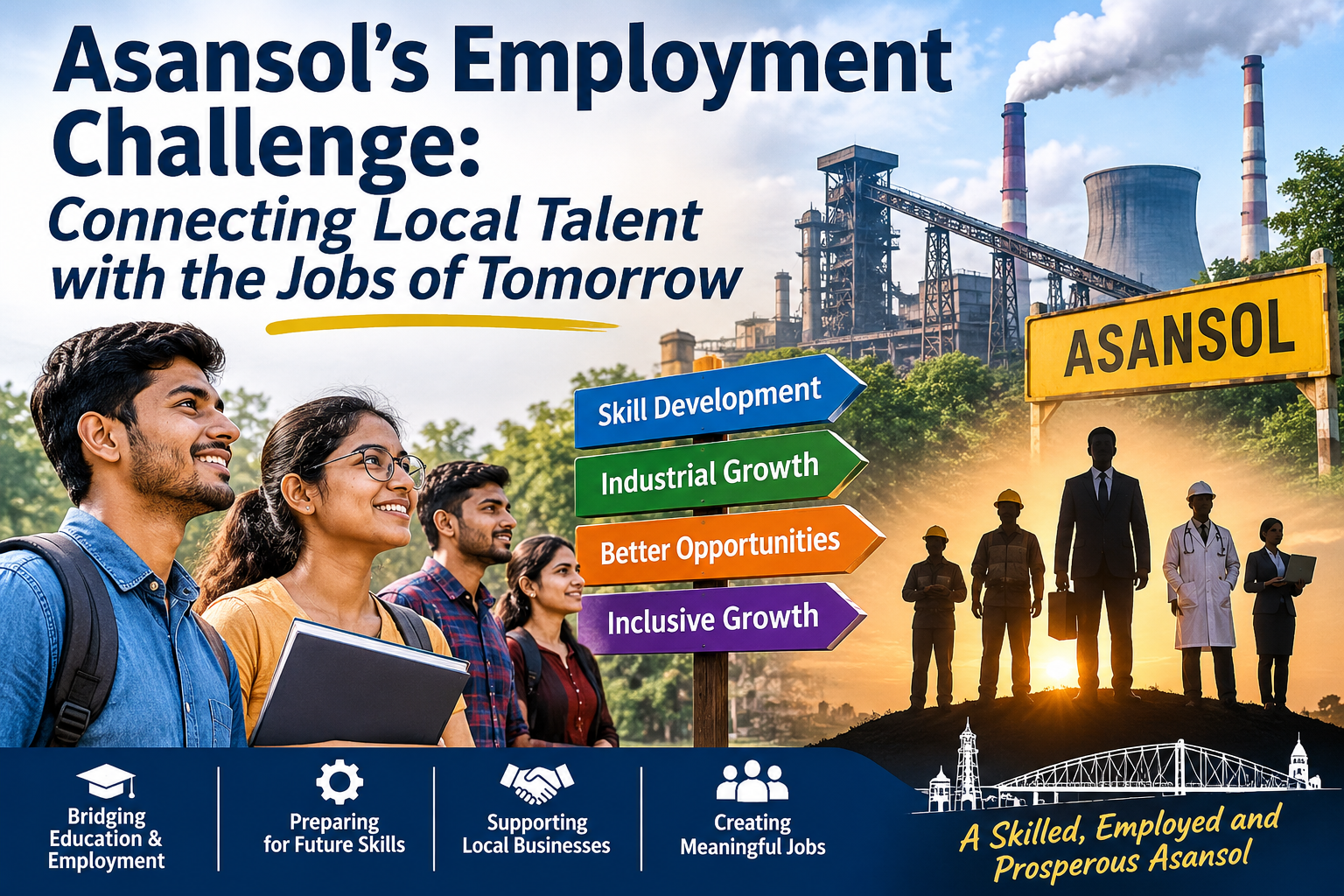
Beyond creating jobs, Asansol must build an economy in which local education, practical skills, industrial opportunities, and career aspirations are connected.
Introduction: When Education Does Not Guarantee Employment
For many young people in Asansol, completing a degree represents years of effort, financial investment, and the hope of achieving economic independence. A graduate may spend years studying commerce, engineering, management, or the humanities, expecting that a recognised qualification will open the door to a stable career. Yet the transition from education to employment can be far more difficult than anticipated.
Some graduates struggle to find positions that match their qualifications. Others accept jobs unrelated to their education, move to larger cities in search of better opportunities, or spend extended periods preparing for competitive examinations and professional qualifications. Meanwhile, employers continue to seek candidates who possess practical knowledge, communication skills, digital competence, and the ability to contribute from the beginning.
This creates a fundamental question for Asansol: if a region has educational institutions, an established industrial base, and a substantial pool of aspiring young professionals, why is connecting local talent with suitable employment still such an important challenge?
The issue cannot be understood through unemployment alone. It also involves the quality of available jobs, the relevance of education, employers’ recruitment practices, access to professional networks, and the ability of local businesses to create new employment opportunities.
Asansol’s employment challenge is therefore closely connected to its wider economic future. The city must not only attract investment and encourage industrial development; it must also ensure that local people are equipped to participate in that growth.
1. Understanding the Employment Paradox
Paschim Bardhaman is officially recognised as a predominantly urban, mining-industrial district, with Asansol serving as its headquarters. Its industrial profile includes coal, steel, heavy engineering, and associated activities. These industries have historically contributed to the region’s economic identity and demand for technical and operational skills.
However, the presence of industries does not automatically translate into sufficient employment for every category of job seeker.
Large industrial establishments may require specialised technical workers, experienced professionals, and employees with specific certifications. Their recruitment needs may not align with the qualifications of every local graduate. Furthermore, increasingly automated production processes can change the number and types of workers required.
A commerce graduate looking for an accounts position, for example, may not directly qualify for a technical role in a steel plant. An engineering graduate may possess theoretical knowledge but lack practical experience with industrial equipment or current production systems. A management graduate may understand business concepts but have limited exposure to workplace communication, data analysis, or operational decision-making.
The result is a mismatch between the workforce available and the jobs being offered.
This does not mean that local graduates lack ability or ambition. Rather, it suggests that the institutions responsible for education, training, recruitment, and economic development must work more closely together.
The challenge is to create a system in which educational qualifications become a foundation for employability rather than an end in themselves.
2. The Growing Gap Between Qualifications and Employability
Formal education remains essential. It develops analytical thinking, subject knowledge, discipline, and the ability to understand complex problems. Nevertheless, employers often evaluate candidates on a broader set of requirements.
For entry-level positions, these may include spreadsheet proficiency, professional writing, presentation skills, problem-solving, digital tools, teamwork, and familiarity with industry-specific processes.
In accounting and finance, for instance, employers may expect candidates to understand bookkeeping, reconciliations, taxation procedures, accounting software, financial reporting, and spreadsheet-based analysis. A degree in commerce provides an important foundation, but candidates may also need opportunities to apply these concepts to practical business situations.
Similar gaps can arise in engineering, manufacturing, logistics, information technology, and administration.
The Periodic Labour Force Survey provides an important national context. According to the Government of India’s reporting on the PLFS 2023–24, the estimated unemployment rate for people aged 15–29 was 10.2% on the usual-status measure. This is an all-India figure, not an estimate for Asansol, and should not be interpreted as one. It nevertheless demonstrates why the transition from education to employment deserves sustained policy attention.
The solution is not to reduce the value of academic education. It is to complement education with practical learning, industry exposure, and structured pathways into employment.
Colleges could strengthen this connection by incorporating real-world projects, internships, workplace simulations, employer-led workshops, and training in commonly used professional software.
Employers, in turn, could help educational institutions identify the skills required for entry-level positions.
When education reflects actual workplace requirements, graduates can approach recruitment with greater confidence and employers can access a more prepared talent pool.
3. The Experience Barrier: How Can Freshers Get Their First Job?
One of the most frustrating aspects of entering the job market is the expectation that candidates should possess experience even when applying for entry-level positions.
Graduates are frequently advised to gain practical exposure, but internships may be unpaid or poorly paid, suitable placements may be limited, and smaller organisations may not have formal training programmes.
Candidates can consequently become trapped in a cycle: they need experience to obtain employment, but they need employment to gain experience.
This problem is particularly significant for young people from families that cannot afford long periods without income. They may need to accept unsuitable work, discontinue further training, or relocate before they are financially prepared to do so.
Asansol could address this barrier by encouraging structured apprenticeships, paid internships, graduate trainee programmes, and entry-level recruitment partnerships with local businesses.
Small and medium-sized enterprises should also be encouraged to offer supervised learning opportunities. A young person working on inventory records, financial reconciliations, customer documentation, machine maintenance, or logistics coordination can gain valuable practical skills when training is properly organised.
Such programmes should have clear learning objectives, defined durations, reasonable working conditions, and transparent assessments.
The objective must be to provide meaningful experience rather than simply relabel routine or unpaid work as an internship.
Employers can also improve recruitment by separating essential requirements from skills that can reasonably be taught after hiring. Entry-level positions should assess a candidate’s potential to learn, not only the experience already accumulated.
A more accessible first step into employment would help young people build confidence and allow businesses to develop their future workforce.
4. Local Industry Needs a Broader Employment Strategy
Asansol’s industrial heritage provides an important foundation for employment, but the region’s future should not depend exclusively on traditional mining and heavy industry.
The wider industrial belt has an established presence in steel, engineering, power, and related activities. This creates opportunities to develop supporting sectors that serve both existing industries and new markets.
Potential employment areas include industrial maintenance, equipment servicing, quality assurance, warehousing, supply-chain management, environmental services, digital operations, business administration, and specialised financial services.
For example, a manufacturing enterprise needs more than production workers. It also requires procurement staff, accountants, logistics coordinators, human resources professionals, compliance personnel, data analysts, and customer-service teams.
Likewise, smaller suppliers need support with bookkeeping, taxation, inventory management, digital payments, and business planning.
Developing these supporting services could broaden the range of employment available to graduates who may not possess the technical qualifications required for factory-floor roles.
Local enterprises can play an especially important role. Micro, small, and medium-sized businesses may not individually employ hundreds of people, but a larger network of viable businesses can generate opportunities across different skill levels.
However, this requires practical support for entrepreneurs, including access to finance, reliable infrastructure, business-development assistance, and links to larger companies’ procurement systems.
The region should measure industrial success not only by the amount of investment attracted but also by the range of jobs created, the participation of local suppliers, and the opportunities available to residents.
5. The Untapped Potential of Digital and Professional Services
The future of employment is not limited to factories, mines, or large industrial projects.
Digital technology has created opportunities for businesses to provide services across geographical boundaries. Depending on connectivity, skills, and market demand, these may include accounting support, payroll processing, data analysis, software services, digital marketing, customer support, and business-process operations.
Asansol could explore ways to help local professionals and entrepreneurs access these markets.
For commerce graduates, digital bookkeeping, financial documentation, taxation support, spreadsheet analysis, and business reporting may provide possible entry points. Engineering graduates could explore computer-aided design, technical documentation, industrial data analysis, and equipment-related digital services, subject to appropriate training.
These opportunities should not be presented as guaranteed employment pathways. Remote work and digital services involve competition, client acquisition, quality expectations, and the need for continuous skill development.
Nevertheless, a diversified local economy can benefit when professionals are able to serve businesses beyond their immediate geographical area.
Educational institutions, professional associations, training providers, and business organisations could help candidates understand the practical requirements of these roles and build relevant portfolios.
The wider objective is to expand the range of viable careers available to local residents.
6. Women and the Unequal Geography of Employment
Employment opportunities are not equally accessible to everyone.
Women may encounter additional barriers, including concerns about safe transportation, limited access to suitable workplaces, family responsibilities, inadequate workplace facilities, and restrictions on mobility.
These factors can influence whether a qualified woman applies for a job, accepts an offer, or continues working after entering employment.
For Asansol to make full use of its local talent, employment policy must consider these practical constraints.
Employers can contribute through safe transport arrangements where necessary, fair recruitment procedures, appropriate workplace facilities, anti-harassment mechanisms, flexible arrangements where operationally feasible, and transparent opportunities for advancement.
Educational institutions and training providers can also help women access technical training, digital skills, professional networks, and career guidance.
Small businesses and professional-service firms may offer opportunities in accounting, administration, education, healthcare, technology, and other fields, provided that the positions offer fair pay and reasonable working conditions.
Women’s participation in the workforce is not merely a social objective. It also expands the available talent pool, supports household incomes, and strengthens the productive capacity of the regional economy.
A development strategy that overlooks barriers to women’s employment risks leaving a substantial share of local talent underutilised.
7. Turning Skill Development into Actual Employment
Skill-development programmes are an important part of the solution, but their effectiveness depends on whether the skills taught correspond to real opportunities.
West Bengal operates Utkarsh Bangla through the Paschim Banga Society for Skill Development, with the stated objective of providing short-term, employment-oriented vocational training and supporting employability and self-employment.
The district administration also maintains information on the programme through its Utkarsh Bangla page.
Such initiatives provide a useful foundation. The next challenge is to ensure that training remains closely connected to the evolving needs of employers and job seekers.
A programme should not be evaluated solely by the number of people enrolled or certificates issued. It should also be assessed through completion rates, relevant job placements, wages, job retention, employer feedback, and opportunities for further career development.
Training providers could consult local businesses regularly to identify skills shortages. Candidates should receive clear information about the occupations available after training, the likely requirements of those roles, and the limits of any placement assistance.
Short courses should complement formal education and practical experience rather than become disconnected credentials that candidates collect without improving their employment prospects.
The most effective approach combines technical competence, communication skills, workplace exposure, and access to employers.
8. What Should Change? A Roadmap for Asansol
A stronger employment ecosystem requires coordinated action rather than isolated initiatives.
First, create a local employment and skills assessment. Employers, educational institutions, industry associations, and district-level stakeholders should identify the occupations in demand, the skills currently available, and the barriers preventing candidates from accessing suitable jobs. Findings should be updated regularly.
Second, strengthen the transition from education to work. Colleges and training institutions should develop employer partnerships, career guidance services, practical projects, apprenticeships, and placement support. Students should understand the skills required for different occupations before they complete their courses.
Third, make first-job opportunities more accessible. Employers should consider paid internships, graduate trainee positions, structured apprenticeships, and entry-level recruitment that assesses learning potential as well as existing skills.
Fourth, support local entrepreneurship and MSMEs. Access to credit, digital tools, business advice, and procurement opportunities can help small enterprises expand and create jobs. Entrepreneurship should be promoted as a genuine economic opportunity, not as a substitute for the availability of suitable employment.
Fifth, broaden the regional economic base. Alongside traditional industries, policymakers should explore viable opportunities in logistics, specialised manufacturing, digital services, healthcare, education, and other sectors that can generate sustainable demand for local talent.
Finally, measure outcomes transparently. Policymakers should track employment rates among programme participants, the relevance of placements, job retention, wage progression, and employer satisfaction. Such evidence can help direct resources towards initiatives that demonstrably improve employment outcomes.
These measures would make employment policy more responsive to the needs of both businesses and job seekers.
Conclusion: The Future Depends on Connecting People with Opportunity
Asansol’s employment challenge is not simply a question of whether enough jobs exist. It is also a question of whether the region’s education system, industrial economy, training programmes, and recruitment practices work together effectively.
A degree should provide a foundation for professional growth. Practical training should help translate knowledge into capability. Employers should have access to prepared candidates, while young people should have realistic pathways into their first jobs and opportunities to progress throughout their careers.
Asansol’s industrial legacy gives it a valuable starting point, but the future of employment will depend on how effectively the region adapts to changing economic needs. A stronger network of local enterprises, more relevant skills training, accessible entry-level opportunities, and a broader range of industries could help reduce the disconnect between local talent and available work.
This transformation will require cooperation among government institutions, employers, educational establishments, training providers, and the wider community. It will also require honest measurement of results rather than reliance on announcements or the number of training certificates issued.
Ultimately, young people should not have to choose between developing their careers and remaining connected to their home region simply because suitable opportunities are difficult to find locally.
Asansol’s future will be stronger when local talent is not merely educated, but connected to meaningful work; when businesses do not simply seek skilled workers, but help develop them; and when economic growth creates opportunities that local people can realistically access.
The jobs of tomorrow may look different from the industries that shaped Asansol’s past. The region’s success will depend on whether its people are prepared, supported, and given a fair opportunity to become part of that future.