The Worldonomics Times | Professional Opportunities for CMAs
The securities market is becoming increasingly complex, with growing requirements around compliance, transparency, investor protection, internal controls, sustainability and financial reporting. This changing regulatory environment is creating new opportunities for Cost & Management Accountants (CMAs) in the ecosystem regulated by the Securities and Exchange Board of India (SEBI).
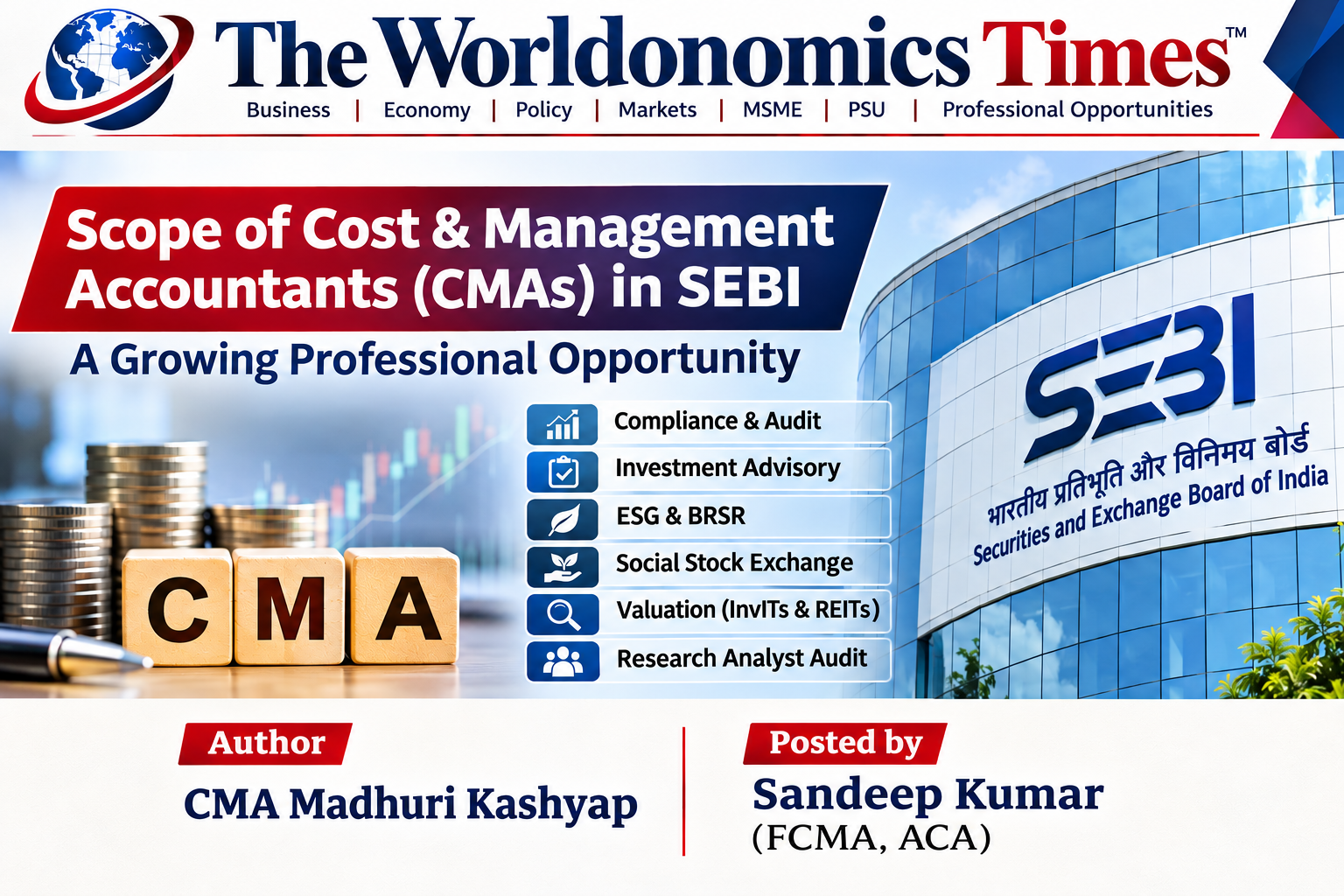
For members of the Institute of Cost Accountants of India (ICMAI), the opportunity is no longer restricted to traditional costing and management accounting. Regulatory developments have expanded the potential role of CMAs in areas such as compliance audits, internal audits, investment-advisory-related activities, research analyst audits, securities-market operations, ESG/BRSR, valuation and Social Stock Exchange-related work. ICMAI itself lists several SEBI-related professional avenues for Cost Accountants. ICMAI
SEBI Opportunities for CMAs
One of the most significant developments came in March 2026, when SEBI clarified the eligibility of ICMAI members to conduct the annual audit of Research Analysts. SEBI’s March 25, 2026 circular specifically addresses the eligibility of members of ICMAI to conduct this annual audit. Securities and Exchange Board of India
SEBI has also expanded the professional pool for compliance audits of Investment Advisers and Research Analysts, bringing Cost Accountants alongside other recognised professional categories. This development can create additional opportunities for practising CMAs with suitable knowledge of securities-market regulations and compliance requirements. Business Standard
1. Compliance Officer Opportunities
SEBI had already recognised members of ICMAI as eligible to act as Compliance Officers for Investment Advisers under Regulation 20(1) of the SEBI (Investment Advisers) Regulations framework. ICMAI records this recognition following the December 2024 regulatory amendment. ICMAI
For CMAs, this opens a professional pathway combining accounting knowledge, regulatory compliance, internal controls and risk management.
2. Annual Compliance Audit of Investment Advisers
Investment Advisers operate in a highly regulated environment. Their activities involve client records, disclosures, compliance systems, investor protection requirements and regulatory documentation.
A CMA with relevant experience can build expertise in SEBI compliance frameworks, documentation, internal controls and regulatory reporting and explore annual compliance audit assignments where permitted by the applicable SEBI framework.
3. Research Analyst Audit
The March 2026 SEBI clarification is particularly important for CMAs because it explicitly addresses their eligibility to conduct annual audits of Research Analysts. Securities and Exchange Board of India
This creates an emerging niche for practising CMAs who understand:
- SEBI Research Analyst Regulations
- Compliance systems
- Client documentation
- Conflict-of-interest controls
- Record maintenance
- Internal audit procedures
- Regulatory reporting
The opportunity is especially relevant for professionals willing to develop a specialised Securities Market Compliance Practice.
4. Internal Audit of Securities-Market Intermediaries
ICMAI identifies several existing SEBI-related avenues for Cost Accountants, including internal audit assignments involving stock brokers, trading members and clearing members, as well as internal audit work relating to credit rating agencies and registrars to an issue/share transfer agents. ICMAI
This is a natural area for CMAs because their professional training combines financial analysis, costing, internal control, risk assessment and performance evaluation.
5. Investment Advisory Opportunities
Another important development relates to investment advice provided by practising Cost Accountants.
ICMAI’s clarification on the September 2024 SEBI circular explains that where investment advice is incidental to a CMA’s professional consultancy, an exemption from SEBI registration may apply. However, where investment advisory services are provided as an independent business activity, SEBI registration requirements may apply. ICMAI
Therefore, CMAs must carefully distinguish between incidental professional advice and operating an independent investment-advisory business.
6. ESG, BRSR and Sustainability
Perhaps one of the most promising areas for CMAs is ESG and sustainability reporting.
Listed companies are facing increasing requirements around Business Responsibility and Sustainability Reporting (BRSR), measurable sustainability indicators and assurance/assessment. ICMAI’s recent professional material highlights CMA opportunities in areas including resource usage, waste management, greenhouse-gas emissions, fair wages, ESG KPIs and BRSR Core readiness and assurance. ICMAI
The CMA’s traditional strength in measurement, cost analysis and performance management provides a strong foundation for sustainability-related assignments.
7. Social Stock Exchange
SEBI has also recognised ICMAI Social Auditors Organisation (ICMAI SAO) as a Self-Regulatory Organisation for Social Impact Assessors in the Social Stock Exchange framework. ICMAI
This creates another specialised area where CMAs can develop expertise in social-impact measurement, assessment and reporting.
8. Valuation and Capital-Market Services
ICMAI also records SEBI-related recognition of Cost Accountants in certain valuation assignments, including financial valuation under regulations concerning Infrastructure Investment Trusts (InvITs) and Real Estate Investment Trusts (REITs). ICMAI
For CMAs interested in valuation, infrastructure, real estate and capital markets, this represents an additional professional direction.
Skills CMAs Should Develop
To take advantage of the expanding SEBI ecosystem, CMAs should move beyond conventional accounting knowledge and develop specialised capabilities in:
SEBI Regulations | Securities Markets | Compliance Audit | Internal Audit | Risk Management | Corporate Governance | ESG & BRSR | Valuation | Investment Advisory Framework | Research Analyst Compliance | Digital Audit Tools
SEBI’s regulatory framework itself continues to evolve. Its current regulations include updated frameworks covering stock brokers, mutual funds, portfolio managers, research analysts, investment advisers, REITs, InvITs, AIFs and other market participants. Securities and Exchange Board of India
The Road Ahead for CMAs
The securities market presents an important growth avenue for the CMA profession. The combination of cost management, financial analysis, internal controls, compliance, risk management and sustainability makes CMAs well positioned to participate in India’s expanding capital-market ecosystem.
For young CMAs, this means a potential career beyond conventional finance roles. For practising CMAs, it presents an opportunity to develop specialised services around SEBI compliance, audit, ESG, valuation and regulatory advisory, subject to the applicable regulations and eligibility conditions.
The message is clear: SEBI is not merely a regulator to be studied for examinations; it represents a growing professional ecosystem for qualified Cost & Management Accountants.
As India’s capital markets deepen and regulatory expectations increase, CMAs who combine their core professional expertise with securities-market knowledge can position themselves for a new generation of professional opportunities.
— The Worldonomics Times : CMA Madhuri Kashyap