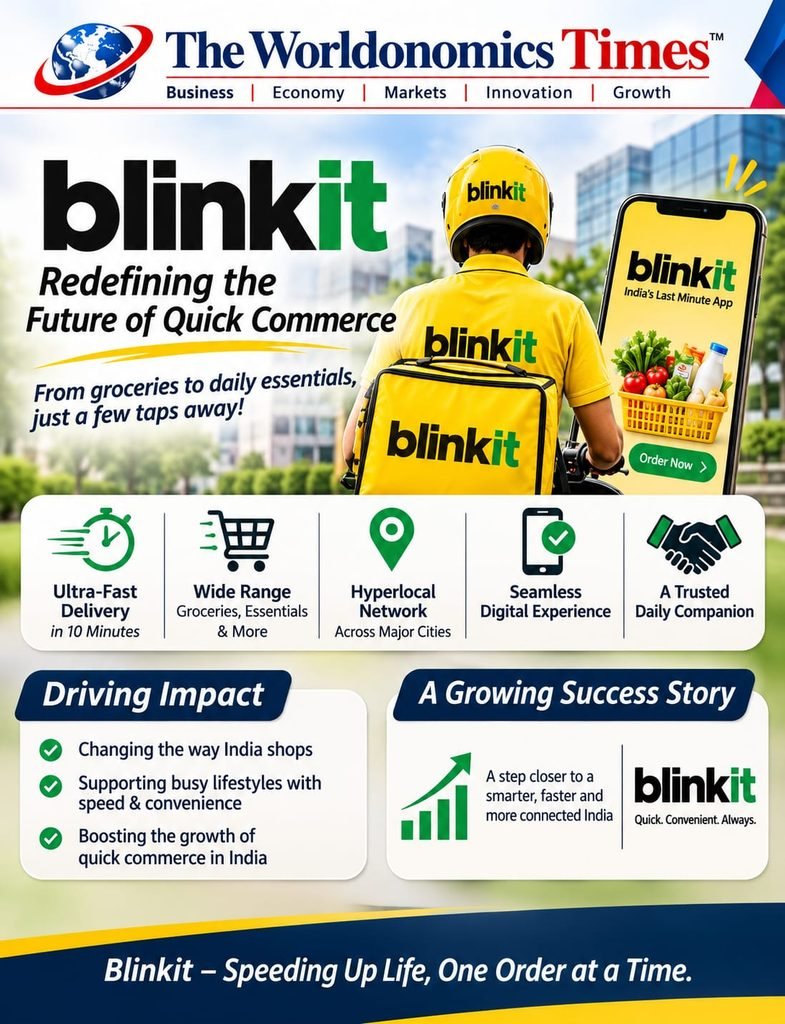
Blinkit: Transforming India’s Quick Commerce Industry Through Speed, Technology and Innovation
The Rise of Instant Delivery: How Blinkit Is Reshaping Consumer Behaviour and India’s Digital Retail Economy
The Worldonomics Times | Business & Economy
Introduction
India’s retail industry is undergoing a significant transformation, driven by digital technology, changing consumer preferences and the growing demand for convenience. One of the most prominent developments in this transformation is the emergence of Quick Commerce (Q-Commerce), a business model that enables customers to order everyday essentials and receive them within minutes.
Among the leading companies driving this change is Blinkit, a quick-commerce platform owned by Eternal Limited (formerly Zomato Limited). From delivering groceries and household essentials to expanding into electronics, beauty products, stationery and other consumer categories, Blinkit has transformed the way millions of Indians shop.
The company’s growth reflects a broader shift in India’s digital economy, where speed, accessibility, technology and customer experience are becoming important factors in business competitiveness.
- The Journey of Blinkit: From Grofers to Quick Commerce
Blinkit’s journey began in December 2013 under the name Grofers, founded by Saurabh Kumar and Albinder Dhindsa. Initially, the company focused on connecting consumers with local grocery stores through an online platform.
Over time, changing consumer expectations and advancements in digital logistics encouraged the company to move towards faster delivery services.
In December 2021, Grofers was rebranded as Blinkit, reflecting its focus on quick commerce and rapid doorstep delivery.
In 2022, Zomato acquired Blinkit, strengthening its position in India’s expanding online commerce ecosystem. Following the corporate rebranding of Zomato Limited to Eternal Limited, Blinkit continues to operate as one of the group’s major businesses.
Today, Blinkit represents a major example of how a traditional grocery-delivery concept can evolve into a technology-driven retail platform.
- Understanding Blinkit’s Business Model
Blinkit operates through a quick-commerce model that combines technology, inventory management, strategically located stores and last-mile delivery.
Unlike traditional e-commerce platforms that may depend on large warehouses and longer delivery timelines, quick-commerce companies establish smaller fulfilment centres, commonly known as dark stores, close to customer locations.
The business model generally operates through the following stages:
- Customer Ordering: Customers select products through the Blinkit mobile application and place an order online.
- Order Processing: The order is automatically communicated to the nearest fulfilment centre.
- Product Picking and Packaging: Store employees collect the required products, verify the order and prepare it for dispatch.
- Last-Mile Delivery: Delivery partners collect the packaged order and transport it to the customer’s doorstep.
- Technology Integration: Digital systems help manage inventory, order allocation, demand forecasting, delivery routes and customer experience.
This integrated operating structure enables Blinkit to reduce delivery distances and fulfil orders within a short period.
- Blinkit’s Business Growth and Financial Performance
Blinkit’s expansion demonstrates the growing commercial potential of India’s quick-commerce sector.
According to Eternal’s FY 2025–26 annual report, Blinkit’s Net Order Value (NOV) reached approximately ₹48,567 crore, registering 117% year-on-year growth.
The company also expanded its network to 2,243 stores across more than 250 cities by March 2026.
Its growth continued during the second quarter of FY 2026–27.
Key Business Highlights – Q2 FY 2026–27
Revenue from operations: ₹19,152 crore.
Year-on-year revenue growth: 93.6%.
Net Order Value: ₹20,940 crore.
Orders processed: Approximately 398.9 million.
Average monthly transacting customers: 37 million.
Total stores at the end of September 2026: 2,751.
Adjusted EBITDA: ₹184 crore.
These figures highlight the increasing scale of Blinkit’s operations and its growing importance within Eternal’s business portfolio.
The company has also increased its store expansion ambition, targeting approximately 3,500 stores by March 2027 and 5,000 stores by March 2028.
Note: Revenue, Net Order Value and adjusted EBITDA are different financial measures and should not be interpreted interchangeably.
- Dark Stores: The Backbone of Quick Commerce
Dark stores are among the most important components of Blinkit’s operational strategy.
These are small fulfilment centres designed exclusively for processing online orders rather than serving walk-in customers.
Their strategic location allows companies to maintain proximity to consumers and reduce delivery time.
Dark stores provide several operational advantages:
Faster order fulfilment through localised inventory.
Better inventory planning and product availability.
Reduced last-mile delivery distances.
Efficient management of frequently purchased products.
Improved demand forecasting through technology.
Expansion into new geographical markets.
However, operating a large network of dark stores also requires significant investment in rent, infrastructure, employees, inventory and technology.
Therefore, maintaining an appropriate balance between store expansion and operational efficiency is essential for long-term profitability.
- Changing Consumer Behaviour and Shopping Preferences
The rapid growth of Blinkit reflects a major change in consumer shopping habits.
Traditionally, households purchased groceries through neighbourhood shops, supermarkets and weekly market visits.
However, smartphone penetration, digital payments and changing lifestyles have encouraged consumers to adopt online purchasing.
Quick commerce has made it possible to order products such as milk, vegetables, snacks, medicines, personal-care items and household essentials without visiting a physical store.
The convenience of receiving products within minutes has particularly influenced urban consumers, working professionals and households with busy schedules.
Another important development is the expansion of product categories beyond groceries.
Customers can increasingly access electronics, home appliances, beauty products, toys, clothing, stationery and other general merchandise through quick-commerce platforms.
This expansion increases the potential frequency of customer purchases and creates new revenue opportunities.
- Employment Generation and Business Opportunities
The expansion of quick commerce has created opportunities across multiple areas of the economy.
Blinkit’s operating ecosystem involves delivery partners, warehouse employees, inventory managers, technology professionals, customer-support executives and logistics personnel.
The growth of this sector also creates indirect opportunities for manufacturers, wholesalers, packaging companies, suppliers and local businesses.
Some important employment and entrepreneurial opportunities include:
Delivery and Logistics: Delivery partners, fleet management, transportation and last-mile logistics.
Warehouse Operations: Inventory management, order processing, packaging and fulfilment-centre administration.
Technology and Data Analytics: Software development, artificial intelligence, data analysis and digital infrastructure.
Supply Chain Management: Procurement, distribution, vendor management and demand forecasting.
Business and Financial Operations: Accounting, taxation, financial reporting, compliance, auditing and internal controls.
The expansion of quick commerce therefore contributes to the development of a wider digital retail and logistics ecosystem.
- Competition in India’s Quick Commerce Industry
India’s quick-commerce market has become increasingly competitive, with several major companies investing in technology, infrastructure and customer acquisition.
Some of the important players include:
Blinkit: Owned by Eternal Limited, with a strong presence across India’s quick-commerce market.
Zepto: A technology-driven quick-commerce company focused on rapid delivery and expanding product availability.
Swiggy Instamart: The quick-commerce business of Swiggy, offering groceries and everyday essentials.
BigBasket: A Tata Digital-owned online grocery platform that has expanded its quick-delivery services.
Amazon Now: Amazon’s quick-delivery offering in selected markets.
Flipkart Minutes: Flipkart’s quick-commerce initiative targeting rapid delivery of everyday products.
Competition among these companies is encouraging innovation in delivery networks, pricing strategies, product assortment and customer experience.
However, aggressive expansion and discount-driven customer acquisition can also increase operating costs.
The long-term success of these platforms will depend on their ability to build customer loyalty while maintaining sustainable financial performance.
- Challenges Facing Blinkit and the Quick Commerce Industry
Despite its impressive growth, Blinkit faces several business and operational challenges.
- High Operational Costs
Maintaining thousands of fulfilment centres requires substantial expenditure on rent, employees, electricity, technology and inventory management.
- Intense Market Competition
Competing platforms continuously invest in discounts, delivery infrastructure and customer acquisition. Maintaining market position without compromising profitability remains a challenge.
- Delivery Partner Welfare and Safety
Quick-commerce operations depend heavily on last-mile delivery partners. Road safety, working conditions, social security and fair compensation are important considerations for the industry.
- Inventory and Supply Chain Management
Managing thousands of products across multiple locations requires accurate demand forecasting, efficient procurement and effective stock control.
- Profitability and Unit Economics
High order volumes do not automatically guarantee profitability. Delivery expenses, discounts, employee costs, rent and other operational expenses must be managed carefully.
- Regulatory and Compliance Requirements
Companies operating in digital commerce must comply with applicable taxation, consumer protection, food safety, labour and other regulatory requirements.
Addressing these challenges is essential for building a reliable and sustainable quick-commerce business.
- Role of Technology and Digital Innovation
Technology is at the centre of Blinkit’s business strategy.
The company relies on digital infrastructure to coordinate customer orders, store operations, inventory availability and delivery networks.
Artificial intelligence and data analytics can support demand forecasting, product recommendations, inventory optimisation and operational planning.
Digital payment systems also make transactions more convenient and improve the efficiency of online retail.
Technology-driven inventory management helps companies monitor stock movement, identify frequently purchased products and reduce the possibility of shortages or excess inventory.
As India’s digital economy expands, the integration of automation, artificial intelligence and advanced logistics systems is likely to become increasingly important for quick-commerce businesses.
- Financial Management and Internal Control in Quick Commerce
The rapid expansion of quick-commerce companies also highlights the importance of strong financial management and internal control systems.
Businesses operating across multiple fulfilment centres and cities need accurate financial records and effective monitoring mechanisms.
Some important areas include:
Inventory valuation and stock reconciliation.
Vendor payment management and purchase verification.
GST compliance and tax reporting.
Revenue recognition and financial reporting.
Expense monitoring and cost control.
Internal audits and operational risk assessment.
Cash-flow management and working capital optimisation.
Efficient accounting and financial control systems help businesses identify operational inefficiencies, reduce errors and improve financial decision-making.
For finance and accounting professionals, the growing digital retail industry also creates opportunities to work in corporate finance, taxation, audit, compliance and management reporting.
- The Road Ahead: Opportunities for India’s Quick Commerce Market
India’s quick-commerce industry has significant potential for further expansion.
Growing internet accessibility, digital payment adoption, urbanisation and increasing demand for convenience are supporting the development of this sector.
Blinkit’s expansion into smaller cities and new product categories indicates that quick commerce is gradually moving beyond its traditional urban grocery market.
In the coming years, business growth may increasingly depend on:
Expansion into emerging cities and new customer segments.
Greater product availability and assortment.
Improved inventory and warehouse efficiency.
Sustainable delivery and logistics practices.
Technology-led operational improvements.
Better customer retention and service quality.
Stronger focus on profitability and financial discipline.
The next phase of competition may not be determined only by who delivers the fastest, but by who can deliver convenience efficiently, consistently and profitably.
Conclusion
Blinkit’s journey from Grofers to one of India’s leading quick-commerce platforms represents an important transformation in the country’s digital retail industry.
Its growth highlights how technology, logistics, consumer convenience and innovative business models can reshape traditional markets.
The company’s expanding fulfilment network, increasing customer base and growing product assortment demonstrate the commercial opportunities available in India’s evolving digital economy.
However, sustainable growth will require more than rapid expansion. Efficient cost management, responsible employment practices, strong financial controls, regulatory compliance and consistent customer satisfaction will remain essential.
As India’s retail ecosystem continues to evolve, Blinkit and other quick-commerce platforms are likely to play an increasingly important role in shaping the future of shopping, employment and digital entrepreneurship.
The future of retail is not just about delivering products faster; it is about building a smarter, more efficient and sustainable business ecosystem.
The Worldonomics Times
Business | Economy | Policy | Markets | MSME | PSU | Professional Opportunities