nancial reporting systems that enable founders to monitor expenditure, revenue, profitability and cash flow.
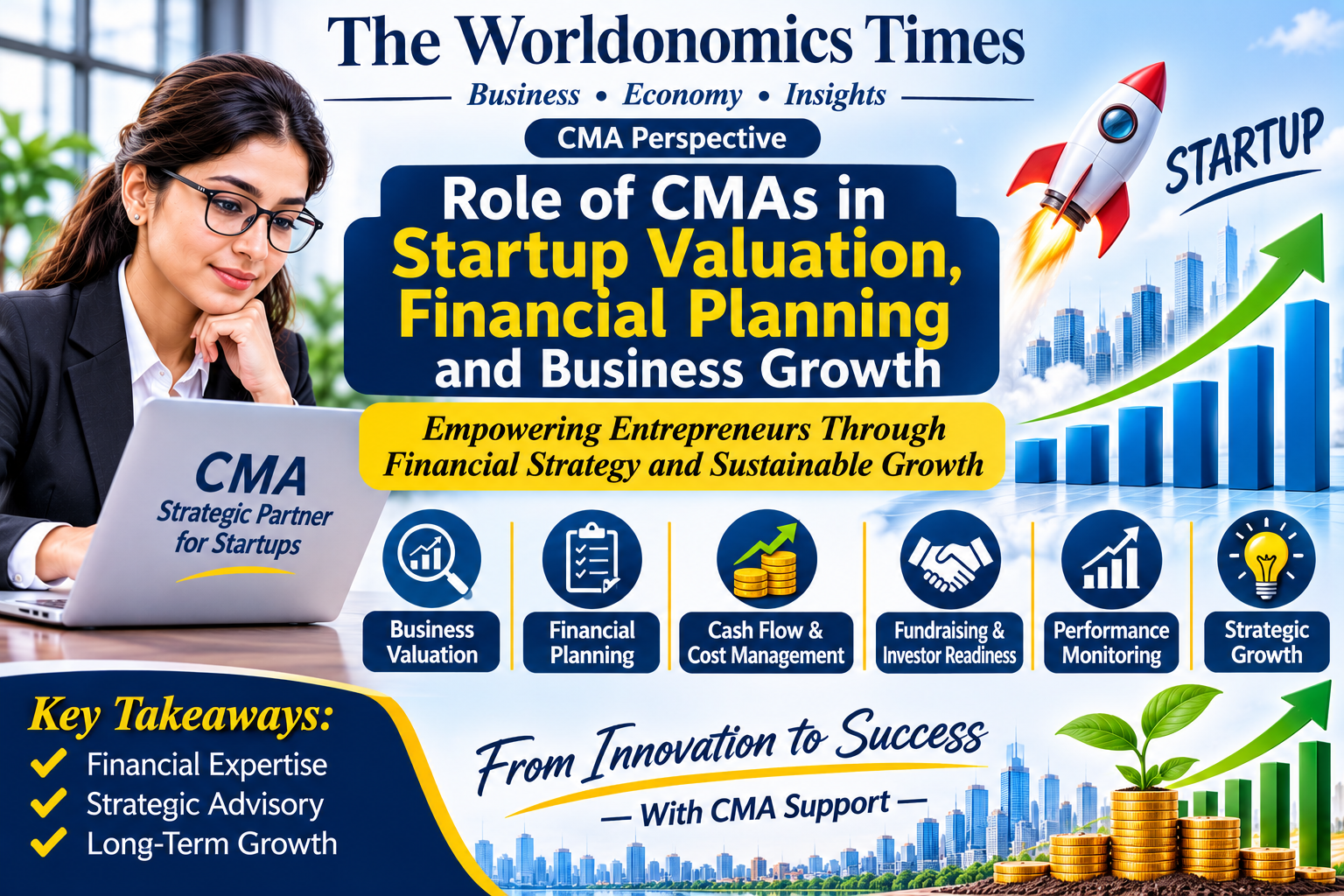
2. Role of CMAs in Startup Valuation
Business valuation is an important requirement when startups seek investment, negotiate ownership arrangements, plan mergers or acquisitions, or assess business performance.
Valuing a startup can be challenging because many young businesses have limited operating histories and may not yet generate consistent profits.
CMAs with appropriate valuation expertise can assist in analysing financial performance, business models, projected cash flows, assets, liabilities, market opportunities and financial risks.
Common valuation approaches include:
- Income approach: Estimates value based on expected future earnings or cash flows.
- Market approach: Compares the business with similar companies or relevant market transactions.
- Asset-based approach: Considers the value of the business’s assets and liabilities.
The appropriate method depends on the business, purpose of valuation, available information and applicable professional or regulatory requirements.
A well-supported valuation can help entrepreneurs and investors understand the financial basis of an investment proposal.
3. Financial Planning and Budget Preparation
Financial planning helps startups allocate limited resources according to business priorities.
CMAs can assist founders in preparing budgets for product development, marketing, salaries, technology, administration and expansion.
They can also prepare financial projections covering revenue, operating expenses, capital expenditure and funding requirements.
A structured budget helps entrepreneurs identify potential financial gaps and avoid unnecessary expenditure.
Regular comparison of actual results with budgeted figures enables management to take corrective action and maintain financial discipline.
4. Cash Flow and Working Capital Management
Cash flow management is one of the most critical challenges for startups. A business may report sales growth but still experience financial difficulties if customer payments are delayed or expenses are not properly controlled.
CMAs can help startups prepare cash flow forecasts, monitor receivables, plan supplier payments and manage inventory.
They can also assess the working capital cycle and identify opportunities to reduce the time between expenditure and cash recovery.
Effective cash flow management helps startups meet their financial obligations, maintain operations and reduce dependence on emergency borrowing.
5. Cost Management and Profitability Analysis
Startups often focus heavily on customer acquisition and revenue growth. However, long-term sustainability depends on understanding the actual cost of delivering products or services.
CMAs can analyse direct costs, indirect expenses, production costs, customer acquisition costs and operating expenditure.
They can also help determine:
- Product-wise and service-wise profitability.
- Contribution margins.
- Break-even sales levels.
- Cost of customer acquisition.
- Unit economics.
- Pricing and discounting strategies.
For example, a startup may experience increasing sales but declining profitability because marketing expenditure and delivery costs are growing faster than revenue.
Cost and profitability analysis helps management identify such problems and develop appropriate strategies.
6. Supporting Startups in Fundraising and Investor Readiness
Access to finance is essential for startups seeking to expand operations, develop technology or enter new markets.
Investors generally examine the business model, financial projections, revenue potential, cost structure, market opportunity and financial risks before making investment decisions.
CMA professionals can help entrepreneurs prepare financial models, business plans, projected cash flows and supporting financial information.
They can also assist in analysing funding requirements and understanding the financial implications of different funding options, including equity and debt.
Accurate financial information and realistic projections can improve the quality of discussions between startups and potential investors.
7. Business Performance Monitoring and Strategic Decision-Making
As startups grow, founders need reliable information to evaluate whether their business strategies are delivering the expected results.
CMAs can develop key performance indicators (KPIs) and management dashboards to monitor financial and operational performance.
Important indicators may include revenue growth, gross margin, operating costs, customer acquisition cost, cash runway, inventory turnover and customer retention.
Such reporting enables management to identify emerging problems, compare performance with targets and make informed decisions about expansion, hiring, marketing and investment.
8. Supporting MSME and Startup Ecosystems
Many startups eventually transition into small and medium-sized enterprises. At this stage, financial systems and management practices become even more important.
CMA professionals can support growing businesses through financial planning, cost optimisation, project feasibility analysis, internal controls and management reporting.
They can also help entrepreneurs understand relevant government schemes, prepare financial documentation and assess the financial viability of proposed projects, subject to applicable eligibility and professional requirements.
By improving financial discipline among startups and MSMEs, CMAs can contribute to entrepreneurship, employment and industrial development.
9. New Professional Opportunities for CMA Professionals
The expanding startup ecosystem offers CMA professionals opportunities in several areas, including:
- Startup financial advisory.
- Business valuation and financial modelling.
- Financial planning and analysis.
- Cost and profitability consulting.
- Fundraising support and investor reporting.
- Working capital management.
- Business restructuring support.
- Management accounting and strategic advisory.
Professionals who develop knowledge of startup business models, technology, investment structures and financial analytics can strengthen their position in this growing field.
10. Skills Required for the Future
To serve startups effectively, CMA professionals need a combination of technical knowledge and entrepreneurial understanding.
Important skills include financial modelling, valuation techniques, budgeting, cash flow forecasting, data analytics, business communication, investment analysis and strategic planning.
They should also understand digital business models, emerging technologies and the financial challenges faced by early-stage enterprises.
Continuous professional development and practical industry exposure will be essential.
Conclusion
India’s expanding startup ecosystem offers significant opportunities for Cost and Management Accountants to contribute to entrepreneurship and economic development.
From business valuation and financial planning to cost management, cash flow monitoring and investor readiness, CMAs can provide valuable support at every stage of a startup’s journey.
Their ability to combine financial discipline with strategic business understanding can help entrepreneurs build stronger, more sustainable enterprises.
As India continues to encourage innovation and entrepreneurship, CMA professionals have an opportunity to become trusted financial partners to the next generation of business leaders.
A successful startup needs more than a great idea; it needs sound financial planning, disciplined cost management and informed business decisions. CMAs can help turn entrepreneurial vision into sustainable business value.