2026 Reforms Strengthen Enforcement, Speed Up Dispute Resolution and Improve Payment Security
New Delhi, November 2026: Timely payment is one of the most important requirements for the financial health of Micro, Small and Medium Enterprises (MSMEs). For a small business operating with limited working capital, a delayed payment from a large customer can affect salaries, raw-material purchases, loan repayments and the ability to accept new orders.
Recognising the seriousness of the delayed-payment problem, the Government of India has introduced significant reforms to strengthen the legal and institutional mechanism for recovery of dues owed to Micro and Small Enterprises (MSEs).
The Micro, Small and Medium Enterprises Development (Amendment) Bill, 2026, passed by Parliament in August 2026, introduces stronger provisions for delayed-payment dispute resolution and recovery. One of the most significant changes is that certain mediated settlements and arbitral awards can now be recovered as “arrears of land revenue.”
Why Delayed Payments Are a Major MSME Challenge
Unlike large corporations, many micro and small enterprises do not maintain substantial cash reserves. Their business model depends heavily on regular working-capital cycles.
When an invoice remains unpaid for several months, the supplier may be forced to borrow money simply to continue normal operations. The resulting interest burden can reduce profitability and discourage entrepreneurs from accepting larger orders.
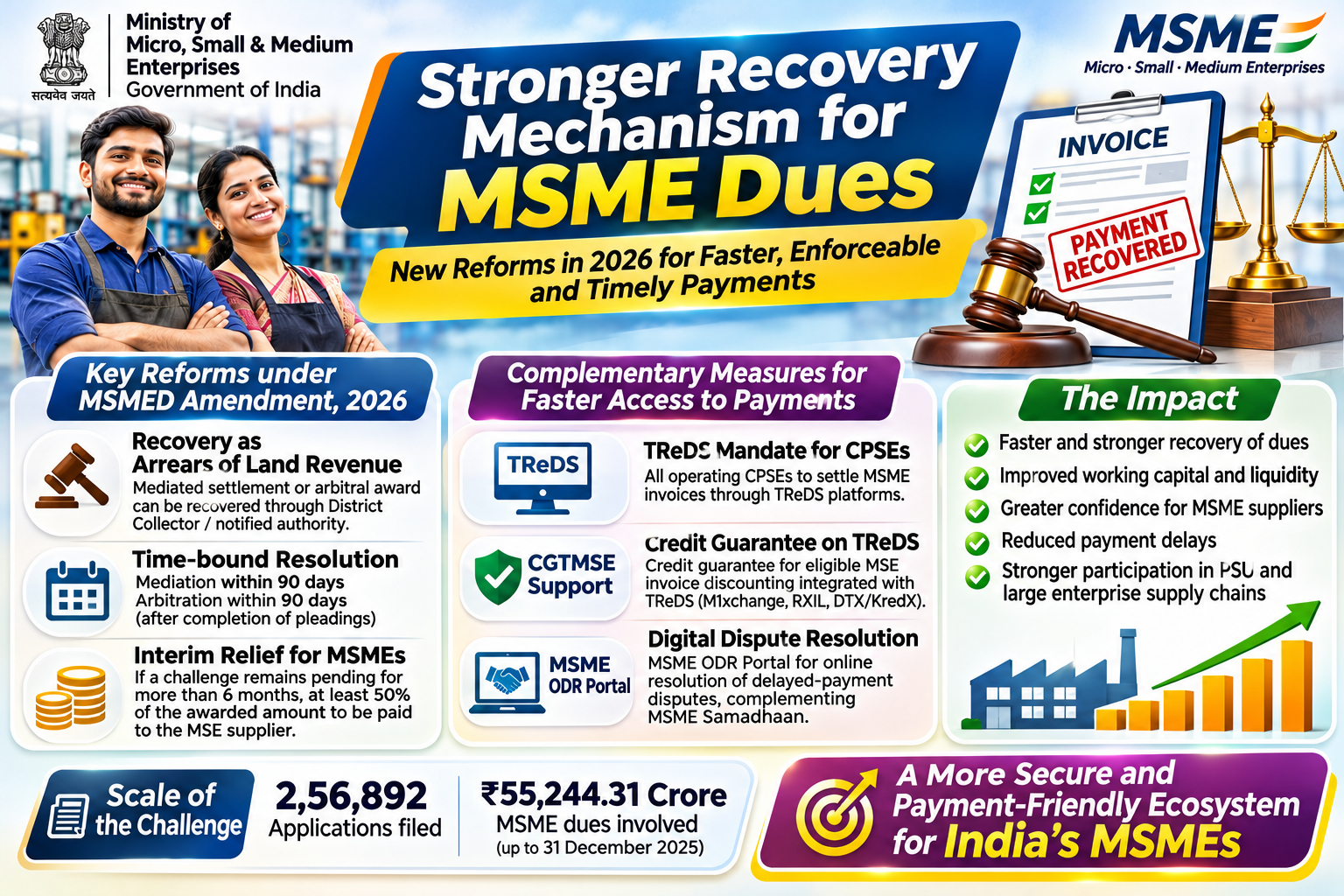
The scale of the problem is significant. According to the Ministry of MSME’s Annual Report 2025-26, up to 31 December 2025, 2,56,892 applications involving ₹55,244.31 crore had been filed by MSEs through the delayed-payment mechanism.
The issue is therefore not merely about individual commercial disputes. It has wider implications for employment, investment, credit demand and the overall competitiveness of India’s MSME sector.
Recovery as Arrears of Land Revenue
One of the most important provisions introduced in 2026 relates directly to recovery.
Under the amended framework, a mediated settlement agreement or arbitral award made through the Facilitation Council, a mediation service provider or an alternative dispute-resolution institution under Section 18 can be recovered as an arrear of land revenue.
Recovery may be undertaken through the District Collector, Deputy Commissioner or another notified authority having jurisdiction over the location of the buyer’s assets.
This is a major change in the enforcement framework because obtaining an award is only useful to an MSME if the amount can ultimately be recovered.
The new mechanism is intended to strengthen the practical enforceability of decisions and provide greater confidence to small suppliers seeking recovery of legitimate dues.
Faster Resolution of Payment Disputes
The 2026 reforms also introduce clearer timelines for delayed-payment proceedings.
Under the amended provisions, mediation is required to be completed within 90 days from the date fixed for first appearance. If mediation fails, the matter is to be referred for arbitration within 30 days from termination of mediation.
The Facilitation Council or relevant alternative dispute-resolution institution is then required to make the arbitral award within 90 days from completion of pleadings.
These timelines are intended to reduce prolonged uncertainty for both suppliers and buyers.
For an MSME, faster adjudication can be particularly valuable because a disputed invoice may represent a substantial portion of its working capital.
Protection During Court Proceedings
Another important reform concerns situations where a party seeks to set aside a decree, award or order.
The amended framework provides that if such an application remains pending for more than six months, courts are required to direct payment to the MSE supplier of at least 50% of the awarded amount, subject to the statutory framework.
This provision seeks to prevent the entire awarded amount from remaining blocked for an extended period while litigation continues.
For small businesses, access to at least part of the awarded amount could provide meaningful working-capital relief.
TReDS Becomes a Stronger Payment Tool
Legal recovery is only one part of the Government’s strategy.
The Trade Receivables Discounting System (TReDS) has emerged as an important mechanism for helping MSMEs convert approved invoices into working capital.
In June 2026, the Government mandated that operating Central Public Sector Enterprises (CPSEs) route settlement of invoices for goods and services procured from MSMEs through RBI-authorised TReDS platforms. CPSEs are also required to disclose relevant TReDS settlement information and obtain statutory-auditor certification of compliance.
The growth of TReDS has been substantial. Invoice discounting through the platform increased from around ₹40,000 crore in FY 2022-23 to ₹3.47 lakh crore in FY 2025-26, according to the Government.
The objective is to reduce the time MSMEs have to wait for payment and provide access to invoice-based financing.
Credit Guarantee Further Strengthens Liquidity
In September 2026, the Government also operationalised credit guarantee support for eligible MSE invoice discounting on TReDS.
The CGTMSE system has been integrated with TReDS platforms including M1xchange, RXIL and DTX (KredX), enabling eligible enterprises to access credit-guarantee-backed invoice financing. The Government stated that the measure is intended to help address delayed payments and improve access to working capital.
This creates an important distinction: an MSME does not necessarily have to wait until the buyer pays the invoice before obtaining liquidity.
Digital Dispute Resolution
The Government has also been strengthening the digital infrastructure for delayed-payment disputes.
The MSME ODR Portal, launched in 2025, provides an online mechanism for resolving delayed-payment disputes. It is designed to reduce the cost and time involved in dispute resolution and complements the existing MSME Samadhaan framework.
The broader objective is to create an ecosystem where filing, tracking, mediation, arbitration and recovery become more transparent and technology-enabled.
What MSMEs Should Do
The new framework provides stronger protection, but MSMEs should also maintain proper documentation.
Enterprises should ensure that they have valid Udyam registration, purchase orders, contracts, invoices, delivery acknowledgements, e-way bills where applicable, correspondence and proof of acceptance of goods or services.
Businesses should also monitor receivables regularly rather than waiting until an invoice becomes significantly overdue.
Where appropriate, MSMEs should explore TReDS for eligible invoices and use the available dispute-resolution mechanisms when payments are delayed.
A Stronger Payment Culture
The 2026 reforms represent an important shift from merely recognising the problem of delayed MSME payments to strengthening enforcement, speed and liquidity.
The combination of stronger recovery provisions, time-bound dispute resolution, TReDS, credit guarantees, online dispute resolution and MSE Facilitation Councils creates a more comprehensive framework for protecting small suppliers.
For India’s MSMEs, the message is increasingly clear: an awarded claim should not remain only a paper victory; the system must enable actual recovery of the money.
If implemented effectively, the strengthened recovery mechanism can improve confidence among entrepreneurs, unlock working capital, reduce financial stress and encourage MSMEs to participate more actively in larger corporate and government supply chains.
Ultimately, timely payment is not simply a legal or accounting issue. It is a foundation for sustainable MSME growth, employment and investment in India.