New Delhi, November 2026: For India’s Micro, Small and Medium Enterprises (MSMEs), the next stage of growth is increasingly about moving beyond traditional local markets and becoming visible, organised and accessible to larger buyers. Two relatively important tools in this transformation are barcode adoption and e-commerce.
Recognising the need to improve the marketing competitiveness of Micro and Small Enterprises (MSEs), the Ministry of Micro, Small and Medium Enterprises has included “Adoption of Bar Code” and “Adoption of e-Commerce Platform” under the capacity-building components of the Procurement and Marketing Support (PMS) Scheme.
The objective is straightforward: help small businesses improve product identification, professionalise their operations and gain access to modern markets. The PMS framework specifically includes barcode adoption and e-commerce platform adoption alongside modern packaging, workshops, seminars and other market-access initiatives.
Why Barcodes Matter for Small Businesses
A barcode may appear to be a simple printed pattern on a product package, but for a growing MSME it can become an important part of a professional supply chain.
Barcodes enable products to be identified electronically and can support inventory management, billing, product tracking and organised retail operations. They become particularly valuable when an MSME moves from direct sales to distributors, retailers, institutional buyers or organised marketplaces.
For a small manufacturer supplying multiple products and customers, manual product identification can become increasingly difficult. A standardised product identification system can help businesses manage their growing product portfolio more efficiently.
Barcode adoption can also improve the professional presentation of an MSME’s products when approaching organised buyers.
Government Support Is Continuing in 2026
The barcode component is not merely a historical provision of the PMS Scheme. Government implementation records show that financial support for barcode adoption continues during 2026.
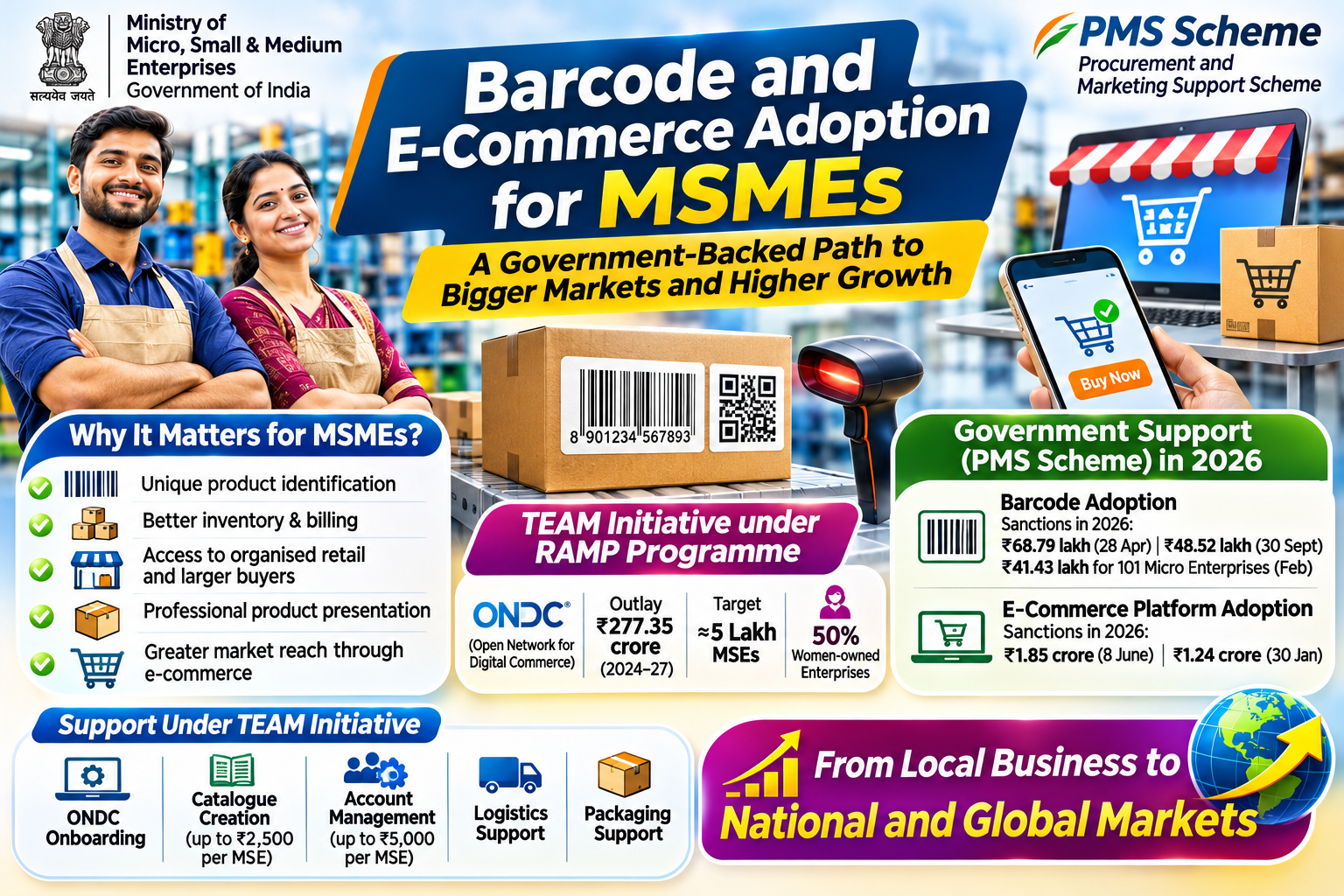
The Office of the Development Commissioner (MSME) recorded a sanction of ₹68.79 lakh on 28 April 2026 under the “Adoption of Bar Code” component. Another sanction of ₹48.52 lakh was issued on 30 September 2026.
Earlier in February 2026, the Government sanctioned ₹41.43 lakh for reimbursement relating to barcodes for 101 Micro Enterprises under the PMS Scheme.
These sanctions demonstrate that barcode adoption continues to receive active policy attention as part of MSME marketing and competitiveness efforts.
From Physical Products to Digital Markets
Barcode adoption addresses the product-identification side of business. E-commerce addresses the market-access side.
An MSME with a good product can still remain small if customers outside its local geography cannot easily discover or purchase it. Digital commerce can change that equation.
The Government’s Trade Enablement and Marketing (TEAM) Initiative, launched under the RAMP Programme, specifically seeks to help MSEs access digital markets through the Open Network for Digital Commerce (ONDC).
The TEAM initiative has an outlay of ₹277.35 crore for 2024-27 and aims to support approximately 5 lakh MSEs, with 50% of the targeted beneficiaries expected to be women-owned enterprises.
What Support Can an MSME Receive?
The TEAM initiative goes beyond simply asking an MSME to register on an online platform.
It provides support for activities including ONDC onboarding, creation of ONDC-compliant catalogues, account management, logistics and packaging.
The official framework provides catalogue-creation support capped at ₹2,500 per MSE, account-management support capped at ₹5,000 per MSE, along with support related to transportation, logistics and packaging.
This is important because many small businesses struggle not with manufacturing but with the practical process of becoming digitally market-ready.
E-Commerce Adoption Is Already Receiving Government Support
The PMS Scheme’s e-commerce component is also being actively implemented.
According to the Development Commissioner’s sanction records, ₹1.85 crore was sanctioned on 8 June 2026 under the “Adoption of e-Commerce Platform” component. Earlier, ₹1.24 crore was sanctioned on 30 January 2026 under the same component.
The Government had also sanctioned e-commerce-related assistance during 2025, demonstrating continuing implementation of this component rather than treating digital commerce as a one-time intervention.
Why MSMEs Should Combine Barcode and E-Commerce
For an MSME, barcode adoption and e-commerce should not be viewed as two unrelated activities.
A better approach is to build an integrated digital product system:
Product → Barcode → Catalogue → Digital Marketplace → Customer → Order → Inventory → Delivery → Repeat Sales
For example, a food-processing MSME can standardise its product identification, improve packaging, create digital product listings and sell beyond its local market. A handicraft enterprise can showcase products online, reach customers in different States and potentially explore export opportunities.
The same approach can be adopted by manufacturers, consumer-product businesses, traditional enterprises and other eligible MSEs.
The Opportunity for Women and Rural Entrepreneurs
Digital commerce can be especially significant for enterprises located outside major metropolitan markets.
A business operating in a smaller city or rural area no longer needs to depend entirely on customers visiting its physical premises. With appropriate digital infrastructure, catalogues, logistics and packaging, products can reach customers across India.
The TEAM Initiative’s target that half of its beneficiaries should be women-owned MSEs also highlights the importance being placed on inclusive digital market access.
What MSMEs Should Do Now
MSMEs interested in using these opportunities should begin with basic formalisation and product readiness.
First, ensure that the enterprise has appropriate Udyam registration and business documentation. Next, identify products suitable for organised retail or digital commerce. Businesses should then evaluate barcode requirements, improve packaging, prepare high-quality product photographs and descriptions, and explore appropriate e-commerce channels.
For enterprises considering ONDC, the TEAM Initiative can provide an additional pathway for onboarding and digital market access.
MSMEs should also regularly monitor the official PMS announcements because assistance, sanctions, eligibility conditions and implementation procedures can change.
From Local Enterprise to National Brand
The broader significance of barcode and e-commerce adoption is that these tools can help MSMEs become more organised, discoverable and scalable.
Barcode technology can strengthen product identification and supply-chain readiness, while e-commerce can open access to customers beyond the enterprise’s immediate geography. Government initiatives such as PMS and TEAM can help reduce some of the barriers associated with this transition.
For India’s MSMEs, the message is increasingly clear: digital adoption is no longer simply a technology upgrade—it is becoming a market-access strategy.
An enterprise that combines quality products with professional packaging, standardised identification, digital catalogues, online distribution and efficient logistics can position itself for a much larger opportunity.
The journey from local seller to national supplier and eventually a global brand may begin with something as simple as a barcode and a digital product catalogue.