Trade Fairs, E-Commerce, Barcodes and Vendor Development Create New Opportunities for Micro and Small Enterprises
New Delhi, November 2026: For India’s Micro, Small and Medium Enterprises (MSMEs), access to customers and markets is often as important as access to finance. A business may have a competitive product, skilled workforce and production capacity, but without adequate market visibility, it can remain restricted to a limited geographical area.
The Government of India’s Procurement and Marketing Support (PMS) Scheme is designed to address this challenge by helping Micro and Small Enterprises (MSEs) participate in trade fairs, exhibitions, vendor development programmes and other market-access initiatives.
The scheme is not merely a policy framework on paper. Official sanction records show that PMS is being actively implemented during 2026, with financial sanctions covering domestic trade fairs, barcode adoption, e-commerce platform adoption, workshops and other activities.
Significant Activity Under PMS in 2026
The implementation record provides a clear indication of the scale of activity.
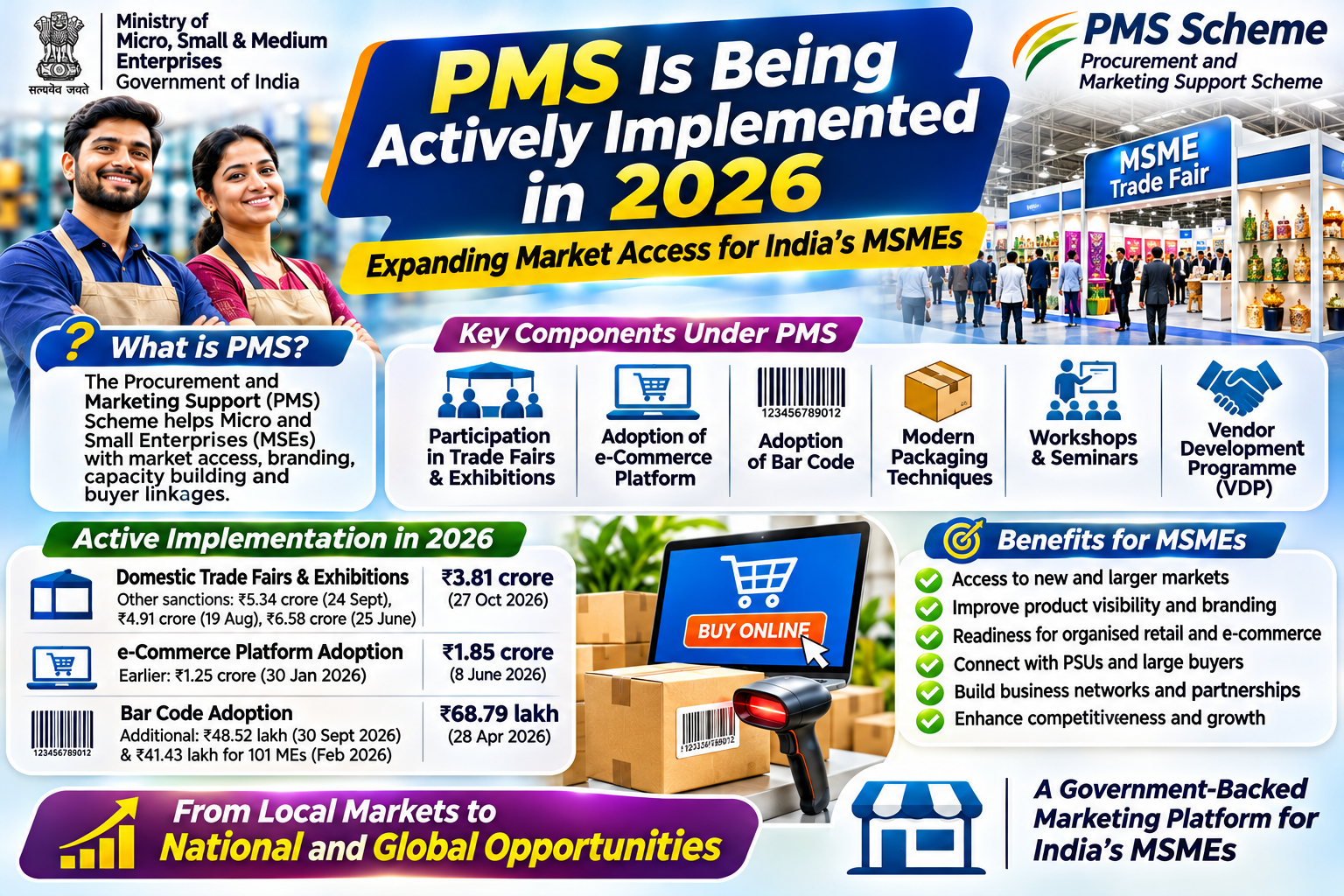
Under the PMS sanction orders, ₹3.81 crore was sanctioned on 27 October 2026 for participation of individual MSEs in domestic trade fairs and exhibitions across India. Earlier, sanctions of ₹5.34 crore on 24 September, ₹4.91 crore on 19 August and ₹6.58 crore on 25 June 2026 were issued for the same broad market-access component.
These interventions are important because trade fairs can provide small enterprises with opportunities to meet distributors, institutional buyers, government representatives, exporters and other businesses.
For an MSME, participation in a well-organised exhibition can therefore become more than a marketing exercise—it can be a route to new customers and business relationships.
Supporting Digital Market Access
One of the most important developments under PMS is its focus on digital commerce.
The scheme specifically includes “Adoption of e-Commerce Platform” as a capacity-building component. The Government’s scheme framework also identifies adoption of barcodes, modern packaging techniques, national workshops and seminars as part of its capacity-building approach.
In 2026, this component has seen direct financial implementation.
On 8 June 2026, ₹1.85 crore was sanctioned under the e-commerce platform adoption component. Earlier, on 30 January 2026, ₹1.25 crore approximately was sanctioned under the same component.
The significance is substantial. Digital commerce can allow an enterprise in a smaller city or semi-urban location to reach customers far beyond its traditional market.
Barcode Adoption Gets Continued Attention
Modern market access also requires better product identification and supply-chain readiness.
PMS includes Adoption of Bar Code as a specific capacity-building component for eligible micro enterprises. The 2026 sanction record shows continued implementation.
On 28 April 2026, ₹68.79 lakh was sanctioned for barcode adoption. Another ₹48.52 lakh was sanctioned on 30 September 2026. In addition, a February 2026 sanction of ₹41.43 lakh provided reimbursement relating to barcodes for 101 Micro Enterprises.
Barcode adoption can help enterprises improve product identification, inventory management, billing and readiness for organised retail and digital marketplaces.
Trade Fairs Remain a Major Market-Access Tool
While digital commerce is growing rapidly, physical business networking remains important.
PMS supports participation of individual MSEs in domestic trade fairs and exhibitions across the country. It also covers organisation and participation in trade fairs and exhibitions by the Ministry, Office of the Development Commissioner (MSME) and government organisations.
The 2026 sanction orders show repeated approvals under this component throughout the year.
This creates an opportunity for MSMEs to display their products directly to potential buyers instead of depending entirely on conventional sales channels.
For manufacturing enterprises, food processors, handicraft businesses, consumer-product companies and service providers, exhibitions can also provide valuable market intelligence—what buyers want, what competitors are offering and what product improvements may be required.
Vendor Development Connects MSMEs with Larger Buyers
Another important component of PMS is the Vendor Development Programme (VDP).
The objective is to facilitate market linkages and support implementation of the Public Procurement Policy for Micro and Small Enterprises. This can help eligible MSEs understand procurement opportunities and develop relationships with larger organisations and government-linked buyers.
For an MSME aspiring to become a supplier to a PSU or a large corporate, vendor development programmes can therefore be an important stepping stone.
2026 Also Brings Active Administrative Implementation
The Government’s PMS circular records show that implementation activity has extended beyond financial sanctions.
During 2026, the Office of the Development Commissioner issued directions relating to applications, approved stall areas, trade-fair participation, documentation, event restrictions and submission of proposals for FY 2026-27. An amendment to the PMS guidelines was also issued on 7 September 2026.
Such administrative activity indicates that the scheme is being continuously managed and refined rather than remaining static.
What MSMEs Should Do
MSMEs interested in benefiting from PMS should approach the scheme strategically.
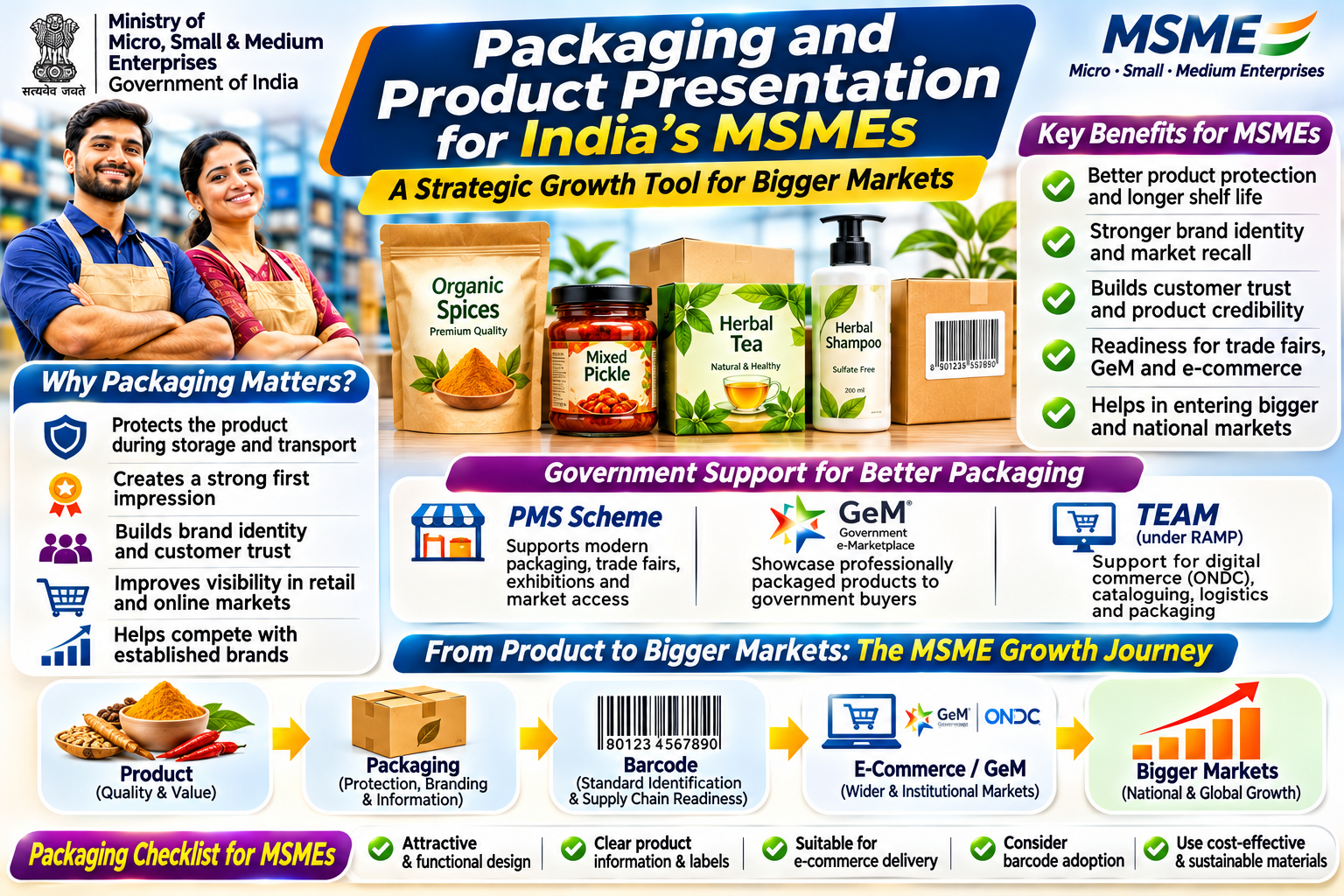
First, enterprises should ensure that their Udyam registration and business documentation are current. They should identify relevant trade fairs and exhibitions, prepare professional product catalogues and packaging, and evaluate whether barcode and e-commerce adoption can improve their market readiness.
Businesses should also explore vendor development programmes and government procurement opportunities.
Importantly, entrepreneurs should monitor official Ministry of MSME and Development Commissioner (MSME) announcements because application procedures, documentation requirements, eligibility conditions and approved activities may change.
From Scheme to Business Opportunity
The real value of PMS lies in its ability to connect government support with actual business development.
A small enterprise can potentially use different components as part of a single growth strategy:
Udyam Registration → Professional Packaging → Barcode → Trade Fair → Vendor Development → E-Commerce → Larger Buyers → Business Expansion
This integrated approach can help MSMEs move beyond local markets and become more organised, visible and competitive.
The 2026 implementation record demonstrates that PMS is actively supporting this transition through financial sanctions and administrative action across multiple components.
For India’s MSMEs, the opportunity is therefore not simply to participate in a government scheme. It is to use market-access support to build stronger brands, discover new customers, develop buyer relationships and ultimately scale the business.
As India’s MSME ecosystem becomes increasingly digital and competitive, programmes such as PMS can play an important role in helping small enterprises make the journey from local business to national supplier and, eventually, global enterprise.