The Worldonomics Times | Tax & Regulatory Affairs
India’s Goods and Services Tax (GST) framework may be heading towards a significant improvement in the availability and utilisation of Input Tax Credit (ITC). The GST Council has recommended a series of reforms covering refund eligibility, restrictions on blocked credits and procedures for challenging the blocking of ITC in electronic credit ledgers.
Announced following the 57th GST Council meeting on October 8, 2026, these proposals are intended to reduce the accumulation of unused tax credits, improve business cash flows and make GST administration more predictable.
For exporters, manufacturers and businesses operating under an inverted duty structure, the proposed changes could provide considerable financial relief. However, taxpayers must understand that the reforms involve different statutory provisions and implementation dates. A Council recommendation does not automatically amend the GST law.
1. Wider eligibility for refund of accumulated ITC
One of the most important recommendations concerns the refund of accumulated ITC on input services and capital goods.
Under the existing framework, Rule 89 of the CGST Rules, 2017, restricts the inclusion of certain categories of ITC when calculating refunds arising from zero-rated supplies and inverted duty structures.
The Council has recommended amendments to Section 54(3) of the CGST Act and the relevant GST Rules to expand refund eligibility.
The proposed changes cover two major categories:
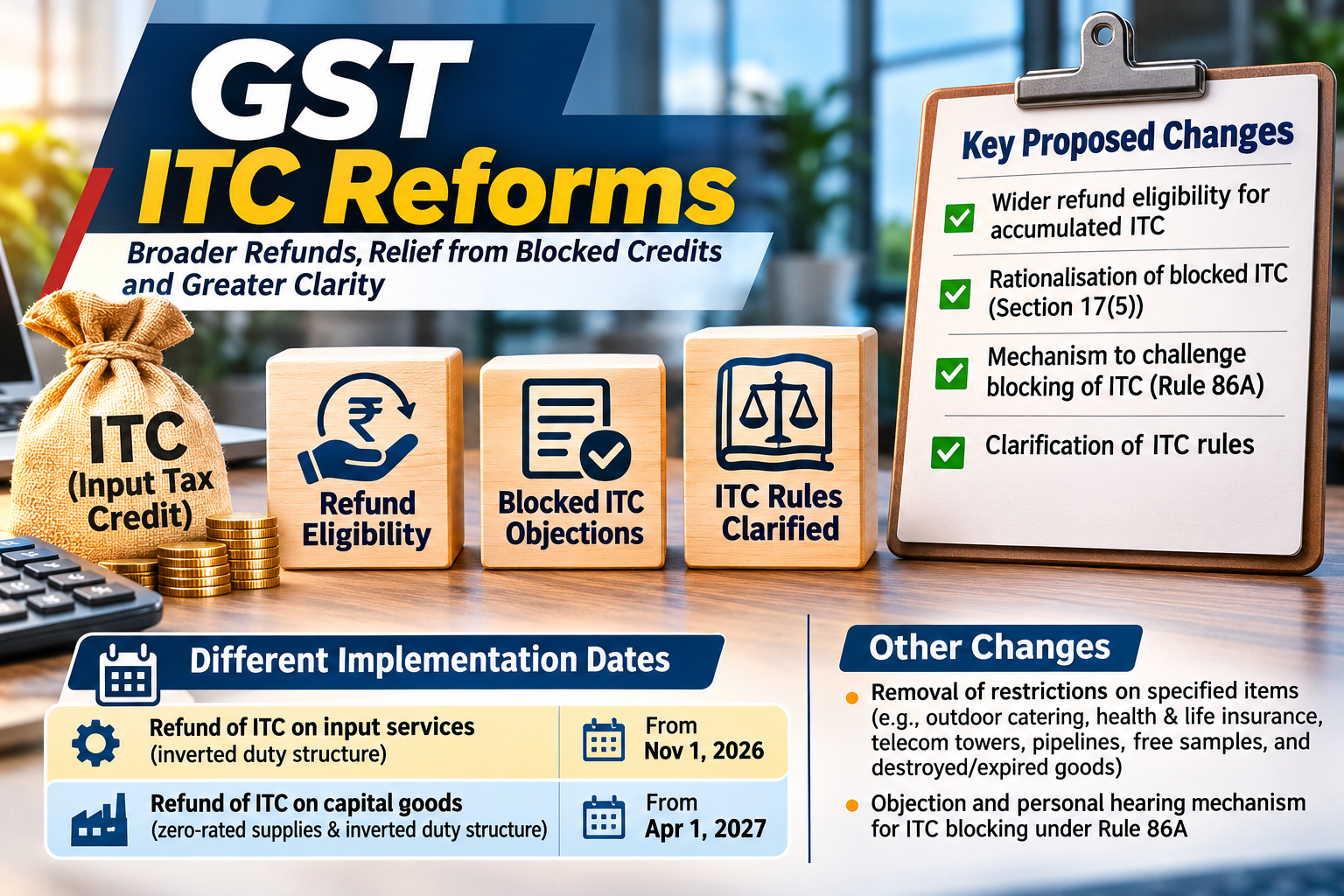
Refund under inverted duty structure: ITC accumulated on input services would become eligible for refund, subject to the applicable conditions. This is particularly relevant for manufacturers and businesses that pay higher GST on eligible inputs than on their outward supplies.
The proposed benefit would apply to ITC on input services availed on or after November 1, 2026.
Refund on capital goods: ITC accumulated on capital goods would also become eligible for refund in cases involving zero-rated supplies and inverted duty structures.
However, the proposed refund would be spread over 60 months, allowing one-sixtieth of the eligible capital-goods credit to be considered for each month.
This provision would apply to eligible ITC on capital goods availed on or after April 1, 2027.
These changes could help businesses reduce the amount of working capital locked in accumulated GST credits. The government’s official FAQ on refunds of ITC relating to input services and capital goods explains the proposed eligibility conditions and calculation mechanism.
Importantly, the reform does not mean that every taxpayer can claim refunds simply because input services or capital goods attract higher GST. The existence of an inverted duty structure must still be established by comparing the applicable tax rates on inputs and outward supplies.
2. Rationalisation of blocked ITC under Section 17(5)
Another significant recommendation concerns Section 17(5) of the CGST Act, which identifies categories of goods and services on which ITC is restricted.
The Council has recommended removing specified restrictions to facilitate a smoother flow of credit across business operations.
The proposed changes cover several categories, including:
- Outdoor catering: Restrictions on ITC relating to specified outdoor catering services are proposed to be removed.
- Health and life insurance: Restrictions relating to specified insurance services are proposed to be relaxed.
- Telecommunication towers: Restrictions affecting ITC on telecom towers are proposed to be removed.
- Pipelines outside factory premises: Restrictions relating to specified pipelines laid outside factory premises are proposed to be removed.
- Free samples: Restrictions on specified free samples are proposed to be rationalised.
- Destroyed or written-off goods: Restrictions relating to goods destroyed or written off on expiry of shelf life, as required by law, are proposed to be removed.
If implemented in the recommended form, these changes could reduce cascading taxation and improve credit availability for businesses in manufacturing, telecommunications, hospitality and other sectors.
However, the removal of specified restrictions should not be interpreted as unrestricted ITC eligibility. General eligibility requirements, documentation standards and other applicable provisions of the CGST Act would continue to matter.
3. New mechanism to challenge blocked ITC
The Council has also recommended an important procedural safeguard concerning Rule 86A of the CGST Rules, 2017.
Rule 86A empowers tax authorities to restrict the use of amounts available in an electronic credit ledger where the prescribed conditions relating to wrongful or fraudulent availment of ITC are satisfied.
Such restrictions can affect a business’s ability to utilise available credit for paying GST liabilities, potentially creating cash-flow difficulties.
To address concerns regarding the exercise of this power, the Council has recommended introducing a mechanism that allows taxpayers to submit objections against the blocking of ITC.
The proposal also provides for an opportunity of personal hearing before the proper officer takes a decision on the objection.
This would introduce an additional procedural safeguard and give taxpayers an opportunity to explain their position before the authorities decide whether the restriction should continue.
For businesses facing blocked-credit disputes, the proposed mechanism could improve transparency and provide a more structured route for presenting supporting documents and explanations.
Nevertheless, the proposed objection mechanism should not be confused with automatic restoration of blocked ITC. The outcome would depend on the facts, applicable legal conditions and the officer’s decision.
4. Different reforms, different implementation dates
A particularly important aspect of the recommendations is that the proposed changes do not all become effective simultaneously.
The Council has identified specific dates for certain categories of refund eligibility.
| Proposed reform | Recommended applicability |
|---|---|
| Refund of ITC on input services under inverted duty structure | ITC availed from November 1, 2026 |
| Refund of ITC on capital goods under zero-rated supplies and inverted duty structure | ITC availed from April 1, 2027 |
| Rationalisation of blocked ITC under Section 17(5) | Subject to implementing amendment |
| Objection and personal hearing mechanism under Rule 86A | Subject to implementing amendment |
The dates above reflect the Council’s recommendations, not independent confirmation that every necessary amendment or notification has commenced.
Taxpayers should monitor the GST Council’s official announcements and CBIC notifications for confirmation of the applicable legal provisions.
5. What businesses should do now
Businesses should review their existing ITC positions, identify accumulated credits and examine whether they may qualify under the proposed expanded refund categories.
Exporters and manufacturers should maintain detailed records of input services, capital goods, tax invoices and relevant return filings. Companies with blocked ITC should preserve supporting documentation and monitor developments concerning Rule 86A.
Businesses should also review their ITC treatment under Section 17(5) rather than immediately assuming that previously restricted credits can be claimed.
Any refund or credit claim should be assessed against the final statutory amendments, applicable dates and eligibility conditions.
Conclusion: A step towards smoother GST credit flow
The proposed ITC reforms represent an important development in India’s indirect tax administration. By widening refund eligibility, rationalising selected blocked-credit restrictions and introducing an objection mechanism for Rule 86A restrictions, the GST Council aims to address some of the practical difficulties faced by taxpayers.
The potential benefits include improved working capital, reduced tax cascading and greater procedural transparency.
However, the reforms must be examined individually because their legal implementation and applicability dates differ.
The bottom line: The proposed GST changes could make input tax credit more accessible and reduce unnecessary financial blockages for businesses. Taxpayers should prepare for the reforms while relying on the final amendments and notifications, rather than treating every Council recommendation as immediately enforceable.