New grant scheme and proposed regulatory changes aim to mobilise long-term institutional capital for infrastructure projects, strengthen Singapore’s financial ecosystem and support Asia’s growing infrastructure financing requirements.
SINGAPORE | 5 November 2026
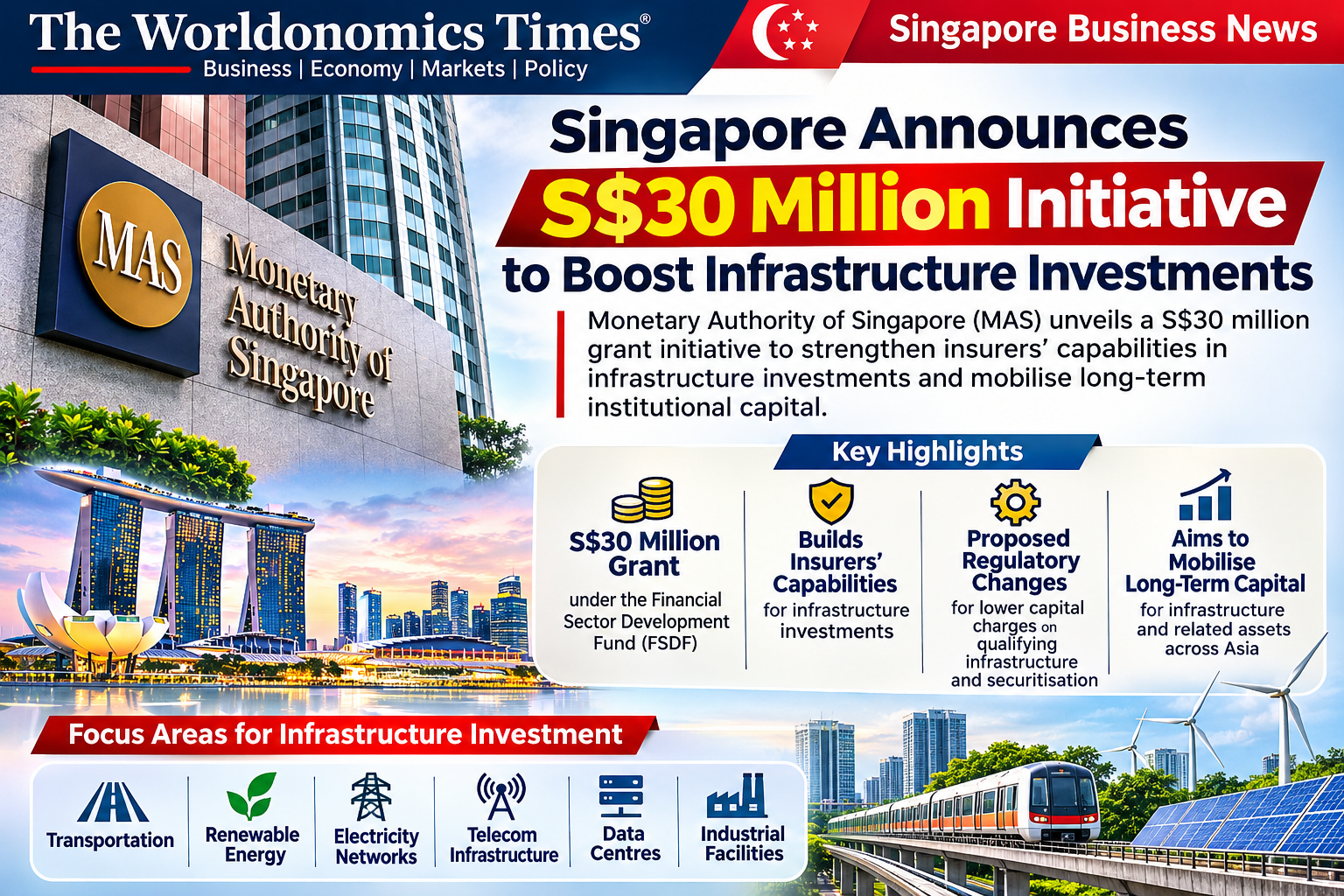
The Monetary Authority of Singapore (MAS) has announced a S$30 million funding initiative to encourage insurance companies to participate more actively in infrastructure investments, marking another step towards strengthening Singapore’s position as a leading financial and investment hub in Asia.
The initiative, announced on 2 November 2026, will support insurers in developing specialised investment capabilities, building dedicated teams and expanding their participation in infrastructure financing and securitised assets.
The announcement was made by Chee Hong Tat, Singapore’s Minister for National Development and Deputy Chairman of MAS, at the Singapore International Reinsurance Conference.
The initiative comes at a time when Asian economies are witnessing increasing demand for infrastructure financing across sectors such as transportation, renewable energy, electricity transmission, telecommunications, industrial facilities and data centres.
S$30 Million Grant to Strengthen Insurance Investment Capabilities
Under the new initiative, MAS will allocate S$30 million through the Financial Sector Development Fund (FSDF) for an Infrastructure Capability Development Grant for Insurers.
The grant is designed to help insurance companies establish or expand their infrastructure investment activities in Singapore.
The funding will support several activities, including:
- Establishment of dedicated infrastructure investment teams.
- Training and skill development of existing employees.
- Engagement of professional advisers and specialised service providers.
- Development of expertise in originating, evaluating and managing infrastructure investments.
The scheme took effect on 2 November 2026. Interested insurers can approach MAS for further details regarding eligibility and grant arrangements.
The initiative seeks to develop specialised investment expertise within Singapore’s insurance industry rather than relying entirely on external investment managers and advisers.
By strengthening institutional capabilities, MAS aims to encourage insurers to become more active participants in financing long-term infrastructure assets.
MAS Proposes Changes to Insurance Capital Framework
Alongside the grant announcement, MAS has proposed enhancements to Singapore’s insurance capital framework to provide more differentiated capital treatment for qualifying infrastructure and securitisation investments.
The proposed changes aim to ensure that capital requirements better reflect the underlying risks associated with different investment categories.
The proposals cover three important areas.
1. Infrastructure Debt Investments
Rated infrastructure debt investments that satisfy specified credit quality and other qualifying requirements may become eligible for lower capital charges.
This could encourage insurers to consider a wider range of infrastructure debt opportunities while maintaining appropriate risk assessment standards.
2. Infrastructure Equity and Debt with Risk-Mitigating Features
MAS has also proposed lower capital charges for qualifying infrastructure equity and debt investments that incorporate additional risk-mitigating features.
These may include revenues supported by long-term contractual arrangements, limited exposure to demand-related risks and support from financially strong counterparties.
Such arrangements can provide greater visibility over future cash flows and help investors evaluate the financial risks associated with infrastructure projects.
3. Senior Investment-Grade Securitisation
The proposals also cover senior investment-grade securitisation tranches that satisfy specified requirements relating to simplicity, transparency and comparability.
Certain investments may also qualify through conditions involving portfolio diversification and liquidity safeguards.
MAS has invited industry participants and interested stakeholders to provide feedback on the proposed regulatory changes. The public consultation will close on 18 December 2026.
Asia’s Infrastructure Financing Requirements Create New Opportunities
The initiative reflects the growing financing requirements of Asian economies.
Infrastructure development requires substantial long-term capital, particularly in emerging areas such as renewable energy, electricity networks, transportation infrastructure, digital connectivity and data centres.
According to remarks made by Minister Chee Hong Tat, ASEAN requires more than US$200 billion in infrastructure investment annually.
At the same time, insurers across the Asia-Pacific region hold more than US$10 trillion in investable assets.
However, historical studies cited by the minister indicate that insurers’ infrastructure allocations remain relatively modest, at approximately 1% to 2% of their total assets.
Even a modest increase in the allocation of institutional capital towards qualifying infrastructure investments could create significant financing opportunities.
Insurance companies are particularly relevant to this investment segment because their long-term liabilities, especially those associated with life insurance and retirement products, can align with the extended cash-flow profiles of infrastructure assets.
Singapore Strengthens Its Position as an Infrastructure Financing Hub
Singapore is seeking to connect insurance companies, banks, asset managers, project developers, investment advisers and institutional investors within a more integrated infrastructure financing ecosystem.
The country’s established financial services industry and insurance and reinsurance capabilities provide a foundation for developing specialised investment structures and mobilising capital for regional infrastructure projects.
MAS is also working with industry participants to improve the assessment of infrastructure investments.
The proposed measures include standardised disclosure templates, clearer assessment guidance and fund-manager declarations. These steps are intended to provide insurers with more consistent information and streamline the investment evaluation process.
Additionally, MAS plans to recognise more external credit assessment institutions with relevant expertise in infrastructure and securitisation issuances.
Data Centres and Emerging Infrastructure Investment Opportunities
Digital infrastructure is emerging as an important area of investment across Asia.
The rapid expansion of artificial intelligence, cloud computing and digital services is increasing demand for data centres, electricity supply, telecommunications networks and associated infrastructure.
Singapore’s financial sector is also exploring specialised insurance arrangements to support the risks associated with data centre development and operations.
Industry participants are developing a Singapore-anchored data centre insurance facility with initial capacity of US$200 million. The facility is expected to address construction, operational, supply-chain, design and cybersecurity risks.
These developments illustrate how insurance and financial institutions can participate in infrastructure development not only through traditional investments but also by providing specialised risk management and insurance solutions.
Outlook: Institutional Capital Could Play a Greater Role
MAS’s S$30 million initiative represents a targeted effort to strengthen the capabilities of insurers and encourage greater institutional participation in infrastructure financing.
The proposed capital framework changes could further influence investment decisions by making the regulatory treatment of qualifying assets more closely aligned with their underlying risks.
For Singapore, the initiative supports its ambition to remain a major financial centre while expanding its role in financing infrastructure projects across the wider Asian region.
For insurers, it presents an opportunity to develop new investment capabilities and explore long-term assets that may complement their liability structures.
The effectiveness of the initiative will depend on industry participation, the final regulatory framework and the availability of investment opportunities that meet the required risk and return criteria.
Nevertheless, the combination of funding support, regulatory consultation and industry capability development signals a broader effort to bring institutional capital closer to Asia’s infrastructure financing needs.
The Worldonomics Times | International Business News