Higher Sovereign Yields and Fiscal Pressures Are Tightening Financial Conditions Across Major Economies
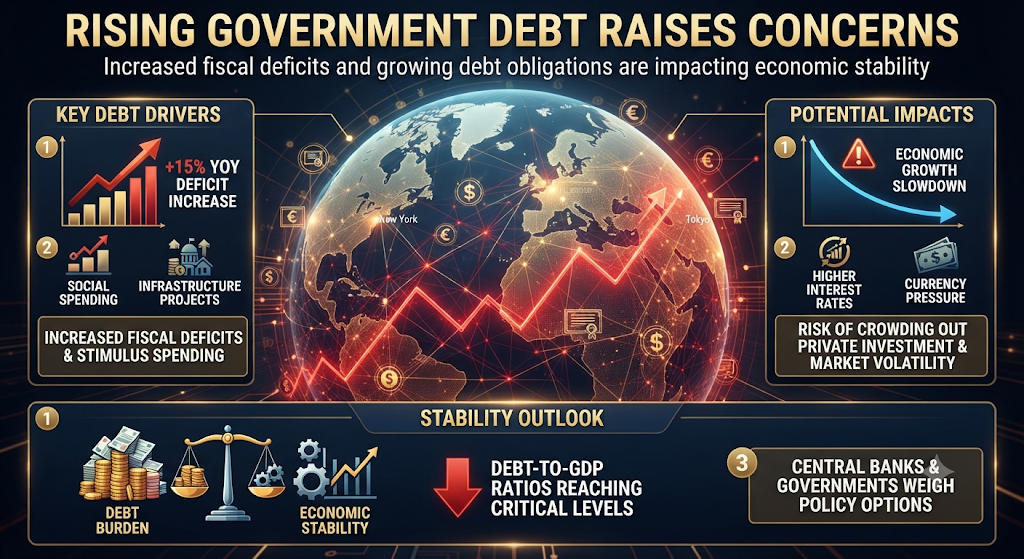
Government debt is emerging as one of the most significant challenges facing the global economy. Several major economies are experiencing rising borrowing costs, increasing fiscal pressures, and growing concerns about long-term financial stability. As governments continue to borrow to finance public spending, infrastructure development, social welfare programmes, and economic recovery initiatives, investors are becoming increasingly cautious about the sustainability of national debt levels.
The rise in sovereign bond yields has added another layer of complexity to the global financial environment. Higher yields indicate that governments must offer greater returns to attract investors, making borrowing more expensive and placing additional pressure on public finances. This situation is creating challenges for policymakers, businesses, financial institutions, and households across different economies.
Growing Government Debt: A Global Challenge
Government borrowing is not necessarily a negative economic development. Countries often rely on debt to finance infrastructure, healthcare, education, defence, and other essential public services. During economic downturns, borrowing can also help governments support businesses, protect employment, and stimulate economic activity.
However, concerns arise when debt increases faster than the economy’s ability to generate income and tax revenue. When governments consistently spend more than they collect, budget deficits expand, requiring additional borrowing to meet financial obligations.
Several major economies, including the United States, Japan, France, Italy, and the United Kingdom, face different combinations of high public debt, fiscal deficits, demographic pressures, and increasing interest expenses. These challenges are intensifying discussions about fiscal discipline and the long-term sustainability of government finances.
Rising Sovereign Yields Increase Borrowing Costs
One of the most visible consequences of growing government debt is the increase in sovereign bond yields. Government bonds are generally considered important benchmarks for financial markets because they influence borrowing costs across the economy.
When investors become concerned about a country’s fiscal position, inflation outlook, or ability to manage its debt, they may demand higher returns for holding its government bonds. This pushes bond yields upward and increases the cost of issuing new debt.
Higher sovereign yields can create a chain reaction throughout financial markets. Banks may face higher funding costs, companies may find it more expensive to raise capital, and households could experience increased interest rates on mortgages and other loans.
For businesses, expensive borrowing can discourage investment, delay expansion plans, and reduce hiring activity. For consumers, higher loan repayments can limit disposable income and weaken overall demand.
Consequently, rising government borrowing costs can gradually affect economic growth beyond the public sector.
Fiscal Pressures Leave Governments With Difficult Choices
Increasing debt-servicing costs are placing additional pressure on government budgets. As a larger share of public revenue is allocated towards interest payments, fewer resources remain available for infrastructure, education, healthcare, and other development priorities.
Governments are therefore facing difficult policy decisions. They must balance the need to maintain economic growth with the responsibility of controlling public expenditure and managing fiscal deficits.
Some countries may consider reducing non-essential spending, improving tax collection, introducing fiscal reforms, or restructuring existing expenditure programmes. However, aggressive spending cuts or higher taxation can also weaken economic activity, particularly when businesses and households are already facing financial pressures.
This creates a delicate balancing act for policymakers. Fiscal consolidation is important for maintaining investor confidence, but implementing it too quickly could affect employment, consumption, and economic growth.
Implications for Global Financial Markets
The growing debt burden is not limited to individual countries. In an interconnected global economy, changes in sovereign bond yields can influence international capital movements, currency valuations, equity markets, and investment decisions.
Higher yields in major economies, particularly the United States, can attract international capital towards government securities offering relatively attractive returns. This may put pressure on emerging-market currencies and make it more expensive for developing economies to borrow internationally.
Stock markets can also experience volatility as investors reassess company valuations in response to higher interest rates. When government bonds offer better returns, some investors may shift funds away from riskier assets, including equities.
Emerging economies are particularly vulnerable because many depend on foreign investment to finance infrastructure and development projects. Currency depreciation, higher external borrowing costs, and capital outflows can create additional challenges for their financial stability.
The Role of Central Banks and Fiscal Policymakers
Central banks play an important role in maintaining monetary and financial stability. However, rising government debt can complicate their responsibilities.
When inflation remains elevated, central banks may need to maintain relatively restrictive monetary policies. Higher interest rates can help control inflation, but they also increase government borrowing costs and may slow economic activity.
At the same time, central banks must preserve their independence and credibility. Monetary policy should remain focused on price stability and broader economic objectives rather than simply reducing the government’s interest expenses.
Effective coordination between fiscal and monetary authorities is therefore essential. Governments must demonstrate credible long-term fiscal strategies while central banks maintain transparent and predictable monetary policies.
What Lies Ahead?
The future direction of government debt will depend on economic growth, inflation, interest rates, fiscal reforms, and political decisions. Stronger economic growth can improve government revenue and make existing debt easier to manage. Conversely, weak growth combined with persistently high borrowing costs could worsen debt-to-GDP ratios.
Technology-driven productivity improvements, responsible public investment, better tax administration, and structural economic reforms could help governments strengthen their fiscal positions.
Investors will increasingly focus on countries that demonstrate transparent budgeting, credible debt-management strategies, and the ability to maintain sustainable public finances.
The Worldonomics Times View
Rising government debt should be viewed not merely as a financial statistic but as a long-term economic challenge that requires responsible leadership and strategic planning. Borrowing can support development and protect economies during difficult periods, but excessive dependence on debt can gradually restrict a government’s ability to respond to future crises.
The Worldonomics Times believes that fiscal responsibility must become a central priority for major economies. Governments should focus on productive investments that generate long-term economic returns rather than allowing borrowing to finance unsustainable expenditure.
At the same time, policymakers must avoid sudden and excessive austerity measures that could undermine growth and employment. A balanced approach combining disciplined spending, efficient taxation, structural reforms, and targeted public investment is essential.
The international financial system also requires greater cooperation, particularly to support emerging economies facing rising external borrowing costs.
Ultimately, government debt is manageable when economic growth, public revenue, and fiscal discipline move in the right direction. The real concern is not borrowing itself, but the inability to manage it sustainably. As sovereign yields rise and financial conditions tighten, governments must recognise that today’s fiscal decisions will shape tomorrow’s economic opportunities.
The message is clear: sustainable growth requires sustainable public finances.