Singapore’s largest lender posts net profit of S$2.81 billion for the July–September quarter, as a sharp fall in trading income offsets growth in lending and wealth management businesses.
SINGAPORE | 5 November 2026
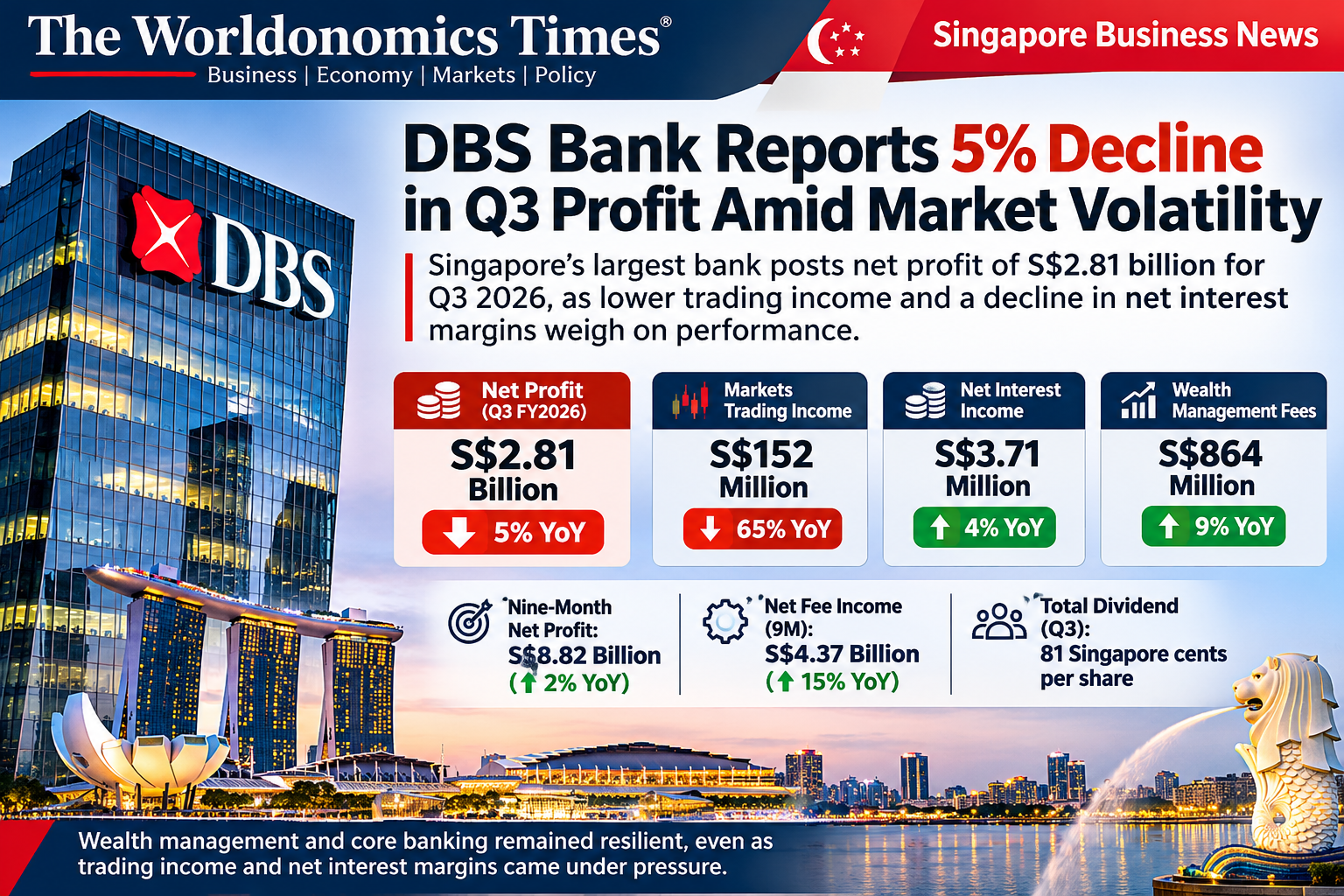
DBS Group Holdings, Singapore’s largest bank and one of Southeast Asia’s leading financial institutions, reported a 5% year-on-year decline in net profit for the third quarter of 2026, as unfavourable equity market conditions and weaker trading income weighed on its financial performance.
The bank recorded a net profit of S$2.81 billion for the quarter ended 30 September 2026, compared with S$2.95 billion in the corresponding period last year. The result also fell short of market expectations, reflecting the impact of volatility in global financial markets and changing interest rate conditions.
Despite the decline in quarterly profitability, DBS continued to demonstrate strength in its core banking operations, particularly in wealth management, lending and customer-related fee income.
Sharp Decline in Markets Trading Income
One of the major factors behind the decline in DBS’s quarterly earnings was the significant reduction in markets trading income.
The bank’s markets trading income fell 65% year-on-year to S$152 million, primarily due to unfavourable equity market conditions. The decline highlighted the challenges faced by financial institutions operating in an environment characterised by volatile asset prices, changing investor sentiment and uncertainty surrounding global economic conditions.
Total income for the third quarter stood at S$5.85 billion, down approximately 1% compared with the corresponding quarter last year.
Net interest income, however, increased 4% to S$3.71 billion, supported by proactive hedging strategies and growth in the bank’s balance sheet. This performance helped offset some of the pressure arising from lower benchmark interest rates.
The group’s net interest margin, an important indicator of banking profitability, declined by nine basis points to 1.87%.
Wealth Management Emerges as a Key Growth Driver
While trading-related income weakened, DBS’s wealth management business continued to deliver positive growth.
Wealth management fees increased 9% year-on-year to S$864 million, supported by higher assets under management and continued demand for investment and wealth-related financial services.
The bank’s net fee income rose 6% to S$1.43 billion. Growth was supported by wealth management activities, transaction services, loan-related fees and card-related income.
DBS also reported record net new money inflows, which contributed to a 5% increase in wealth segment assets under management to a new high of S$544 billion.
The performance demonstrates the growing importance of wealth management as a source of recurring fee income for major financial institutions, particularly in Asia, where demand for investment advisory, portfolio management and private banking services continues to provide opportunities.
Nine-Month Performance Remains Positive
Despite the weaker third-quarter results, DBS maintained positive growth in its overall financial performance during the first nine months of 2026.
For the nine months ended September 2026, the bank reported net profit of S$8.82 billion, representing a 2% increase over the corresponding period last year.
Total income increased 2% to a record S$17.9 billion, reflecting growth across several core business segments.
Net fee income recorded particularly strong growth, increasing 15% to S$4.37 billion. Wealth management fees rose 24% to a record S$2.69 billion during the nine-month period.
The bank’s return on equity stood at 17%, reflecting its continued ability to generate attractive returns despite a challenging interest rate and market environment.
Asset quality also remained resilient. The non-performing loan ratio improved to 0.9%, compared with 1% in the corresponding period last year.
Dividend Payout and Capital Position
DBS announced a total dividend of 81 Singapore cents per share for the third quarter of 2026.
The payout comprises an ordinary dividend of 66 Singapore cents per share and a capital return dividend of 15 Singapore cents per share.
The bank also maintained a healthy capital position, with its reported Common Equity Tier-1 capital ratio at 15.9% under transitional arrangements.
Strong capital adequacy and liquidity positions provide the bank with financial flexibility to manage economic uncertainty while continuing to support lending, investment and business expansion.
Management Cautions Against Global Economic Uncertainty
Commenting on the financial performance, DBS Chief Executive Officer Tan Su Shan highlighted the resilience of the bank’s core franchise, supported by growth in loans, deposits and wealth management assets.
However, management indicated that the global economic outlook had become more uncertain amid elevated energy prices, tighter financial conditions and geopolitical risks.
The bank expects continued structural growth opportunities in wealth management and a potentially more supportive interest rate environment to support its future earnings performance.
For 2027, DBS expects total income to grow in the mid-single-digit range, subject to its economic and interest rate assumptions.
The bank has indicated that it will continue to focus on capturing growth opportunities while maintaining prudent risk management.
Leadership Transition at DBS
Alongside its financial results, DBS announced a leadership change at the board level. Independent director Anthony Lim will become the bank’s Chairman with effect from 1 January 2027, succeeding Peter Seah, who is stepping down after 16 years in the role.
The transition comes at a significant time for the bank as it continues to strengthen its position in regional banking, digital financial services and wealth management.
Outlook: Balancing Growth with Market Risks
DBS’s third-quarter performance reflects a broader challenge facing international banking institutions: maintaining profitability when trading conditions become volatile and interest rate movements put pressure on traditional banking margins.
Although lower trading income affected quarterly earnings, the bank’s wealth management business, lending growth and fee-based services continued to provide important support.
For investors and financial market participants, the coming quarters will be important in assessing whether growth in wealth management and core banking operations can compensate for fluctuations in markets-related income.
DBS’s performance also highlights the increasing significance of diversified revenue streams in the banking industry. As global financial markets continue to evolve, institutions with strong capital positions, diversified operations and resilient customer franchises may be better positioned to navigate economic uncertainty.
The Worldonomics Times | International Business News
Source: DBS Group Holdings – Third Quarter 2026 Financial Results.