Introduction
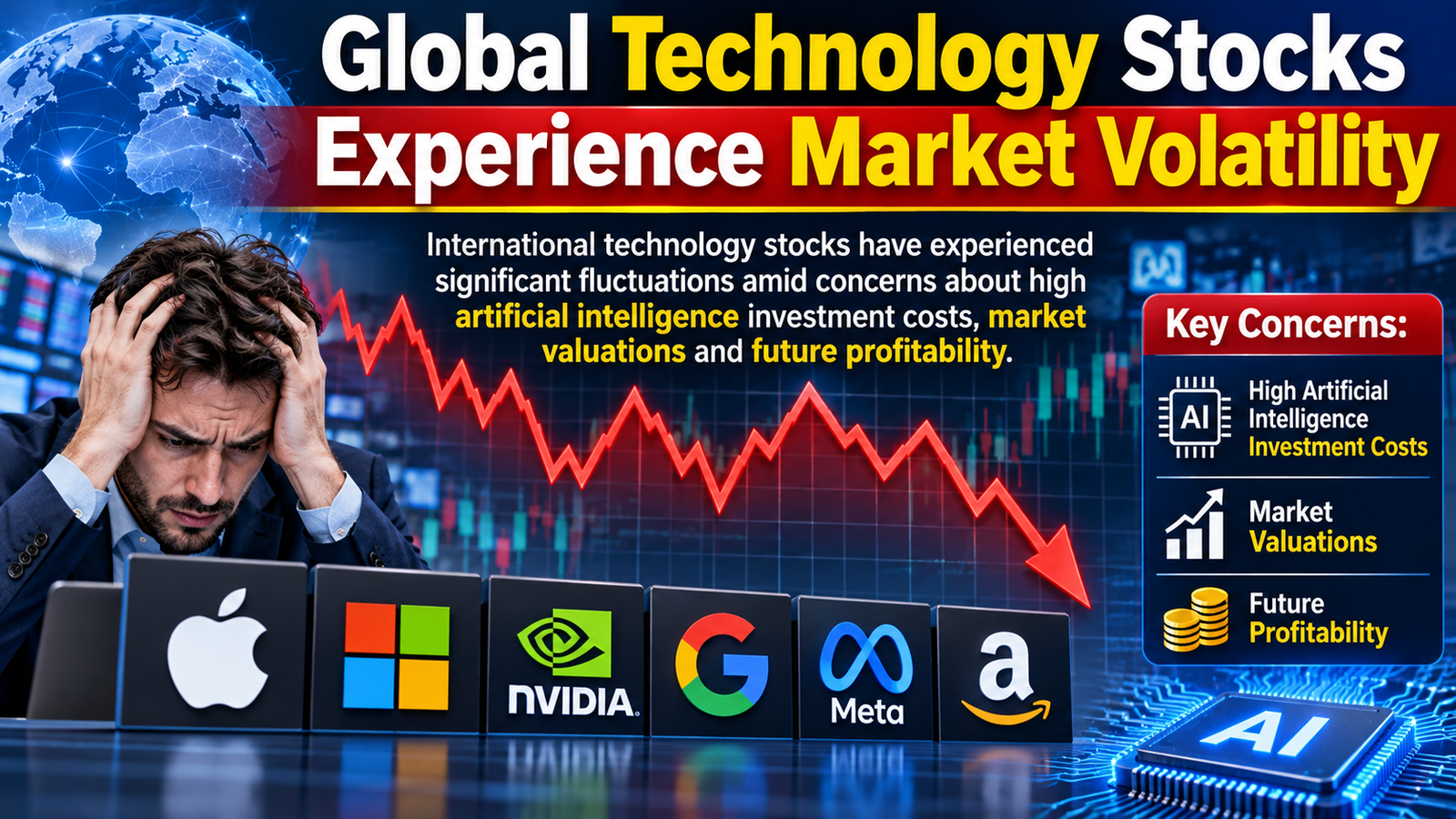
Global technology markets are experiencing significant volatility as investors reassess the financial prospects of the artificial intelligence (AI) industry. After a prolonged period of strong gains driven by expectations of rapid AI adoption, technology stocks have come under renewed selling pressure.
The recent market fluctuations reflect growing concerns about the enormous investments required to develop AI infrastructure, the high valuations of leading technology companies and uncertainty surrounding future profitability.
Although demand for AI services, advanced semiconductors and data-centre infrastructure remains substantial, investors are increasingly questioning whether the revenue generated by these investments will be sufficient to justify their costs.
The developments highlight a changing investment environment in which market participants are paying closer attention to cash flow, debt levels and sustainable earnings growth rather than relying entirely on expectations of future technological expansion.
Technology Stocks Face Renewed Selling Pressure
Technology shares have experienced sharp declines across international markets, particularly in the United States, where major technology companies account for a significant share of leading stock-market indices.
On November 5, 2026, the Nasdaq Composite fell nearly 4%, moving more than 10% below its October 6 record closing level and entering correction territory. The semiconductor index also experienced a particularly severe decline, briefly falling as much as 11% during the trading session.
The pressure continued into November. On November 10, the Nasdaq declined another 1%, while semiconductor giant Nvidia fell approximately 6.5%. The company was on track to lose more than $470 billion in market value over two sessions.
These movements demonstrate how quickly investor sentiment can change when concerns emerge about the financial sustainability of the AI investment boom.
Rising AI Investment Costs Create Profitability Concerns
One of the biggest reasons behind the market volatility is the extraordinary amount of capital being committed to AI development.
Major technology companies are investing heavily in data centres, advanced processors, cloud computing infrastructure, networking equipment and specialised software.
According to Reuters reporting in November, combined spending on AI-related infrastructure and development was expected to exceed $730 billion in 2026.
While these investments could create substantial long-term business opportunities, they also require companies to manage enormous capital expenditure.
Building and operating data centres involves significant expenses, including electricity, cooling systems, land, construction, semiconductor equipment and maintenance.
Investors are increasingly concerned that some companies may struggle to generate sufficient revenue to recover these costs within a reasonable period.
Another important issue is financing. Several large technology companies are increasingly relying on debt and other external funding sources to support their expansion plans. Higher borrowing costs and increased financial commitments can put additional pressure on future profitability.
High Market Valuations Increase Investment Risks
Another factor contributing to the volatility is the high valuation of several technology and semiconductor companies.
During the AI investment boom, investors assigned substantial premiums to companies expected to benefit from increasing demand for advanced computing and digital infrastructure.
However, high valuations create greater expectations for future business performance. Companies must deliver strong revenue growth and earnings to justify the prices investors are willing to pay.
Even when a company reports positive financial results, its share price may decline if investors believe that future growth will be slower than previously expected.
This has become an important concern across the technology sector. Investors are increasingly distinguishing between companies with proven AI-related revenue streams and businesses whose valuations depend largely on future expectations.
The changing market environment is encouraging investors to examine financial fundamentals more carefully, including operating margins, free cash flow, capital expenditure and debt obligations.
Semiconductor and Data-Centre Companies Under Pressure
The semiconductor industry has been particularly affected by changing investor sentiment.
Companies producing advanced processors, memory chips and networking equipment have benefited significantly from the expansion of AI infrastructure. However, their shares are also exposed to concerns about investment cycles and future demand.
Data-centre operators and infrastructure providers face similar challenges. Their business prospects depend heavily on continued investment by large cloud computing companies and technology platforms.
If major technology companies slow their infrastructure expansion, demand for specialised chips, cooling systems, networking equipment and data-centre services could grow more slowly than expected.
However, this does not necessarily indicate that the AI industry is losing its long-term potential. Rather, investors are questioning the pace of investment, the availability of financing and the time required to convert technological demand into sustainable profits.
Global Financial Markets Feel the Impact
The technology sector’s influence on global stock markets means that significant movements in major technology shares can affect broader investment sentiment.
When highly valued companies experience sharp declines, investors may reduce exposure to other growth-oriented assets and move towards sectors considered comparatively defensive.
The recent technology sell-off has also encouraged greater attention towards consumer staples, utilities and other businesses with more predictable earnings.
International markets are particularly sensitive because technology companies and semiconductor manufacturers operate through interconnected global supply chains.
Major semiconductor producers in the United States, Taiwan, South Korea and Japan are closely linked to international demand for computing equipment and electronic products.
Consequently, changes in investment expectations in one major market can influence technology shares across several countries.
Implications for India
Global technology market volatility has important implications for India, particularly because the country has a growing information technology services industry and increasing ambitions in semiconductor manufacturing.
Indian IT companies provide software development, cloud computing, consulting, business-process services and digital transformation solutions to international clients.
If global technology companies reduce spending or delay projects, Indian IT service providers could face pressure on new contracts and technology-related investment.
However, the changing environment may also create opportunities. Businesses increasingly seeking cost efficiency, automation and productivity improvements could continue investing in selected digital services.
India’s semiconductor ambitions could also benefit from long-term global efforts to diversify supply chains. However, international investment uncertainty may influence the pace of new projects and funding decisions.
For Indian investors, fluctuations in global technology shares can affect market sentiment and foreign investment flows. Careful evaluation of company earnings, valuations and business fundamentals therefore remains important.
The Road Ahead: Can AI Investment Deliver Sustainable Returns?
The future performance of technology stocks will largely depend on the ability of companies to demonstrate measurable financial benefits from their AI investments.
Investors will closely monitor upcoming earnings announcements, capital expenditure plans, operating cash flows and demand for AI-related services.
Companies that successfully convert AI investment into recurring revenue, improved productivity and sustainable profit margins may remain attractive over the long term.
On the other hand, businesses with excessive financial commitments and uncertain revenue models could face continued valuation pressure.
The market will also monitor interest rates, financing conditions and government policies affecting data-centre development.
The Worldonomics Times Views
The recent volatility in global technology stocks highlights an important transition in the AI investment cycle. The market is moving beyond initial excitement about technological possibilities and demanding stronger evidence of financial returns.
Artificial intelligence has considerable potential to transform industries, improve productivity and create new business opportunities. However, technological progress does not automatically guarantee investment profitability.
Technology companies must demonstrate that their capital expenditure can generate sustainable revenue, healthy cash flows and long-term shareholder value. Investors should also avoid evaluating businesses solely on expectations surrounding future technological growth.
For India, the situation presents both challenges and opportunities. The country should continue strengthening its IT services sector, semiconductor ecosystem and digital infrastructure while encouraging investment based on sustainable business models.
Ultimately, market volatility should not be interpreted as the end of the AI growth story. Instead, it represents a period of financial reassessment in which realistic valuations, responsible investment and measurable profitability will become increasingly important.