Introduction
The United Kingdom is facing renewed inflationary pressure, placing the Bank of England (BoE) under increasing pressure to maintain tighter monetary policy. Rising energy costs, persistent price increases and uncertainty surrounding international developments have complicated the central bank’s efforts to bring inflation back towards its 2% target.
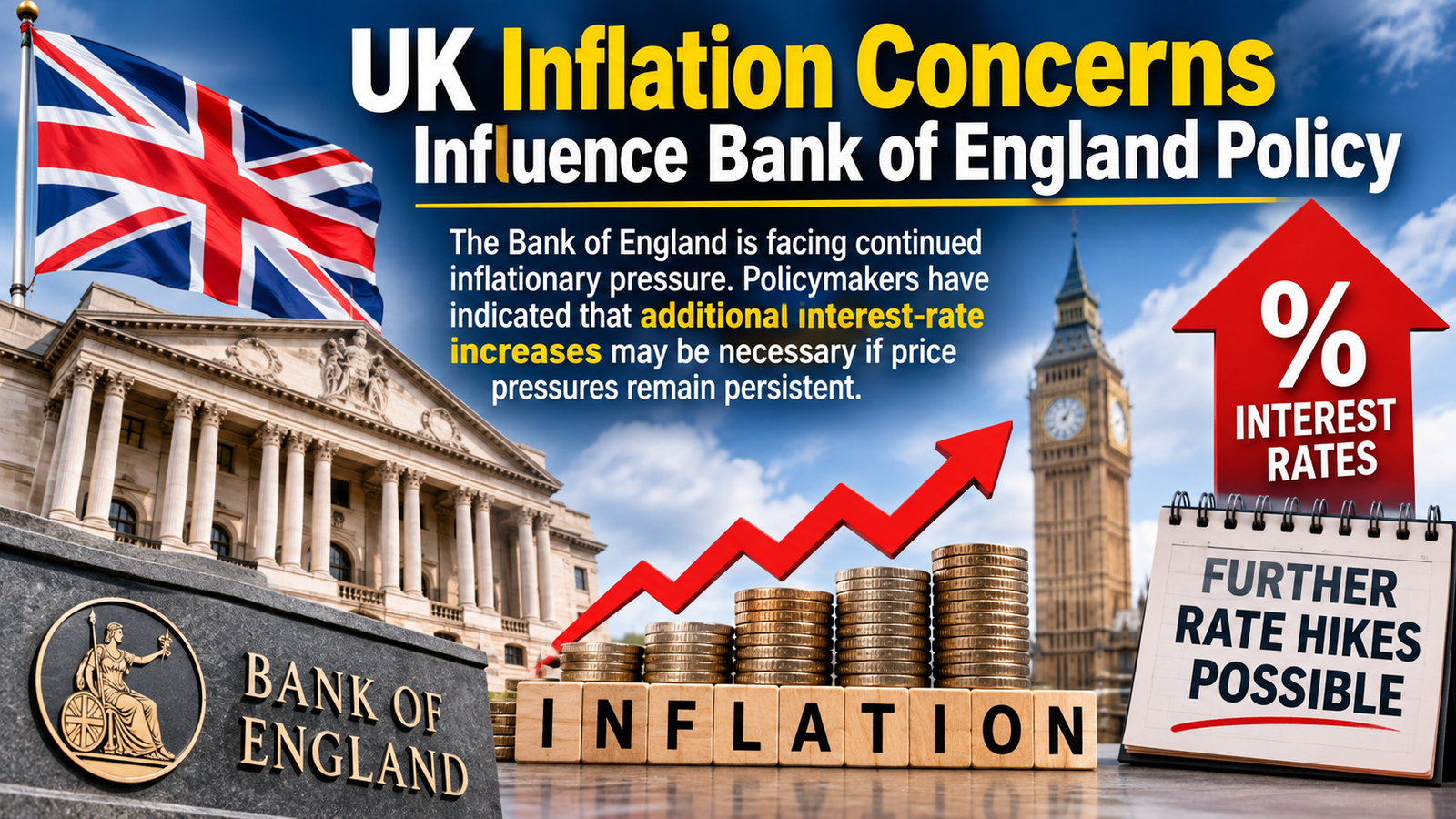
The situation has become more challenging following the Bank of England’s decision on November 5, 2026, to increase its key interest rate for the first time in more than three years. Policymakers have also indicated that further increases may be necessary if inflationary pressures remain persistent.
The decision highlights the difficult balance facing the central bank: controlling inflation while avoiding excessive pressure on households, businesses and the wider British economy.
UK Inflation Remains Above the Bank of England’s Target
According to the latest figures from the Office for National Statistics (ONS), UK consumer price inflation increased to 3.5% in September 2026, compared with 3.1% in August. This was the highest annual rate since October 2025.
Higher transport costs, particularly petrol and diesel prices, contributed significantly to the increase. Rising energy prices have also created concerns about further increases in household and business expenses.
Core inflation, which excludes energy, food, alcohol and tobacco, increased to 2.8% in September from 2.6% in August. This suggests that price pressures are not limited entirely to volatile energy markets.
The Bank of England has warned that inflation could rise further, potentially reaching 4.8% in the second quarter of 2027 under its central forecast. This would be considerably above its 2% inflation target.
Bank of England Raises Interest Rates to 4%
In response to growing inflation concerns, the Bank of England raised its benchmark interest rate from 3.75% to 4% on November 5, 2026. This was its first rate increase since August 2023.
The Monetary Policy Committee voted 8–1 in favour of the increase, although one member supported a larger rise to 4.25%. The decision reflected growing concern that higher energy prices could continue influencing inflation in the months ahead.
Governor Andrew Bailey indicated that another increase could be necessary if the conflict in the Middle East continues to affect energy markets. However, he also stressed that further increases should not be considered automatic.
The Bank’s message reflects a cautious approach: policymakers are prepared to tighten monetary policy further, but future decisions will depend on economic data and the development of inflationary risks.
Rising Energy Costs Create Additional Inflation Risks
Energy prices have become a major concern for the UK economy. International geopolitical tensions and uncertainty surrounding oil and gas supplies have contributed to higher energy costs.
The impact can extend beyond household electricity and heating bills. Businesses that depend on transportation, manufacturing, logistics and energy-intensive production may also face increased operating expenses.
Companies could respond by raising the prices of goods and services, potentially spreading inflationary pressure across the economy.
Another concern is the delayed effect of energy prices on household bills. Changes in wholesale energy costs can take time to appear in regulated consumer tariffs, meaning households may continue experiencing higher expenses even after international prices begin to stabilise.
The Bank of England is therefore monitoring not only current inflation but also the possibility that higher costs could become embedded in future prices and wage demands.
Impact on Households and Businesses
Higher interest rates can help reduce inflation by making borrowing more expensive and encouraging saving. However, they also create financial challenges for households and businesses.
Homeowners with variable-rate mortgages and households approaching the end of fixed-rate agreements may face higher monthly repayments. Consumers may also find personal loans, vehicle finance and credit more expensive.
As household budgets become tighter, spending on non-essential goods and services could decline. This may affect retailers, restaurants, travel companies and other consumer-focused businesses.
Businesses face similar pressures. Higher borrowing costs can discourage investment, delay expansion plans and increase the expense of maintaining working capital.
Small and medium-sized enterprises may be particularly vulnerable because they often have fewer financial resources to absorb higher financing and operating costs.
The central bank must therefore consider the possibility that excessive monetary tightening could weaken economic activity.
Implications for the UK Economy and Global Markets
The Bank of England’s decision is significant for international financial markets because the UK remains an important global financial centre.
Higher British interest rates can influence the value of sterling, government bond yields and international investment decisions. Investors may become more interested in UK assets if they offer comparatively attractive returns.
However, rising interest rates can also increase government borrowing costs and place pressure on financial markets.
The situation is particularly important because other major central banks are also dealing with inflation risks. Differences in monetary policy between the United Kingdom, United States and European economies can influence currency movements and international capital flows.
For emerging markets, changing global interest-rate expectations may affect investment flows, exchange rates and the cost of overseas borrowing.
What It Means for India
Developments in the UK economy can have implications for India through trade, investment and financial-market connections.
The United Kingdom is an important economic partner for India, with business relationships spanning financial services, pharmaceuticals, information technology, manufacturing and professional services.
If higher British interest rates slow consumer demand and business investment, Indian exporters operating in the UK market could experience weaker demand for certain products and services.
Currency movements may also influence trade and investment decisions. Changes in the value of sterling can affect the cost of Indian exports, imports and financial transactions involving the UK.
At the same time, Indian businesses with operations or investments in Britain may need to reassess borrowing costs and expansion plans.
The Reserve Bank of India will also continue monitoring international financial conditions when evaluating domestic inflation, currency stability and monetary policy.
The Road Ahead: Will More Rate Hikes Be Necessary?
The future direction of Bank of England policy will depend heavily on energy prices, wage growth, inflation expectations and economic activity.
If energy costs remain elevated and inflation continues moving further away from the 2% target, policymakers may consider additional increases.
However, a prolonged period of higher borrowing costs could weaken household consumption, business investment and employment.
Recent recruitment-sector survey findings indicate that permanent hiring declined in October, even as starting salaries increased. This combination highlights the difficulty of controlling inflation without creating additional pressure on the labour market.
The Bank of England will therefore need to assess incoming economic information carefully before making further decisions.
The Worldonomics Times Views
The United Kingdom’s renewed inflation challenge demonstrates how international energy-market developments can influence domestic monetary policy. The Bank of England’s decision to raise interest rates to 4% reflects its determination to prevent inflation from becoming more persistent.
However, higher interest rates are not without consequences. Households face increased borrowing costs, businesses may delay investment and the wider economy could experience slower growth.
Policymakers should maintain a balanced approach, responding firmly to persistent inflation while avoiding unnecessary pressure on economic activity. Greater attention should also be given to energy-market stability, productivity improvements and measures that strengthen long-term economic resilience.
For India and other emerging economies, developments in British monetary policy offer an important reminder that global inflation and interest-rate movements remain closely interconnected.
Ultimately, the success of the Bank of England’s strategy will depend on its ability to restore price stability without undermining economic confidence. The coming months will be crucial in determining whether the recent rate increase is sufficient or whether further monetary tightening becomes necessary.