Introduction
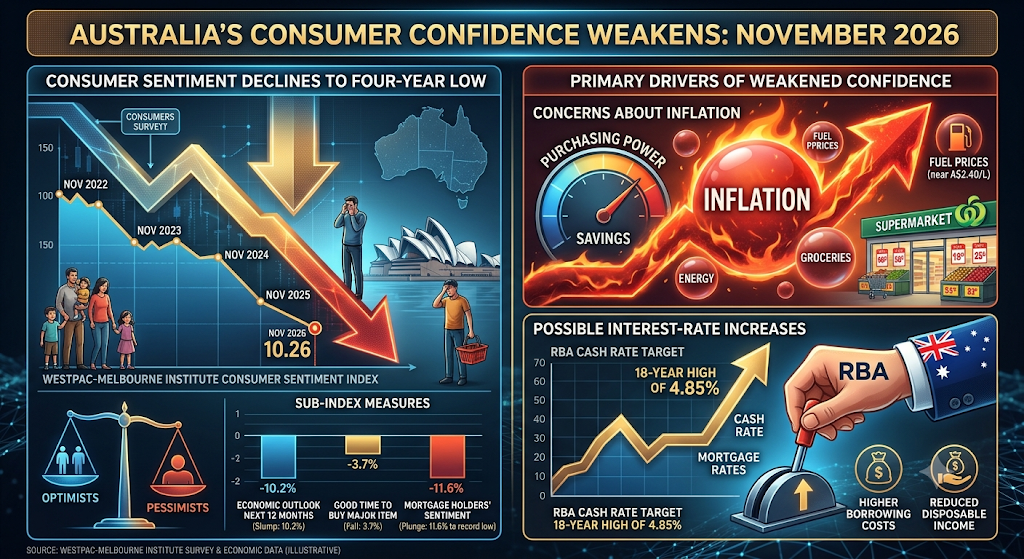
Australia’s consumer confidence has fallen to its weakest level in four years, highlighting growing financial pressure on households as inflation and interest rates remain major economic concerns. The latest Westpac–Melbourne Institute Consumer Sentiment Index declined by 2.7% to 78.2 in November 2026, following significant falls in September and October.
The continued deterioration suggests that Australian consumers are becoming increasingly cautious about their financial circumstances and the country’s economic outlook. Higher mortgage repayments, rising fuel prices and persistent cost-of-living pressures are influencing household decisions, creating challenges for retailers, businesses and policymakers.
Consumer Sentiment Falls to a Four-Year Low
The November survey recorded the third consecutive monthly decline in consumer sentiment. The index dropped from 80.4 in October to 78.2 in November, leaving it almost 25% below its level a year earlier.
A reading below 100 indicates that pessimists outnumber optimists. Australia’s latest result therefore reflects widespread concern about household finances and future economic conditions.
One of the most significant developments was the deterioration in expectations for the national economy. The survey’s measure of the economic outlook over the next 12 months fell by 10.2%, indicating that consumers have become substantially less optimistic about near-term economic performance.
The results suggest that households are increasingly concerned about the combined effects of higher borrowing costs, inflation and uncertainty surrounding future employment and income growth.
Inflation and Living Costs Put Pressure on Households
Rising living expenses remain a major factor behind Australia’s weakening consumer confidence. Higher fuel prices, housing expenses, groceries and essential services have placed additional pressure on household budgets.
According to the Australian Bureau of Statistics, headline inflation reached 4.3% annually in September 2026, while underlying inflation also remained elevated. These figures indicate that inflationary pressure extends beyond individual products and continues to affect a broad range of household expenses.
When essential costs increase faster than household incomes, consumers have less money available for discretionary purchases. Families may postpone buying electronics, furniture, vehicles and other expensive products while prioritising essential spending.
This behaviour can affect retailers and consumer-facing businesses, particularly during important shopping periods such as the Christmas season.
Interest-Rate Concerns Increase Financial Uncertainty
Interest rates have become another important source of pressure for Australian households. The Reserve Bank of Australia raised its cash rate by 25 basis points to 4.85% in November 2026, marking its fifth increase of the year and taking borrowing costs to their highest level in 18 years.
Higher interest rates increase repayment obligations for households with variable-rate mortgages and can make new borrowing more expensive. Consumers may consequently reduce spending or delay major financial decisions.
The Westpac–Melbourne Institute survey found that 72% of consumers interviewed after the latest RBA decision expected mortgage rates to increase further over the following 12 months.
The impact has been particularly severe among mortgage holders. Their consumer sentiment measure fell 11.6% in November to 68.1, its lowest level in the survey’s records dating back to 1994.
These developments demonstrate how monetary policy decisions can influence household confidence beyond their immediate effect on borrowing costs.
Retail Spending and Consumer Demand Face Challenges
Weak consumer confidence can create difficulties for Australia’s retail and services industries. When households become uncertain about future income and expenses, they often reduce non-essential purchases and adopt more cautious spending habits.
Retailers may experience weaker demand for clothing, furniture, electronics, household appliances and other discretionary products. Businesses could respond by offering discounts, reducing inventory purchases or postponing expansion plans.
The survey also found that 38% of consumers planned to spend less on Christmas gifts than in the previous year, while 46% expected to spend approximately the same amount.
However, weak confidence does not automatically translate into an immediate contraction in consumer spending. The Reserve Bank of Australia has noted that household consumption growth has moderated, but household balance sheets and real income conditions have provided some support.
Nevertheless, prolonged pessimism could make consumers more cautious and gradually weaken demand across the wider economy.
Employment Concerns Add to Economic Uncertainty
Consumer confidence is also influenced by expectations about employment and income security. Although the November survey did not indicate widespread alarm over job losses, unemployment expectations have gradually increased.
The Reserve Bank of Australia reported that the unemployment rate reached 4.6% in the September quarter. While employment growth has remained relatively resilient, slower economic activity and persistent business cost pressures could influence future hiring decisions.
If companies become less confident about sales and investment, they may reduce recruitment or delay expansion. This could further affect household confidence, particularly among workers concerned about job security.
A combination of slower employment growth, higher borrowing costs and elevated living expenses could create additional pressure on household consumption in the coming months.
Implications for Australia’s Economic Outlook
Australia’s economy relies significantly on domestic consumption, making household confidence an important indicator of economic momentum.
If consumers continue to reduce discretionary spending, businesses may face weaker revenue growth, potentially affecting investment, employment and overall economic activity.
Policymakers face a difficult balancing act. The Reserve Bank must address persistent inflation without placing excessive pressure on households and businesses. At the same time, the government must consider how targeted cost-of-living support can protect vulnerable households without adding unnecessary inflationary pressure.
The coming months will be important in determining whether consumer sentiment stabilises or deteriorates further. Inflation trends, interest-rate expectations, employment conditions and household income growth will all influence the direction of consumer demand.
Implications for India and the Global Economy
Australia’s weakening consumer confidence also has implications for international trade and business relationships. India and Australia maintain commercial ties across education, pharmaceuticals, information technology, engineering, agriculture and services.
If Australian households become more cautious, demand for certain imported consumer products and services could weaken. Indian exporters and businesses operating in the Australian market may therefore need to monitor changes in purchasing behaviour.
However, opportunities remain in areas such as technology services, education, healthcare and essential products, where demand may be less sensitive to short-term changes in consumer confidence.
More broadly, Australia’s experience highlights the challenges facing advanced economies as inflation and higher borrowing costs influence household financial decisions. Similar pressures can affect consumer demand, business confidence and economic growth in other markets.
The Worldonomics Times Views
Australia’s consumer confidence decline to a four-year low is an important warning sign for the country’s economic outlook. The November reading of 78.2 reflects growing household anxiety about inflation, mortgage repayments and the possibility of further interest-rate increases.
Although the decline in sentiment does not necessarily mean that consumer spending will fall immediately, prolonged pessimism could weaken retail demand and create challenges for businesses across the economy.
Policymakers should focus on restoring price stability while protecting household financial resilience. Improving productivity, supporting employment and maintaining sustainable economic policies will be essential for strengthening consumer confidence.
For Australia, the central challenge is to manage inflation without undermining domestic demand. The direction of household confidence in the coming months will provide an important indication of whether the economy can maintain stable growth amid continuing financial pressures.