Introduction
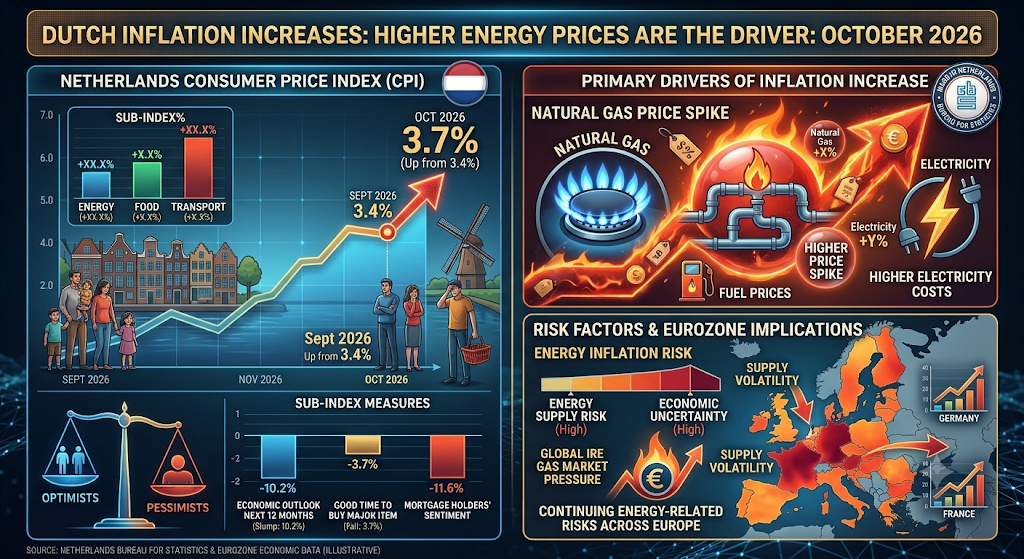
The Netherlands recorded an increase in consumer inflation in October 2026, highlighting the continuing influence of energy prices on Europe’s economic outlook. According to Statistics Netherlands (CBS), annual inflation reached 3.7% in October, compared with 3.4% in September. The increase was primarily driven by higher energy costs, particularly natural gas, which has become a significant contributor to household expenses.
The latest figures underline the challenges facing European policymakers as they attempt to maintain price stability while supporting economic growth. Although inflation in the Netherlands remains below the eurozone average under the harmonised measure, rising energy prices could create additional pressure on consumers, businesses and monetary policy.
Natural Gas Prices Drive Inflation Higher
Natural gas played a major role in the October inflation increase. CBS reported that natural gas prices were 11.7% higher than a year earlier, compared with an annual increase of 7.4% in September.
Higher gas prices can affect households directly through heating and energy bills. They can also influence businesses that depend on natural gas for manufacturing, food processing, transportation-related operations and other industrial activities.
The impact may extend beyond the energy sector. When companies face higher electricity, heating and production expenses, they may increase the prices of goods and services to protect their profit margins. This can gradually spread energy-related inflation across the wider economy.
The Netherlands is particularly exposed to developments in European energy markets because natural gas remains an important component of its energy system. Changes in wholesale prices and supply conditions can therefore influence domestic consumer costs.
Inflation Rises Across Consumer Categories
The October figures indicate that energy was not the only factor influencing Dutch inflation. Food prices also contributed to the increase because their annual decline became smaller.
Food prices were 1.1% lower in October than a year earlier, compared with a decline of 1.7% in September. Although food prices continued to fall on an annual basis, the slower decline provided less downward pressure on the overall inflation rate.
Housing and utilities remained an important contributor to inflation, accounting for 1.14 percentage points of the annual CPI increase in October, compared with 1.03 percentage points in September. Transport contributed 1.04 percentage points, slightly above September’s 1.02 percentage points.
Overall consumer prices increased by 0.7% between September and October. CBS noted that this monthly increase was greater than the average October increase recorded over the previous ten years.
These figures demonstrate how energy, housing and transportation expenses can influence the cost of living even when some product categories experience falling prices.
Household Budgets Face Renewed Pressure
Higher energy costs can reduce the purchasing power of Dutch households. When families spend more on natural gas, electricity and transportation, they have less disposable income available for other purchases.
This can influence spending decisions across retail, hospitality, tourism and consumer services. Households may postpone major purchases, reduce leisure spending or become more cautious about discretionary expenses.
Lower-income households can be particularly vulnerable because essential expenses generally account for a larger share of their monthly budgets. For these families, even a moderate increase in energy bills can create financial difficulties.
If energy prices remain elevated, household consumption could weaken, potentially affecting businesses that depend on domestic demand. The resulting slowdown in spending could become an additional challenge for the Dutch economy.
European Inflation Concerns Become More Significant
The Dutch inflation figures also reflect a broader development across the eurozone. According to the harmonised consumer price index (HICP), inflation in the Netherlands increased from 3.0% in September to 3.3% in October. Across the eurozone, the corresponding rate rose from 3.8% to 4.0%.
Energy inflation was particularly significant. Under the HICP measure, energy prices, including motor fuels, increased by 14.5% annually in the Netherlands and 20.8% across the eurozone.
This difference indicates that energy-related inflationary pressures were even stronger across the wider currency bloc.
Higher energy prices can create challenges for European economies with substantial manufacturing and transportation sectors. Countries that rely heavily on imported energy may face additional pressure on production costs, trade balances and household purchasing power.
The Dutch experience therefore provides an indication of how international energy-market developments can influence inflation across different European economies.
European Central Bank Faces a Policy Challenge
Rising energy prices complicate the monetary policy outlook for the European Central Bank (ECB). The central bank must determine whether higher energy costs are temporary or likely to spread into wages, services and other consumer prices.
Energy-driven inflation can be difficult to manage through interest-rate adjustments alone. Higher borrowing costs cannot directly reduce international natural-gas prices, but monetary tightening can help prevent temporary price increases from becoming embedded in broader inflation expectations.
The ECB must therefore balance the risk of persistent inflation against the possibility that higher interest rates could weaken investment, household borrowing and economic activity.
The October eurozone inflation increase to 4.0% makes this balance particularly important. Policymakers will need to monitor energy prices, underlying inflation and wage developments before determining the appropriate direction of monetary policy.
Energy Security and the Long-Term Economic Outlook
The latest inflation figures have renewed attention on Europe’s energy security. Greater diversification of energy supplies, improved storage facilities and investment in renewable energy could help reduce the region’s exposure to international fuel-price volatility.
Expanding wind and solar generation, strengthening electricity networks and improving energy efficiency can gradually reduce dependence on imported fossil fuels.
However, the transition requires substantial investment and careful planning. European governments must ensure that energy remains reliable and affordable while supporting the shift towards cleaner sources.
For the Netherlands, maintaining stable energy supplies will be important for protecting households and preserving the competitiveness of energy-intensive businesses.
Implications for India and the Global Economy
Developments in European energy markets are relevant to India because international fuel prices influence the cost of imports, transportation and industrial production.
As a major importer of crude oil and other energy resources, India remains sensitive to global energy-market volatility. Sustained increases in fuel prices could add to domestic inflationary pressure and increase operating costs for manufacturers and logistics companies.
European inflation can also influence demand for Indian exports. If higher living expenses reduce consumer spending in the Netherlands and other European countries, Indian businesses supplying textiles, pharmaceuticals, engineering goods and consumer products may face weaker demand.
At the same time, Europe’s investment in renewable energy and energy infrastructure could create opportunities for Indian manufacturers and technology providers involved in solar equipment, batteries, engineering and clean-energy solutions.
The Worldonomics Times Views
The Netherlands’ increase in inflation to 3.7% demonstrates that energy prices remain an important source of economic uncertainty in Europe. The 11.7% annual increase in natural-gas prices highlights the vulnerability of household budgets and business operations to changes in energy markets.
Although the latest figures do not necessarily indicate a prolonged inflation surge, they underline the importance of monitoring energy costs and their wider economic effects.
European policymakers should prioritise energy diversification, infrastructure investment and targeted assistance for households most affected by rising utility expenses. The ECB, meanwhile, must carefully assess whether energy-related price increases are spreading into the broader economy.
For India and other trading partners, developments in European inflation will remain relevant to export demand, investment and international energy prices. The Netherlands’ latest figures offer a reminder that affordable and reliable energy is not simply an environmental or industrial objective; it is also essential for economic stability and sustainable growth.