Introduction
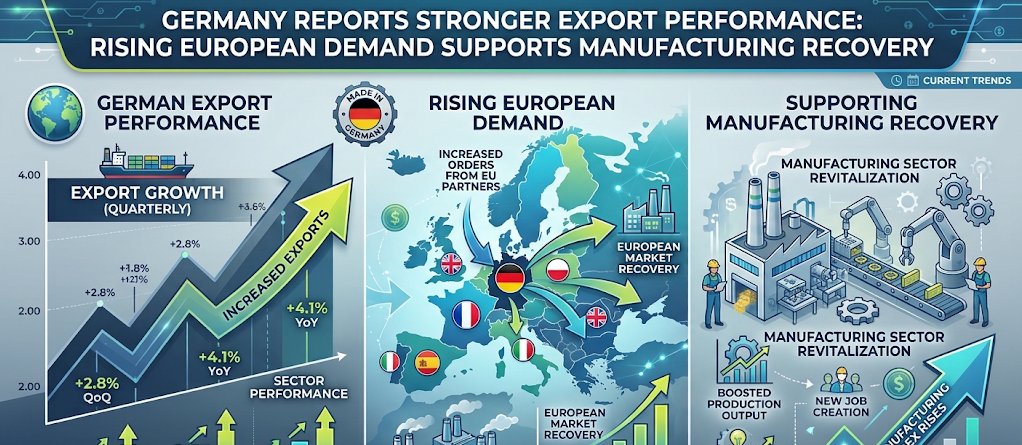
Germany’s export sector delivered a stronger-than-expected performance in September 2026, offering some encouragement to Europe’s largest manufacturing economy after a period of uneven industrial activity. According to preliminary data released by Germany’s Federal Statistical Office (Destatis) on November 9, exports increased by 2.0% compared with August, reaching €141.1 billion. The expansion exceeded market expectations of approximately 0.5% and reversed two consecutive months of decline.
The improvement was largely supported by stronger demand from other European Union countries. Although the figures provide a positive signal for Germany’s trade-dependent economy, rising imports and continued weakness in some major international markets indicate that the recovery remains uneven.
Exports Rebound Beyond Market Expectations
The September export performance marked Germany’s strongest monthly increase since February 2026. On a year-on-year basis, exports were 7.7% higher than in September 2025, indicating an improvement in the value of goods shipped overseas.
The rebound is significant because Germany’s manufacturing sector has faced considerable challenges, including elevated production costs, international competition and uncertainty surrounding global trade policies.
Stronger exports can support industrial production by encouraging manufacturers to increase output, manage inventories and maintain employment. They can also improve business confidence and create opportunities for investment in machinery, technology and production facilities.
However, the latest figures represent preliminary trade statistics and do not necessarily indicate a broad-based recovery across every manufacturing industry.
European Union Demand Drives Export Growth
Demand from European trading partners played a central role in September’s improvement. German exports to other EU member states increased by 3.5% month-on-month, reaching €80.8 billion.
Shipments to euro-area countries rose by 2.4% to €55.8 billion, while exports to EU countries outside the euro area increased by 6.1% to €25 billion.
The figures demonstrate the importance of regional trade relationships for Germany’s export-oriented economy. European markets remain important destinations for German automobiles, industrial machinery, chemicals, pharmaceuticals and other manufactured products.
Stronger demand within the European Union can provide support when overseas markets experience uncertainty. It also highlights the importance of economic conditions across the wider European region, where consumer demand, industrial investment and business confidence influence Germany’s manufacturing performance.
Trade with Major Global Markets Remains Uneven
Despite the overall improvement, Germany’s export performance across major international markets showed mixed results.
Exports to the United States, Germany’s largest individual country destination for goods, declined by 0.5% compared with August, reaching €13.4 billion. Shipments to China fell by 5.2% to €5.5 billion, while exports to the United Kingdom declined by 4.7% to €7.3 billion.
These developments underline the challenges facing German manufacturers in important overseas markets. Competition from Chinese producers has intensified across several industrial sectors, while uncertainty surrounding international trade policies and tariffs can influence purchasing decisions and business investment.
The decline in shipments to China is particularly relevant because the country has traditionally been an important market for German automobiles, machinery and industrial equipment. Maintaining competitiveness in this market will remain an important priority for German exporters.
Rising Imports Narrow Germany’s Trade Surplus
Germany’s imports increased more rapidly than exports in September. Imports rose by 4.2% month-on-month to €125.5 billion, compared with the 2.0% increase in exports.
As a result, Germany recorded a seasonally and calendar-adjusted trade surplus of €15.6 billion, down from €17.9 billion in August.
The increase in imports can reflect stronger domestic demand, higher purchases of intermediate goods and the requirements of industrial production. Imported components, raw materials and energy resources are important inputs for Germany’s manufacturing industries.
A narrower trade surplus is therefore not necessarily a negative development on its own. However, the faster increase in imports means that net trade provided a smaller surplus than in the previous month.
The relationship between imports and exports will remain important in assessing whether Germany’s economic recovery is being supported by stronger domestic activity as well as international demand.
Manufacturing Sector Looks for Sustainable Recovery
Germany’s manufacturing industry remains central to its economic performance. The country has a strong industrial base, with major businesses operating in automotive production, engineering, chemicals, pharmaceuticals and advanced machinery.
Improved export demand can encourage factories to increase production and strengthen their order books. It may also support suppliers, logistics companies and smaller industrial businesses connected to international supply chains.
Nevertheless, structural challenges remain. High energy and operating costs, labour shortages, competition from international manufacturers and uncertainty over global demand continue to influence business decisions.
The September export rebound should therefore be viewed as an encouraging development rather than confirmation that Germany’s industrial difficulties have ended. Sustained improvements in export orders, industrial production and business investment will be necessary to establish a stronger recovery.
Implications for Europe and India
Germany’s export performance has wider implications for the European economy because of the country’s importance in regional manufacturing and trade. Stronger German shipments can support suppliers and industrial partners in neighbouring European countries, while improved production activity may strengthen regional supply chains.
For India, Germany is an important economic and commercial partner. Changes in German industrial demand can influence opportunities for Indian exporters supplying engineering goods, automotive components, chemicals, pharmaceuticals, textiles and other manufactured products.
A sustained recovery in German manufacturing could create additional demand for imported components and industrial supplies. Indian companies with established European business relationships may benefit from stronger purchasing activity.
However, continued weakness in selected international markets and uncertainty surrounding global trade could limit the pace of new orders. Indian exporters should therefore monitor German industrial demand, trade policies and investment trends when assessing opportunities in Europe.
The Worldonomics Times Views
Germany’s 2.0% export growth in September provides a welcome signal for Europe’s largest manufacturing economy. The improvement exceeded expectations and demonstrated the importance of strong regional demand, particularly from other EU member states.
However, the faster growth in imports and declining exports to China, the United States and the United Kingdom show that Germany continues to face an uneven international trade environment. A single month’s improvement cannot establish a lasting manufacturing recovery.
The priority for German policymakers and businesses should be to strengthen industrial competitiveness, encourage investment in advanced manufacturing and improve access to reliable, affordable energy. Expanding trade relationships and supporting innovation will also be essential for maintaining Germany’s position in global markets.
For Europe and its trading partners, Germany’s export performance remains an important indicator of industrial confidence. If the September improvement continues in the coming months, it could provide meaningful support to regional economic activity. The real test, however, will be whether stronger exports translate into sustained manufacturing growth, employment and investment.