ormation raises an important question:
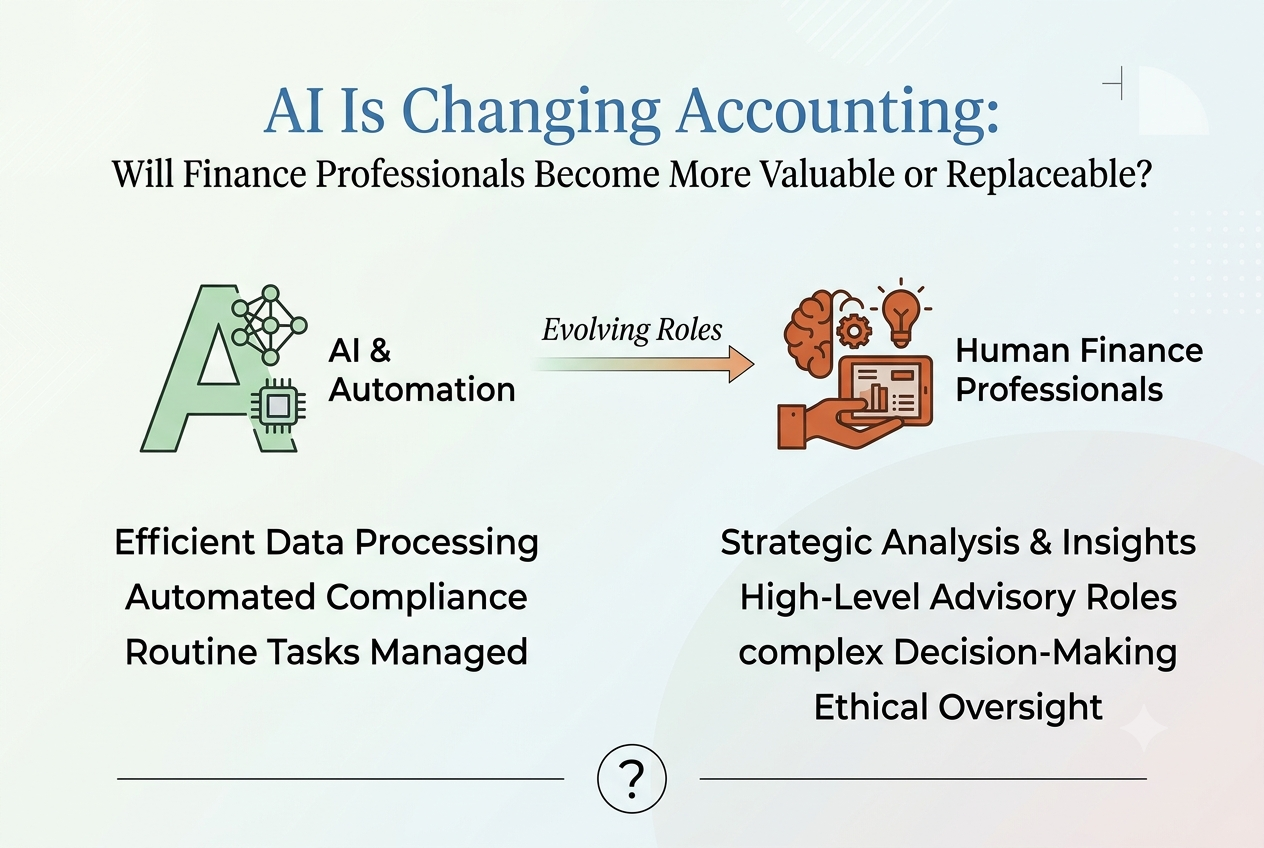
Will Artificial Intelligence replace finance professionals, or will it create opportunities for them to become more valuable?
The answer may depend less on what AI can do and more on how professionals choose to adapt.
1. The Changing Landscape of Accounting
Accounting is no longer limited to recording financial transactions and preparing reports. Businesses increasingly expect finance professionals to interpret information, identify financial risks and support strategic decisions.
AI is accelerating this transition through applications such as:
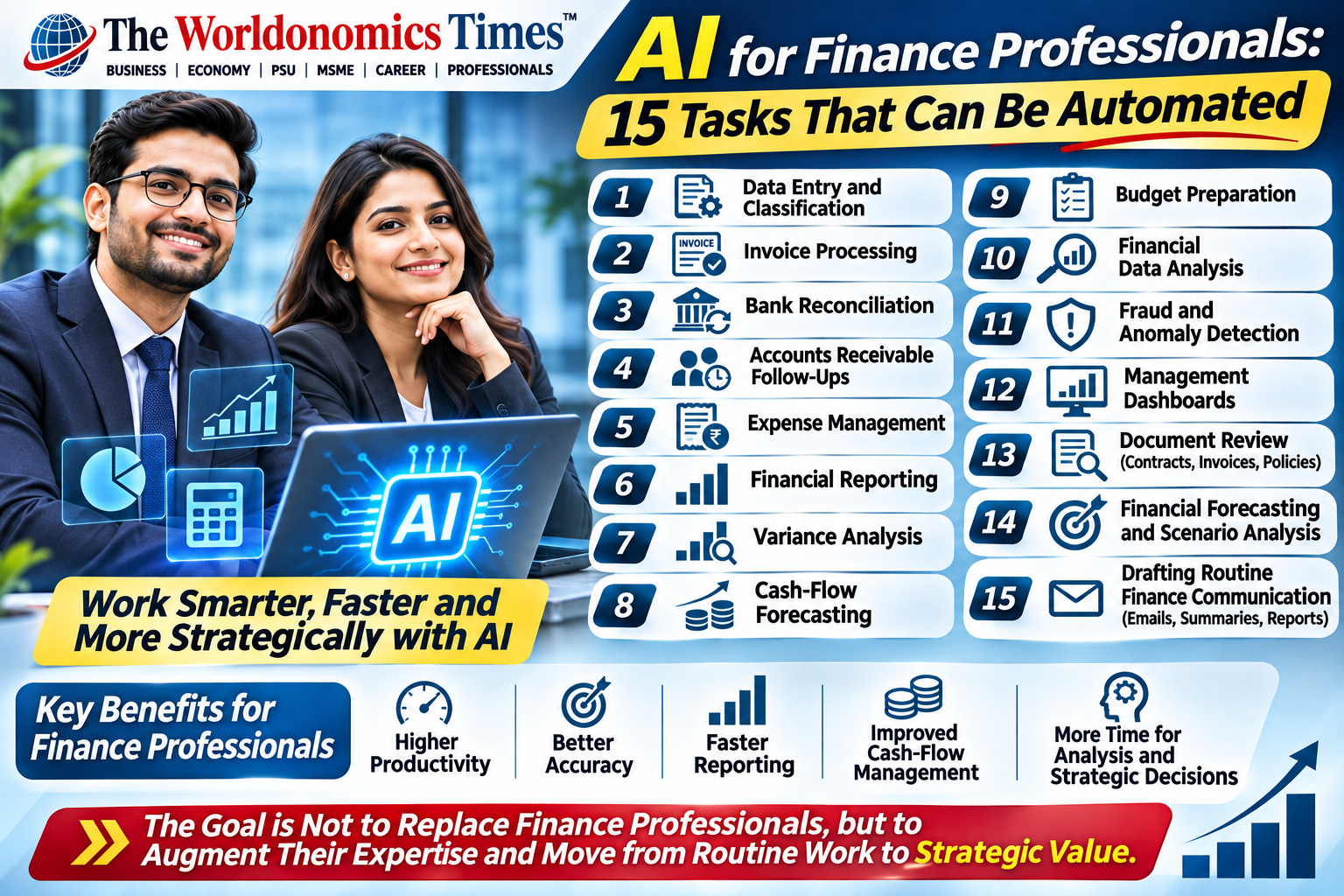
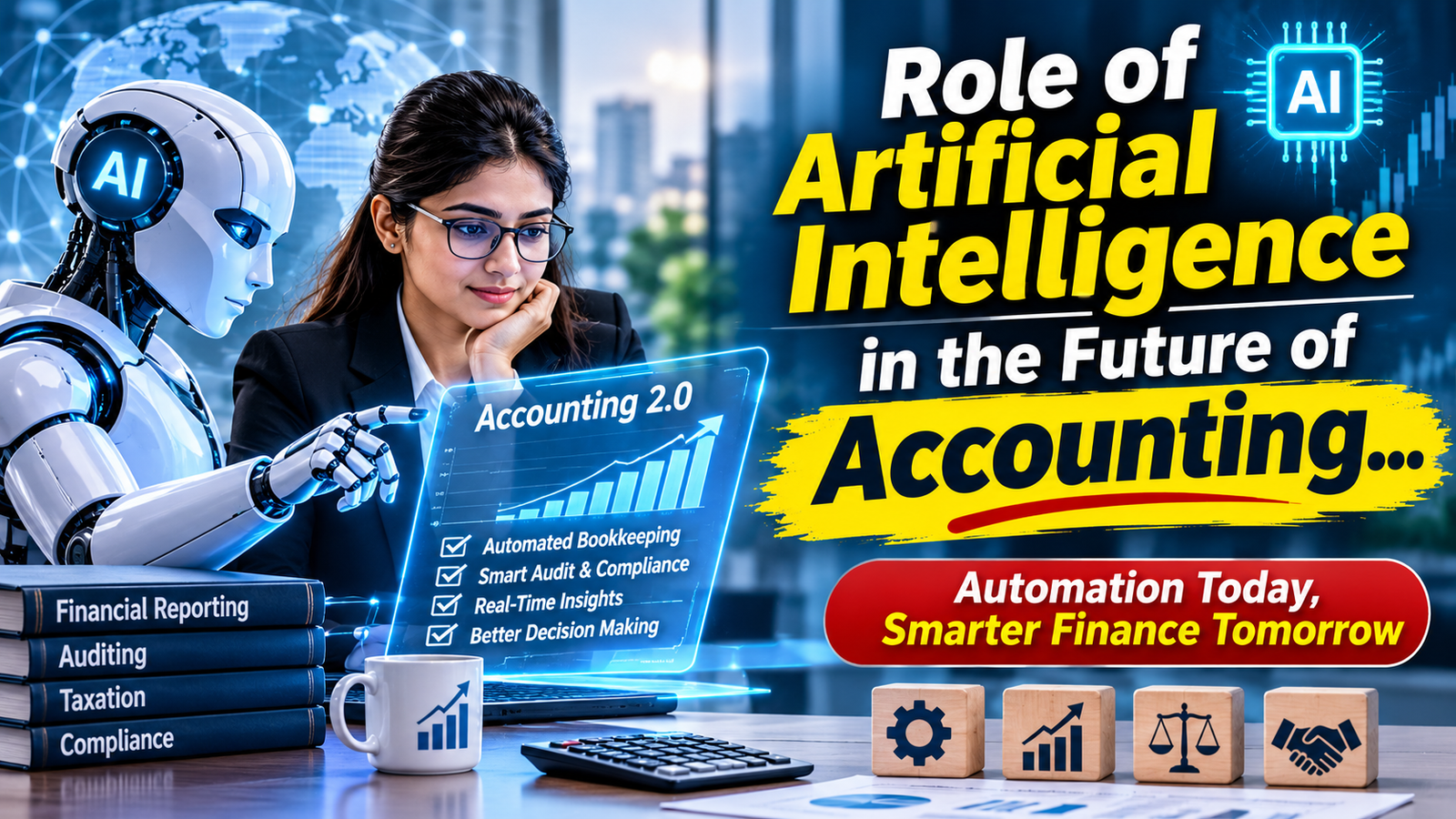
- Automated Bookkeeping: AI-powered systems can classify transactions, process invoices and assist with bank reconciliations.
- Intelligent Auditing: AI can analyse large volumes of transactions, identify unusual patterns and highlight potential risk areas.
- Tax Research and Compliance: AI tools can assist with information retrieval, document analysis and preliminary tax research.
- Financial Forecasting: AI can support budgeting, cash flow projections and financial performance analysis.
- Management Reporting: Financial information can be summarised and presented more efficiently to support management decisions.
These developments are changing not only how accounting work is performed but also what organisations expect from finance professionals.
2. What Does the Industry Tell Us?
The transformation is already visible in industry research.
According to Thomson Reuters’ Future of Professionals Report 2026, 81% of tax and audit firm professionals surveyed reported regularly using AI in their day-to-day workflows.
Similarly, KPMG’s 2026 Global AI in Finance survey, covering 1,013 senior finance leaders across 20 countries, found that active AI use in finance functions had increased from 30% in 2024 to 75% in 2026.
These findings indicate that AI is moving beyond experimentation and becoming an important part of professional finance operations.
However, increased adoption does not mean that human expertise is becoming irrelevant. Instead, it highlights the need for professionals to develop new capabilities alongside technological advancements.
3. Can AI Replace Human Judgement?
AI can process information, recognise patterns and generate recommendations, but accounting involves much more than processing data.
Consider a situation where an AI system identifies an unusual financial transaction.
It can flag the transaction, compare historical patterns and highlight possible irregularities.
However, determining whether the transaction represents fraud, a legitimate business decision or an accounting error requires investigation, professional judgement and an understanding of the business environment.
Similarly, tax compliance is not simply about identifying a provision of law. It involves interpreting applicable legislation, understanding facts, evaluating risks and accepting professional responsibility for advice.
The Institute of Chartered Accountants of Scotland (ICAS), in its 2026 research on generative AI and professional judgement, highlighted concerns about accuracy, confidentiality and over-reliance on AI-generated outputs.
This reinforces an important principle:
AI can support professional judgement, but accountability cannot simply be transferred to a machine.
4. The Real Risk: Professionals Who Refuse to Adapt
The biggest challenge may not be AI replacing accountants directly. It may be professionals who continue relying entirely on traditional methods while the expectations of the industry evolve.
Routine and repetitive activities are increasingly becoming automated. Consequently, the value of professionals will depend more on their ability to analyse information, solve problems and provide meaningful financial insights.
The future finance professional will need to combine:
- Strong accounting and taxation fundamentals.
- Understanding of AI-powered tools and automation.
- Analytical and critical thinking skills.
- Data interpretation and financial decision-making.
- Ethical judgement and professional scepticism.
- Communication and advisory capabilities.
Technology may change the way work is performed, but strong fundamentals will remain essential to evaluating the quality of its output.
5. What Does This Mean for India’s Finance Professionals?
India has a growing ecosystem of businesses, startups, financial institutions and professional services firms.
As these organisations embrace digital transformation, the demand for finance professionals who can combine financial expertise with technological understanding is likely to evolve.
For students pursuing CA, CMA, CS and other finance-related qualifications, this transition presents both a challenge and an opportunity.
Instead of viewing AI as a competitor, aspiring professionals should understand how it can improve their productivity and strengthen their analytical capabilities.
For instance, a Cost and Management Accountant can use technology to support cost analysis, budgeting, variance analysis and management reporting while applying professional judgement to business decisions.
Similarly, tax professionals can use AI-assisted research to improve efficiency while independently verifying statutory provisions and ensuring compliance.
The objective should not be to compete with technology in performing repetitive tasks. It should be to develop capabilities that allow professionals to use technology responsibly and create greater value.
6. The Way Forward: Collaboration, Not Competition
The future of accounting should not be viewed as a battle between humans and machines.
It should be viewed as an opportunity for collaboration.
Organisations must invest in employee training, responsible AI adoption, data security and appropriate internal controls.
Educational institutions and professional bodies must also ensure that future professionals are equipped with technological awareness alongside strong conceptual knowledge.
Finance professionals, meanwhile, must embrace continuous learning and remain open to changing business requirements.
AI can improve speed and efficiency, but trust, integrity, accountability and professional judgement must remain at the centre of financial decision-making.
Conclusion: The Future Belongs to Those Who Adapt
Artificial Intelligence is undoubtedly transforming accounting, auditing, taxation and financial management.
Some traditional tasks may become less dependent on human involvement, but the broader role of finance professionals is evolving towards analysis, interpretation, strategic thinking and advisory services.
The question is therefore not simply whether AI will replace accountants.
The more important question is whether accountants are prepared to evolve with AI.
The future does not necessarily belong to those who know the most about technology, nor only to those who understand accounting. It belongs to professionals who can bring both together.
Because AI may change how numbers are processed, but the ability to understand what those numbers mean, question the results and make responsible decisions will continue to matter.
Technology is changing the profession. Adaptability will determine who leads it.