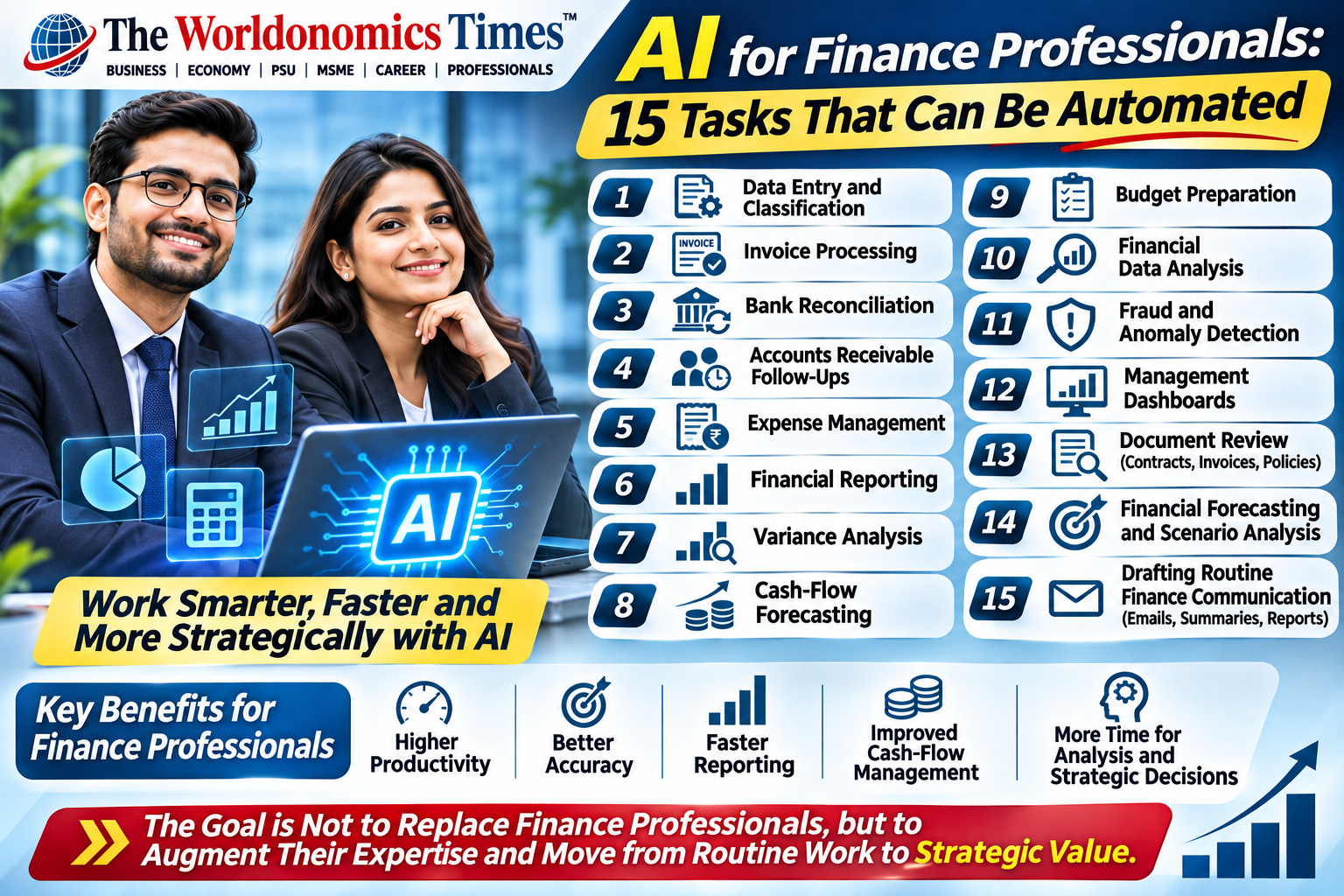
Artificial intelligence is transforming the finance function. For CA, CMA and other finance professionals, the opportunity is not to replace expertise—but to use technology to work faster, smarter and more strategically.
Artificial Intelligence (AI) is rapidly changing the way businesses operate. Finance departments are among the areas where AI and automation can have a significant impact because many financial activities involve structured data, repetitive processes, reporting and analysis.
For Chartered Accountants (CAs), Cost and Management Accountants (CMAs), finance managers and accounting professionals, the rise of AI should not simply be viewed as a threat. It can become a powerful productivity tool.
The future finance professional may spend less time preparing repetitive reports and more time analysing information, advising management and supporting strategic decisions.
Here are 15 finance tasks that can increasingly be supported or automated using AI and digital technologies.
1. Data Entry and Classification
AI-enabled systems can help extract information from invoices, receipts, statements and other documents and classify transactions into appropriate accounting categories.
This can reduce manual data-entry work and allow finance teams to focus on review and analysis.
2. Invoice Processing
Invoice processing is one of the most repetitive finance activities.
AI-powered systems can extract vendor information, invoice numbers, amounts, tax details and dates, helping automate the movement of invoices through approval and accounting workflows.
Human review remains important, particularly for exceptions and unusual transactions.
3. Bank Reconciliation
AI and rules-based automation can compare bank transactions with accounting records and identify matching entries.
Unmatched or unusual transactions can be highlighted for finance professionals to investigate.
This can significantly reduce the time spent on routine reconciliation.
4. Accounts Receivable Follow-Ups
Finance teams can use automation to monitor outstanding invoices, identify overdue accounts and generate payment reminders.
AI can also help prioritise follow-ups based on customer behaviour and payment history.
5. Expense Management
Digital systems can automatically capture expense information, categorise transactions and check them against company policies.
AI can help identify unusual expenses or transactions requiring additional review.
6. Financial Reporting
AI-assisted tools can help consolidate financial data and generate recurring management reports.
Instead of manually preparing the same reports every month, finance professionals can spend more time interpreting the numbers and explaining business trends.
7. Variance Analysis
Budget-versus-actual analysis is an important finance activity.
AI can identify significant variances, unusual movements and recurring patterns and bring them to the attention of finance teams.
The professional’s role then shifts towards understanding why the variance occurred and what action should be taken.
8. Cash-Flow Forecasting
AI can analyse historical transactions, receivables, payables and other financial information to support cash-flow forecasting.
Finance professionals can use these insights to prepare different scenarios and identify potential liquidity pressures.
AI-generated forecasts should always be reviewed because business conditions can change rapidly.
9. Budget Preparation
AI can assist finance teams in analysing historical spending patterns and preparing initial budget assumptions.
It can also help compare different scenarios and identify areas where spending may require management attention.
The final budget, however, should remain a management decision rather than an automatic output.
10. Financial Data Analysis
Large datasets can be difficult to analyse manually.
AI tools can help identify trends, relationships, anomalies and patterns within financial information.
For CA and CMA professionals, this can create more time for higher-value analysis and strategic recommendations.
11. Fraud and Anomaly Detection
AI can examine large volumes of transactions and identify unusual patterns.
Examples may include duplicate payments, unexpected transaction amounts, unusual timing or deviations from normal behaviour.
AI does not eliminate fraud risk, but it can help finance and audit teams identify transactions that deserve closer examination.
12. Management Dashboards
Finance professionals can use AI-enabled business intelligence tools to generate dashboards covering revenue, costs, profitability, working capital and other key performance indicators.
Interactive dashboards can make financial information easier for management to understand.
13. Document Review
Finance teams regularly deal with contracts, invoices, policies, financial statements and other documents.
AI can help summarise lengthy documents, extract key information and identify specific clauses or data points for review.
Important legal, financial or contractual conclusions should still be validated by qualified professionals.
14. Financial Forecasting and Scenario Analysis
AI can support forecasting by analysing historical data and modelling different scenarios.
For example, finance teams can evaluate potential changes in sales, costs, interest rates or working capital.
This can help management understand potential outcomes before making important decisions.
15. Drafting Routine Finance Communication
AI can assist in preparing first drafts of routine emails, management summaries, meeting notes, financial explanations and internal communications.
This can save time while allowing finance professionals to focus on accuracy, judgement and final approval.
AI Will Change the Role—Not Eliminate the Professional
The most important point for finance professionals is that automation does not remove the need for professional judgement.
Accounting standards, taxation, audit, costing, financial controls, governance and business decisions require expertise, interpretation and responsibility.
AI can process information quickly, but professionals must determine whether the information is accurate, relevant and appropriate for the decision being made.
For this reason, CA and CMA professionals should focus on developing a combination of finance expertise, data analytics, AI literacy, business understanding and communication skills.
What Should Finance Professionals Learn?
Professionals looking to become future-ready should consider learning:
- Generative AI and effective prompting
- Advanced Excel
- Power BI and data visualisation
- Financial modelling
- ERP and digital finance systems
- Automation and workflow tools
- Data interpretation
- AI governance and data privacy
The goal should not be to become a technology specialist overnight. The objective is to understand how technology can improve the finance function.
The Future Finance Professional
The finance profession is moving from manual processing to intelligent analysis.
A professional who once spent hours preparing a report may increasingly spend those hours asking more important questions: What is driving the numbers? What risks are emerging? Where can costs be reduced? What opportunities should management pursue?
That is where the real value of AI lies.
For CA, CMA and other finance professionals, the message is clear: AI should not be seen only as a replacement for routine work. It should be viewed as a tool that can help professionals move from number processing to strategic decision-making.
Those who learn to combine professional knowledge with AI and analytics will be better positioned to lead the finance function of the future.