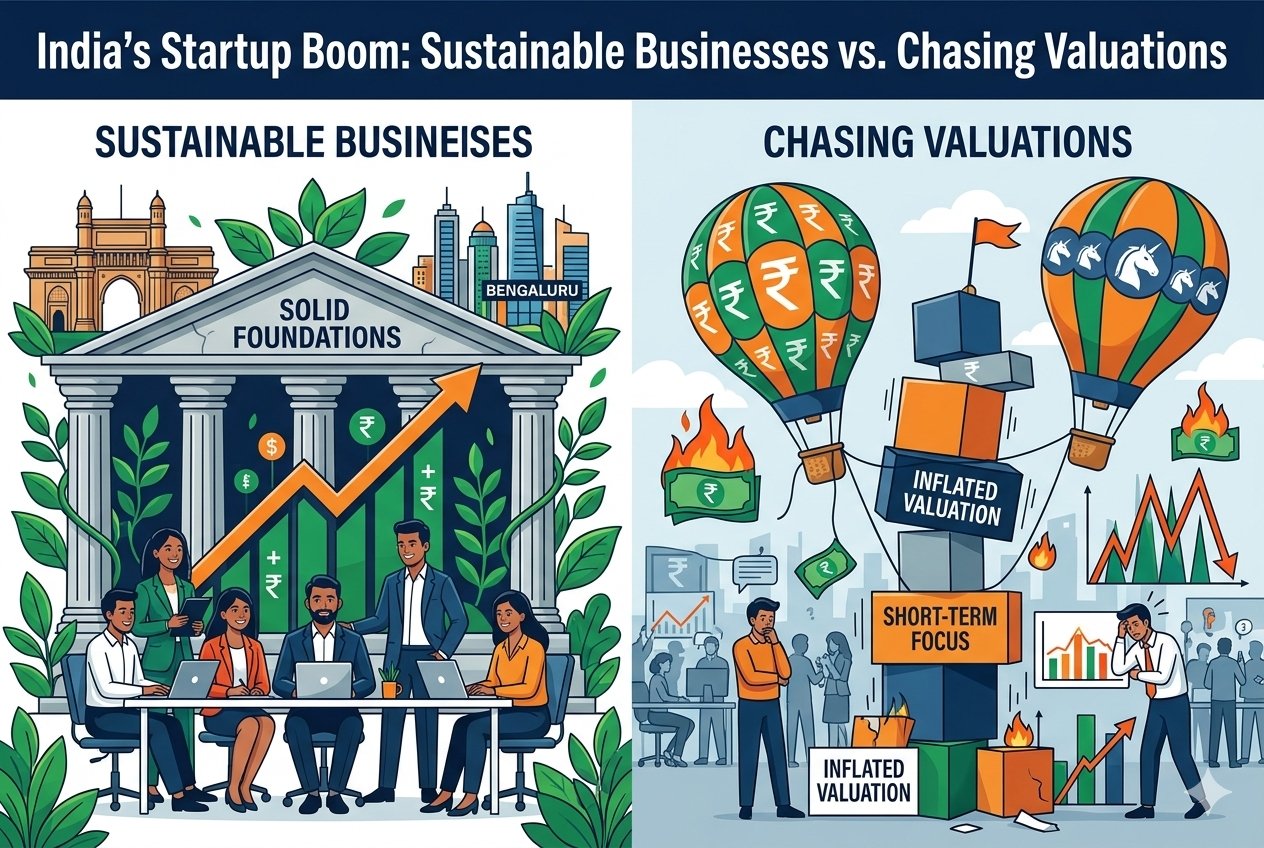
India has emerged as one of the world’s most dynamic startup ecosystems. From fintech and e-commerce to artificial intelligence and deep technology, Indian startups are transforming industries, creating employment opportunities and attracting global investors.
But behind the impressive funding announcements and billion-dollar valuations lies an important question: Are we building businesses that can survive independently, or are we simply chasing valuations?
The Growth Story Behind the Numbers
India’s startup ecosystem continues to attract significant investor attention. However, the investment landscape is changing. Investors are becoming more selective, prioritising companies with sustainable business models, strong revenue visibility and a clear path to profitability.
The shift is significant. Startups can no longer depend entirely on external funding to support expansion. They must demonstrate that their business models can generate long-term economic value.
Revenue Is Important, But Profitability Matters
A startup may report impressive revenue growth, acquire millions of customers and achieve a high valuation. Yet, these indicators do not necessarily reflect financial strength.
Consider a business that spends heavily on discounts, marketing and customer acquisition. Its revenue may grow rapidly, but if its operating costs continue to exceed its earnings, its long-term sustainability becomes questionable.
This is where financial discipline becomes essential.
Businesses must focus on:
- Positive operating cash flows.
- Sustainable profit margins.
- Effective working capital management.
- Strong unit economics.
- Responsible financial planning.
Growth without financial discipline can become a liability rather than an achievement.
The Changing Expectations of Investors
Investors today are looking beyond attractive presentations and ambitious projections. They want to understand the fundamentals of a business.
Questions around customer retention, contribution margins, cash burn, corporate governance and scalability are becoming increasingly important.
A strong valuation may attract attention, but sustainable financial performance builds investor confidence.
The Role of Financial Professionals
This changing startup environment creates significant opportunities for finance and accounting professionals.
Startups need professionals who can go beyond bookkeeping and compliance. They need strategic financial partners who can interpret financial data, identify risks, manage costs, evaluate investments and support business decisions.
Cost accountants, financial analysts and management professionals can play a crucial role in building financially disciplined organisations.
Building Businesses That Last
India does not just need more unicorns. It needs more financially sustainable enterprises that create employment, encourage innovation, contribute to economic development and generate long-term value.
Valuation may measure what investors believe a business could become, but profitability and cash flow reveal how well it is performing today.
The real success of a startup should not be measured only by how quickly it reaches a billion-dollar valuation, but by how sustainably it creates value.
Perhaps the next phase of India’s startup revolution should focus not merely on creating more unicorns, but on building businesses that can stand strong even when external funding slows down.
Because a successful business is not just one that grows fast. It is one that knows how to sustain that growth.