How Lithium, Nickel and Rare Earth Elements Are Reshaping Global Trade, Manufacturing and India’s Economic Strategy
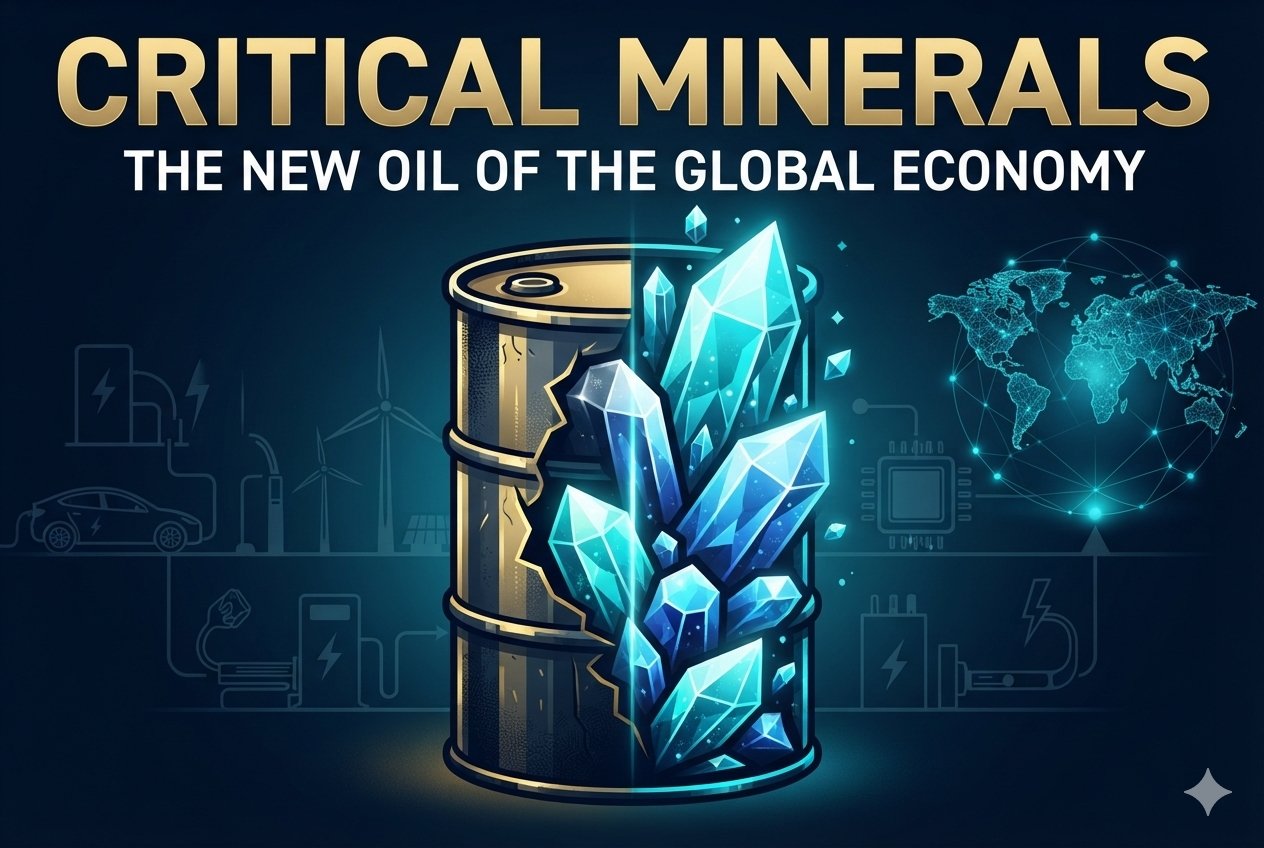
For decades, crude oil has been one of the most influential resources shaping global trade, geopolitics and economic power. Today, another group of resources is gaining similar strategic importance: Critical Minerals.
From electric vehicle batteries and smartphones to semiconductors, wind turbines and defence equipment, critical minerals are becoming the foundation of modern industrial development.
As the world moves towards cleaner energy and advanced technologies, control over these resources could become one of the biggest determinants of economic competitiveness.
1. What Are Critical Minerals?
Critical minerals are naturally occurring resources that are essential for economic development, national security and technological advancement but face significant supply-chain risks.
Some important examples include:
- Lithium: Essential for rechargeable batteries used in electric vehicles and energy storage.
- Nickel: Important for battery manufacturing and stainless steel production.
- Cobalt: Used in several battery chemistries and specialised industrial applications.
- Rare Earth Elements: Essential for high-performance magnets, electronics, wind turbines and defence technologies.
- Graphite: A major material used in lithium-ion battery anodes.
Their importance extends far beyond mining. Processing, refining and manufacturing determine how effectively these resources can be converted into industrial products.
2. Why Are Critical Minerals Becoming the New Oil?
The global economy is undergoing a structural transformation.
Electric mobility, renewable energy, digital infrastructure and advanced manufacturing are increasing demand for specialised materials.
Consider three major developments:
Electric Mobility: Electric vehicles depend on advanced battery technologies, creating demand for lithium, nickel, graphite and other battery materials.
Clean Energy Transition: Wind turbines, solar infrastructure and energy storage systems require specialised minerals and materials.
Technology and Defence: Semiconductors, aerospace systems, telecommunications and modern defence equipment rely on several critical minerals.
Unlike traditional energy resources, critical minerals are not simply fuel for the economy. They are essential inputs into the technologies that will power future industries.
3. India’s Big Move: Strengthening Domestic Capabilities
India is taking important steps to reduce its dependence on imported critical mineral processing and build a stronger domestic supply chain.
A significant development came on 4 November 2026, when the Union Cabinet approved the Capital Expenditure Support Scheme to Promote Critical Mineral Processing.
Key highlights include:
- Total financial outlay of ₹2,814 crore.
- Implementation period from FY 2026–27 to FY 2030–31.
- 30% capital subsidy to support the establishment of two lithium and two nickel processing plants.
- Expected investment of approximately ₹10,000 crore.
The objective is to strengthen domestic processing capabilities and support industries such as electric mobility, battery storage, electronics, defence and speciality steel.
Additionally, on 5 November 2026, the Ministry of Mines launched the ninth tranche of critical and strategic mineral block auctions, offering 20 mineral blocks.
These developments indicate India’s growing focus on securing strategic resources and strengthening industrial self-reliance.
4. The Business and Investment Opportunities
The critical minerals ecosystem offers opportunities across several stages of the value chain.
Mining and Exploration: Companies involved in identifying and extracting mineral resources can benefit from increasing industrial demand.
Processing and Refining: Domestic processing capabilities can reduce import dependence and create opportunities for industrial investment.
Battery Manufacturing: Growing electric mobility and energy storage requirements can support battery manufacturing businesses.
Recycling: Recovering valuable materials from used batteries and electronic waste can create an additional source of supply.
Technology and Research: Advanced material sciences, mineral recovery technologies and efficient processing methods can become important areas of innovation.
The opportunity is not limited to mining companies. It extends across manufacturing, logistics, technology, infrastructure and financial services.
5. The Challenges India Must Address
Despite the opportunities, building a competitive critical minerals ecosystem will not be easy.
Some of the major challenges include:
- High dependence on imports for several processed minerals.
- Limited domestic refining and processing infrastructure.
- Environmental concerns associated with mining and mineral extraction.
- High capital investment and technological requirements.
- Global competition for access to mineral resources.
- Price volatility and geopolitical supply-chain disruptions.
India will need to develop a complete ecosystem, from exploration and extraction to processing, recycling and advanced manufacturing.
6. A New Dimension of Global Economic Competition
Critical minerals are increasingly becoming a strategic component of international trade and economic diplomacy.
Countries are looking to diversify their supply chains, secure long-term mineral access and reduce dependence on concentrated sources of production and processing.
Consequently, mineral resources are becoming more than commodities. They are strategic economic assets.
For India, developing domestic capabilities could strengthen manufacturing competitiveness, improve supply-chain resilience and create opportunities for exports.
Conclusion: The Future Belongs to Those Who Secure Their Resources
The global economy is gradually moving beyond its traditional dependence on fossil fuels towards a technology-driven industrial ecosystem.
In this transformation, critical minerals will play a defining role.
India’s recent policy initiatives demonstrate an important recognition: becoming a manufacturing powerhouse requires more than factories and investment. It also requires secure access to the resources that make modern manufacturing possible.
Oil powered the industrial economy of the past. Critical minerals could shape the industrial economy of the future.
The next global economic race may not simply be about who manufactures the most, but about who secures, processes and manages the resources behind that manufacturing.
— Ankita Nag