By The Worldonomics Times
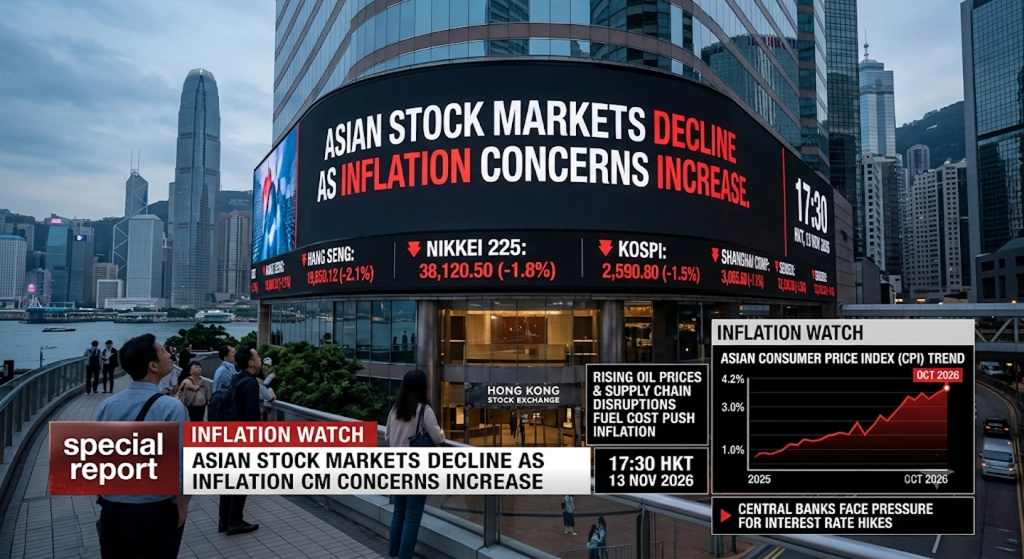
Asian stock markets are facing renewed pressure as rising inflation concerns, higher energy prices, increasing bond yields, and uncertainty over central bank policies weigh on investor confidence. Markets across the region have experienced periods of volatility, with technology-heavy exchanges and emerging economies particularly sensitive to changes in global financial conditions.
Investors are increasingly concerned that persistent inflation could force central banks to maintain restrictive monetary policies or introduce further interest rate increases. Higher borrowing costs can reduce corporate investment, weaken consumer demand, and make equities less attractive compared with relatively safer fixed-income investments.
The situation has been further complicated by geopolitical tensions, fluctuations in international oil prices, and changing expectations surrounding global economic growth. These developments highlight the close relationship between inflation, monetary policy, and stock market performance.
Inflation Concerns Put Pressure on Asian Equity Markets
Inflation remains a major concern for policymakers and investors across Asia. Rising energy, food, transportation, and manufacturing costs can affect corporate profitability while reducing household purchasing power.
For businesses, higher input costs can reduce profit margins, particularly when companies are unable to increase selling prices without affecting consumer demand. Investors often respond by reassessing company valuations and reducing exposure to sectors that may struggle in a high-inflation environment.
According to the International Monetary Fund’s October 2026 Regional Economic Outlook for Asia and the Pacific, the recent increase in inflation across several Asian economies has been influenced substantially by global energy prices and currency depreciation. The IMF also noted that long-term government bond yields have increased by approximately 40 to 60 basis points across most Asian economies during 2026.
Higher yields can increase financing expenses for businesses and governments while placing downward pressure on equity valuations. Consequently, inflation concerns can influence stock markets even before central banks announce changes in interest rates.
Rising Oil Prices Increase Economic Uncertainty
Energy prices are an important factor influencing financial markets across Asia, particularly because several major economies in the region depend on imported crude oil and natural gas.
When international oil prices rise, transportation, manufacturing, electricity generation, and logistics become more expensive. These additional costs can increase inflation and reduce the profitability of energy-dependent companies.
Geopolitical tensions in the Middle East have added to these concerns by creating uncertainty around energy production and international shipping routes.
Countries such as India, Japan, South Korea, and several Southeast Asian economies are particularly exposed to fluctuations in imported energy costs.
Higher oil prices can also weaken the currencies of energy-importing countries by increasing demand for foreign currency to finance imports. Currency depreciation may then make imported commodities even more expensive, creating additional inflationary pressure.
This combination of higher energy costs and currency volatility can make investors more cautious about regional equity markets.
Central Bank Interest Rate Policies Influence Investor Sentiment
Central bank decisions are another major factor shaping Asian stock market performance.
When inflation remains above desired levels, monetary authorities may maintain higher interest rates or consider additional tightening. Although these measures can help control price increases, they also make borrowing more expensive.
Companies may postpone expansion plans, reduce capital expenditure, and face higher debt-servicing costs. Consumers may also become more cautious about spending because loans for homes, vehicles, and other purchases become costlier.
Investors consequently pay close attention to policy signals from the US Federal Reserve, the Bank of Japan, the Reserve Bank of India, and other regional central banks.
Changes in US interest rate expectations are particularly important because they can influence international capital flows and currency movements. Higher US yields may encourage investors to shift funds towards dollar-denominated assets, putting pressure on emerging Asian markets.
Technology Stocks and Foreign Investment Face Volatility
Technology and semiconductor companies have an important influence on several Asian stock exchanges, particularly those of South Korea, Taiwan, Japan, and China.
These markets benefited significantly from investor enthusiasm surrounding artificial intelligence, semiconductor demand, and digital infrastructure investment. However, concerns about high valuations, investment costs, and future profitability have recently contributed to greater volatility.
A November 11, 2026, Reuters report noted that foreign investors withdrew approximately $49.77 billion from equities in South Korea, Taiwan, India, Indonesia, Thailand, Vietnam, and the Philippines during October. Concerns about artificial intelligence infrastructure spending, corporate cash requirements, and profitability contributed to the withdrawals.
Such movements demonstrate how quickly investor sentiment can change when global economic uncertainty increases.
Foreign investment is an important source of liquidity for many Asian markets. Large withdrawals can increase selling pressure, weaken currencies, and create additional uncertainty for domestic investors.
Impact on Major Asian Economies
The effects of inflation and market volatility differ across Asian economies.
Japan faces the challenge of balancing economic growth with persistent inflation and changing interest rate expectations. Higher bond yields can affect equity valuations, while currency movements influence exporters and import-dependent businesses.
South Korea and Taiwan remain particularly sensitive to developments in the global semiconductor and technology industries. Their stock markets can experience significant movements when investors reassess expectations for artificial intelligence investment and chip demand.
China faces a different combination of challenges, including subdued domestic demand, property-sector pressures, and changing international trade conditions. These factors influence corporate earnings expectations and investor confidence.
Emerging Southeast Asian economies must manage energy price volatility, currency pressures, and changing foreign investment flows.
Although these markets face common global risks, their domestic economic conditions and policy responses will determine how strongly they are affected.
India’s Stock Market and Inflation Outlook
India’s equity markets are also experiencing the influence of rising inflation and international energy prices.
On November 13, 2026, the Nifty 50 declined 0.61% to 25,144.3, while the Sensex fell 0.39% to 81,592.45. Higher crude oil prices and October retail inflation above the Reserve Bank of India’s target range of 2% to 6% contributed to the pressure.
However, the broader picture remains mixed. Both benchmark indices recorded weekly gains, supported partly by foreign investment inflows earlier in November.
India’s relatively strong domestic demand, infrastructure investment, manufacturing expansion, and services sector provide important support to its financial markets.
Nevertheless, higher oil prices could increase import expenditure, influence the rupee, and create additional inflationary pressure. Investors are therefore likely to monitor RBI policy decisions, corporate earnings, foreign investment activity, and global commodity prices closely.
The Worldonomics Times View
The recent weakness in Asian stock markets reflects more than temporary fluctuations in share prices. It highlights the growing influence of inflation, energy security, monetary policy, and international capital movements on regional financial stability.
In our view, investors should focus on the underlying economic conditions rather than reacting exclusively to short-term market movements. Corporate profitability, debt levels, cash flow, business fundamentals, and exposure to rising input costs will remain important factors in determining long-term investment performance.
Governments and central banks must also maintain a careful balance between controlling inflation and supporting economic growth. Excessively restrictive monetary policies can weaken business investment and consumer demand, while insufficient action against persistent inflation can damage purchasing power and market confidence.
For Asian economies, strengthening domestic demand, improving energy security, maintaining currency stability, and encouraging productive investment will be essential.
India, in particular, should continue focusing on infrastructure development, domestic manufacturing, financial stability, and broader energy diversification to reduce its vulnerability to external economic shocks.
Ultimately, inflation remains one of the most important factors influencing the direction of Asian financial markets. Although short-term volatility may continue, economies with strong fundamentals, credible monetary policies, and sustainable growth strategies will be better positioned to withstand market uncertainty.
The coming months will be important in determining whether inflationary pressures ease or require further monetary tightening. Investors, businesses, and policymakers will need to remain cautious as Asia navigates an increasingly complex global economic environment.