Government inspections, fake recycling claims and the growing importance of accountability in India’s circular economy.
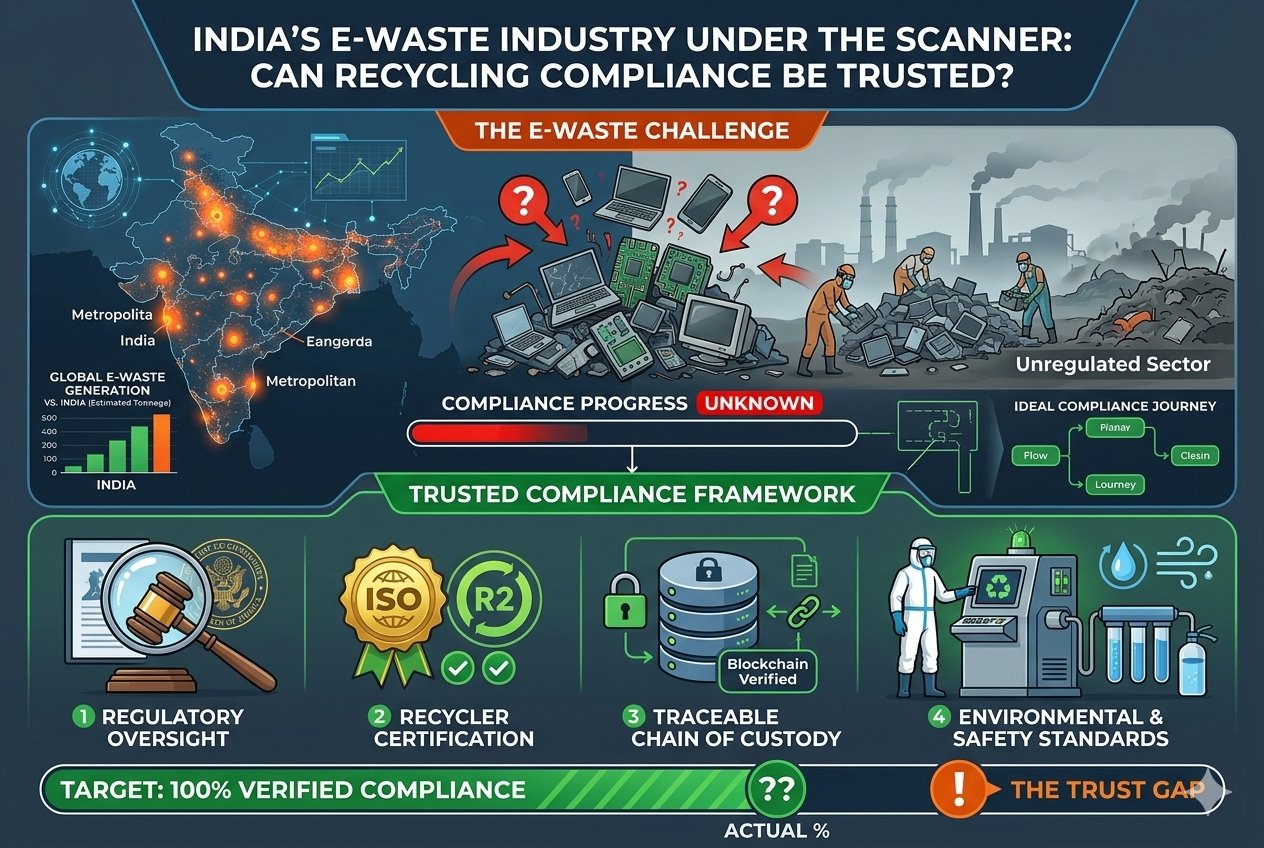
India’s digital economy is expanding rapidly. From smartphones and laptops to televisions, refrigerators and industrial electronics, technology has become an essential part of everyday life. But as electronic consumption increases, so does an often-overlooked problem: electronic waste.
India is among the world’s largest generators of e-waste. While recycling offers an opportunity to recover valuable resources, a new regulatory challenge is emerging: What happens when recycling is reported on paper but not actually carried out?
A major enforcement exercise announced in November 2026 has brought this question into focus.
1. The Government’s Crackdown on Fake Recycling Claims
According to a Reuters report published on 13 November 2026, Indian authorities have ordered inspections of more than 2,000 recycling facilities, including 309 e-waste processing units.
The inspections are intended to identify inflated recycling figures, forged compliance documents and facilities that claim to process waste without actually undertaking the reported activity.
The audit process reportedly includes:
- Physical inspection of recycling machinery.
- Trial runs to verify actual processing capacity.
- Examination of electricity consumption against reported production.
- Verification of documents and recycling claims.
Uttar Pradesh, which is home to a significant share of India’s e-waste recyclers, has also begun inspections, including checks at 33 facilities.
The message is clear: regulatory compliance must be supported by actual recycling activity, not merely documentation.
2. Understanding Extended Producer Responsibility (EPR)
At the centre of India’s e-waste regulatory framework is Extended Producer Responsibility (EPR).
Under the E-Waste (Management) Rules, 2022, producers are responsible for ensuring that e-waste generated from their products is channelled towards authorised recycling.
The framework requires producers, manufacturers, refurbishers and recyclers to register on the Central Pollution Control Board’s (CPCB) online portal.
Producers can fulfil their recycling obligations through EPR certificates generated by registered recyclers.
In principle, this creates a market-based mechanism:
- Producers meet their recycling obligations.
- Registered recyclers process electronic waste.
- EPR certificates provide evidence of recycling activity.
- Digital records support monitoring and compliance.
However, the system depends heavily on the authenticity of recycling data and certificates.
3. The Problem: Compliance on Paper vs Reality
A regulatory framework can only succeed when reported activities reflect actual outcomes.
If a recycler generates certificates without processing the corresponding quantity of waste, the entire EPR mechanism risks losing credibility.
Such practices can create several problems:
For businesses: Companies may believe they have fulfilled environmental obligations even when the underlying recycling claims are questionable.
For genuine recyclers: Businesses investing in machinery, technology, skilled workers and environmental safeguards may face unfair competition from non-compliant operators.
For the environment: Electronic waste may continue to be dismantled or processed through unsafe and unauthorised channels.
For regulators: False data weakens monitoring, enforcement and confidence in the compliance system.
The latest inspection exercise therefore represents an important test of the credibility of India’s EPR framework.
4. E-Waste Is Also an Economic Opportunity
Electronic waste should not be viewed merely as an environmental burden. It can also be a valuable source of secondary raw materials.
Discarded electronic products contain metals and other recoverable materials that can support manufacturing and resource security.
A stronger recycling ecosystem can create opportunities in:
- Urban mining: Recovering valuable metals from discarded electronic products.
- Advanced recycling: Investing in technologies that improve material recovery.
- Formal employment: Creating skilled jobs in collection, dismantling and processing.
- Circular manufacturing: Reintroducing recovered materials into production.
- Compliance technology: Developing systems for traceability, monitoring and verification.
India’s circular economy ambitions will depend on making these activities commercially viable as well as environmentally responsible.
5. What Should Businesses and Regulators Do Next?
The current enforcement exercise highlights the need to move beyond certificate-based compliance towards verifiable performance.
Some important measures include:
- Stronger physical verification: Periodic inspections should establish whether registered facilities have the machinery and capacity they claim.
- Digital traceability: Technology can help track e-waste from collection through processing and final recovery.
- Independent audits: Third-party verification can strengthen confidence in reported recycling quantities.
- Formalising the informal sector: Small waste collectors and dismantlers should be encouraged to enter authorised supply chains through training, incentives and accessible registration.
- Strict accountability: Fraudulent claims and forged certificates should attract meaningful regulatory consequences.
The objective should not simply be to increase the number of registered recyclers, but to ensure that the recycling ecosystem delivers measurable results.
6. The Bigger Picture: Trust Is the Foundation of Green Business
India’s transition towards a circular economy requires more than environmental policies and ambitious recycling targets. It requires trust between regulators, producers, recyclers, investors and consumers.
For businesses, EPR is no longer just an environmental compliance requirement. It is increasingly connected with supply-chain responsibility, sustainability reporting, operational costs and corporate reputation.
For investors, a transparent recycling market can create opportunities in a sector that is essential to sustainable industrial growth.
For policymakers, the challenge is to ensure that incentives reward genuine recycling rather than paperwork-driven compliance.
Conclusion
India’s e-waste recycling industry stands at an important turning point. The country has established a regulatory framework, expanded digital monitoring and created a market for recycling obligations. The next challenge is ensuring that these mechanisms deliver genuine environmental outcomes.
The latest inspection drive sends an important message to businesses: Green compliance must be measured by what companies actually do, not merely by what they report.
As India moves towards a more resource-efficient economy, the credibility of its recycling ecosystem could become just as important as its growth.
By Ankita Nag