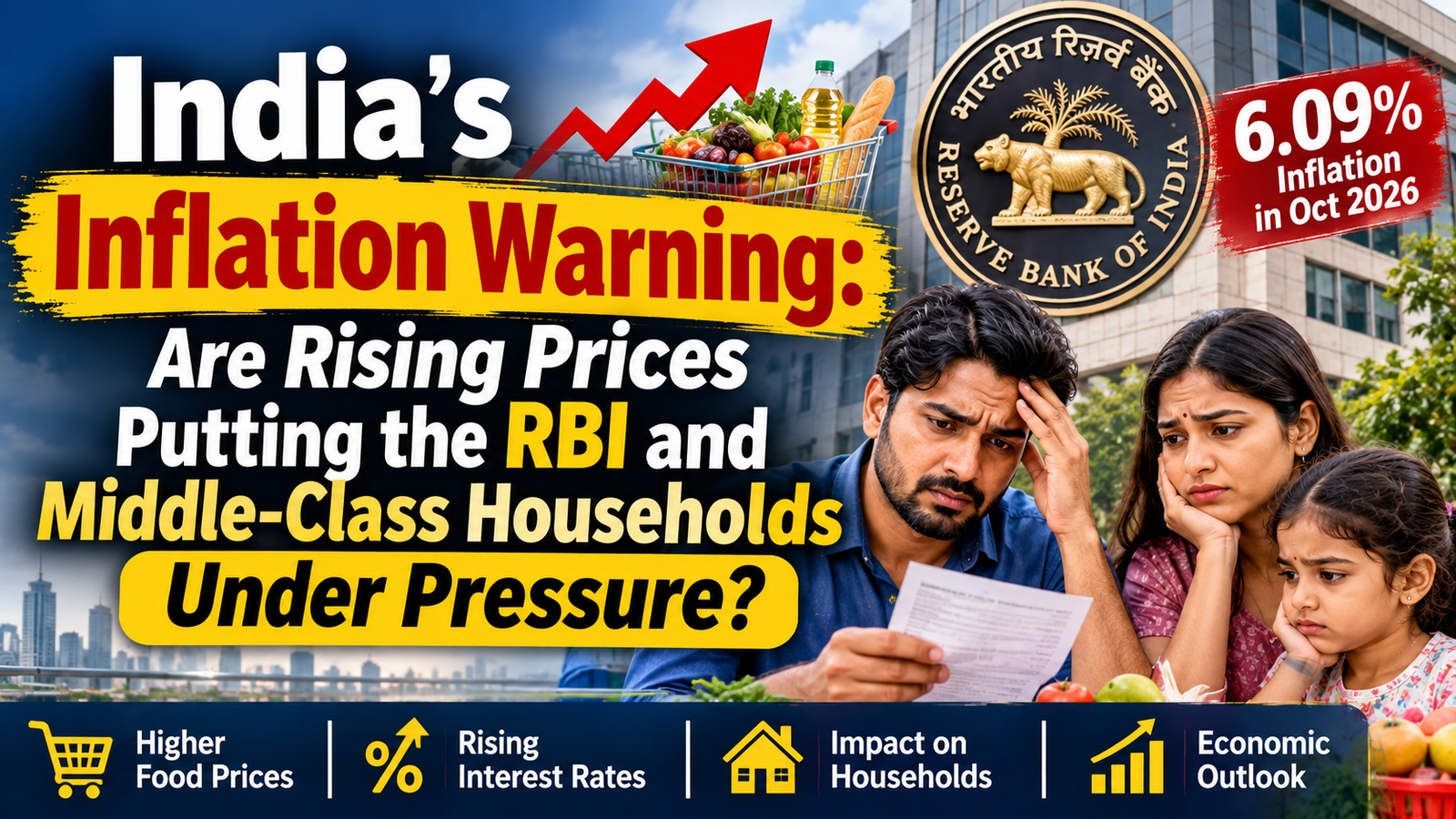
Rising retail and food inflation are putting pressure on household budgets, business costs and monetary policy, raising concerns about India’s purchasing power and economic stability.
Introduction: When Inflation Hits the Household Budget
Inflation is no longer just an economic statistic discussed by policymakers. It is increasingly reflected in grocery bills, transportation expenses, education fees and everyday household spending.
According to the Ministry of Statistics and Programme Implementation (MoSPI), India’s retail inflation increased to 6.09% in October 2026, compared with 5.54% in September. Food inflation rose to 8.94%, crossing the Reserve Bank of India’s upper tolerance limit of 6% for overall CPI inflation.
This raises an important question: Are rising prices becoming a challenge for India’s economic stability and middle-class financial security?
1. Understanding the Inflation Surge
The October figures indicate increasing price pressure across selected essential commodities.
Some notable year-on-year price increases included:
- Onion: 116.22%
- Garlic: 60.74%
- Ginger: 48.32%
- Lemon: 47.30%
These individual commodity increases highlight the pressure on food expenditure, although some other vegetables recorded price declines.
Rural inflation reached 6.63%, compared with 5.41% in urban areas, demonstrating that inflation does not affect every household equally.
2. Why Are Prices Rising?
Inflation is influenced by several interconnected factors:
Agricultural supply disruptions: Weather conditions, seasonal production changes and inadequate storage can affect the availability of essential food commodities.
Higher transportation costs: Fuel, logistics, packaging and distribution expenses can increase the final prices paid by consumers.
Global commodity fluctuations: International crude oil prices and geopolitical disruptions can influence India’s import costs and domestic production expenses.
Demand-supply imbalance: When demand remains strong but the availability of essential products declines, prices can rise.
These factors make inflation a complex economic challenge that cannot be addressed through monetary policy alone.
3. The RBI’s Dilemma: Inflation vs Economic Growth
The Reserve Bank of India follows a flexible inflation-targeting framework with a 4% CPI inflation target and a tolerance band of 2% to 6%.
At its October 2026 monetary policy meeting, the RBI increased the repo rate by 25 basis points to 5.50% and adopted a calibrated tightening stance.
Higher interest rates can help moderate demand and control persistent inflation. However, they can also increase borrowing costs for businesses and households.
This creates a difficult balancing act: controlling inflation without unnecessarily slowing investment, consumption and economic growth.
Moreover, higher interest rates cannot directly resolve agricultural supply shortages or transportation bottlenecks.
4. The Middle-Class Financial Squeeze
For salaried households, inflation directly affects disposable income and purchasing power.
Consider a household spending ₹40,000 every month. If its expenses increase by 6.09%, monthly expenditure would rise to approximately ₹42,436.
That means an additional ₹2,436 every month, even without any improvement in lifestyle.
When salaries fail to grow at the same pace as living costs, families may reduce savings, postpone investments and depend more heavily on borrowing.
The consequences can be particularly significant for households already managing rent, education expenses, healthcare costs and loan EMIs.
5. Impact on Businesses and Investors
Inflation also affects business profitability.
Manufacturers, retailers and small enterprises face higher raw-material, transportation, electricity and operating costs. Businesses that cannot pass these expenses to customers may experience declining profit margins.
For investors, inflation reduces the purchasing power of money and affects real investment returns.
For example, an investment earning 7% annually against inflation of 6.09% produces an approximate real return of only 0.86%, before taxes.
Therefore, nominal returns alone do not provide a complete picture of financial performance.
6. What Needs to Change?
Managing inflation requires a combination of monetary discipline and structural improvements.
Key priorities include:
- Improving agricultural productivity and storage infrastructure.
- Strengthening supply chains and reducing logistics costs.
- Monitoring essential commodity prices.
- Encouraging investment in climate-resilient agriculture.
- Maintaining a balanced monetary policy.
- Promoting household budgeting and responsible financial planning.
The objective should be to control persistent price pressures without unnecessarily weakening economic activity.
Conclusion: Economic Growth Must Protect Purchasing Power
India’s October 2026 inflation figures highlight the importance of price stability in maintaining economic confidence and household financial security.
The RBI faces the challenge of controlling inflation while supporting economic growth. Businesses must manage rising costs, while households struggle to maintain savings and purchasing power.
However, sustainable inflation management cannot depend on interest-rate adjustments alone. Agricultural productivity, efficient supply chains, affordable essential services and better market infrastructure are equally important.
Ultimately, economic progress should not be measured only by GDP growth or investment figures. It should also be measured by whether ordinary households can afford their everyday needs without sacrificing their financial future.