By The Worldonomics Times
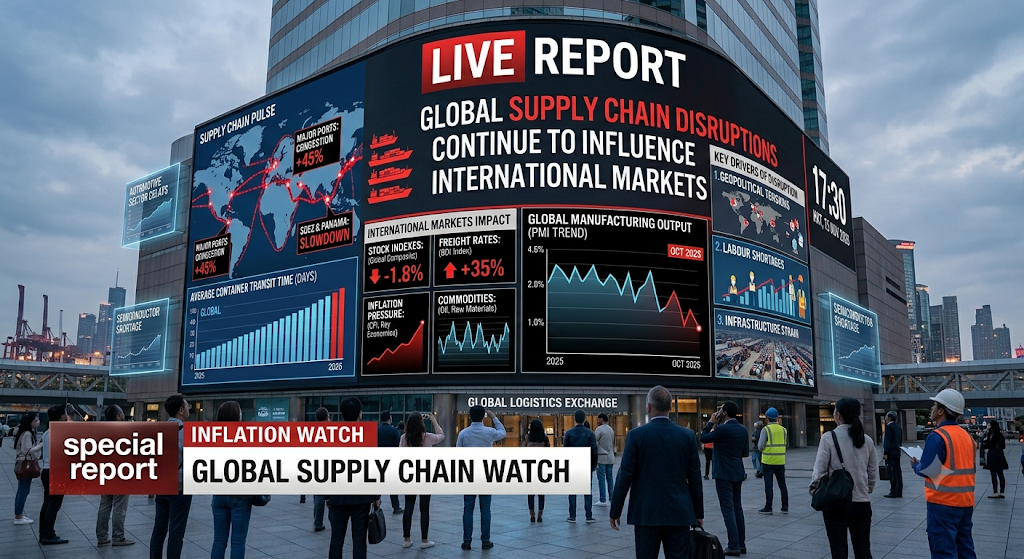
Global supply chains remain under pressure as geopolitical conflicts, shipping disruptions, changing trade policies and rising transportation costs continue to influence international markets. Businesses across manufacturing, energy, agriculture, electronics and retail are facing an increasingly complex operating environment. Although international trade has demonstrated considerable resilience, disruptions to major shipping routes and essential commodity supplies continue to create uncertainty for businesses and governments.
Modern supply chains connect manufacturers, suppliers, logistics providers and consumers across multiple countries. A disruption in one region can affect production schedules, delivery times and prices in markets thousands of kilometres away. As a result, supply-chain resilience has become a major economic and strategic priority.
Geopolitical Tensions Disrupt Global Trade Routes
Geopolitical developments remain among the most significant sources of supply-chain uncertainty. Conflicts and security concerns around important maritime routes can force shipping companies to change their schedules, reroute vessels and incur additional operating expenses.
The Strait of Hormuz has become a particularly important concern in 2026 because of its role in international energy transportation. Continuing security incidents have affected shipping confidence and increased the risks associated with transporting oil, natural gas and other commodities.
The United Nations Conference on Trade and Development (UNCTAD) has highlighted how disruptions around major maritime chokepoints, including the Red Sea, Black Sea and Strait of Hormuz, have contributed to longer shipping distances, port congestion and volatile freight rates.
These developments demonstrate that international trade depends not only on production capacity but also on secure and predictable transportation networks.
Shipping Costs and Delivery Delays Increase Business Pressure
Rerouting vessels and adjusting logistics networks can increase fuel consumption, insurance costs and delivery times. Companies may also need to maintain larger inventories to protect themselves against unexpected delays.
According to a November 2026 analysis by Xeneta reported by the World Ports Organization, spot container freight rates from the Far East to the US West Coast increased by 343% between February 28 and October 2026. The report also noted that global on-time container arrivals fell to 27% in the third quarter, with delayed containers arriving an average of six days behind schedule.
Such conditions can affect businesses of different sizes. Large multinational companies may have the resources to negotiate alternative shipping arrangements, while smaller importers and exporters often face greater difficulties absorbing higher logistics costs.
When transportation expenses increase, companies may pass some of the additional costs on to customers. This can contribute to higher prices for consumer goods, industrial materials and essential products.
International Trade Demonstrates Resilience
Despite continuing disruptions, global trade has shown an ability to adapt. Businesses are increasingly exploring alternative suppliers, transportation corridors and regional distribution centres to reduce their dependence on vulnerable routes.
The World Trade Organization (WTO), in its October 8, 2026, Global Trade Outlook, revised its forecast for world merchandise trade volume growth in 2026 to 3.9%, up from its earlier projection of 1.9%. The improvement reflected stronger-than-expected trade performance during the first half of the year and the ability of supply chains to adjust to disruptions in energy and fertilizer markets.
The WTO also reported that global container throughput increased by 3.9% year-on-year through July 2026. This indicates that alternative suppliers and shipping arrangements have helped maintain the movement of goods despite significant regional challenges.
However, the recovery is uneven. Some regions and industries remain more exposed to transport interruptions, energy shortages and higher input costs than others.
Technology and Diversification Transform Supply-Chain Management
Technology is becoming increasingly important in strengthening supply-chain resilience. Artificial intelligence, real-time tracking, predictive analytics and automated warehouse systems allow businesses to monitor shipments, identify potential delays and improve inventory management.
Digital platforms can also help companies assess supplier performance and identify alternative sources of essential materials. These tools support faster decision-making and improve visibility across international logistics networks.
Businesses are also reconsidering traditional sourcing strategies. Instead of depending heavily on a single country or supplier, many are exploring multiple sourcing locations and regional manufacturing partnerships.
Strategies such as nearshoring, friend-shoring and supplier diversification are gaining attention. Although these approaches may increase certain production costs, they can reduce exposure to unexpected disruptions and improve long-term operational stability.
Impact on Developing Economies
Developing economies are particularly vulnerable to global supply-chain disruptions because many depend on imported fuel, fertilizers, machinery and industrial components.
Higher shipping costs and longer delivery times can place pressure on domestic manufacturers and increase the cost of essential goods. Countries with limited port infrastructure, restricted transport connectivity or narrow export bases may face additional difficulties.
UNCTAD has warned that disruptions to maritime transport and trade routes can disproportionately affect developing countries, especially landlocked economies, least developed countries and small island developing states.
Improving port capacity, customs efficiency, regional connectivity and trade facilitation can help these economies become more resilient. International cooperation is also important to maintain predictable trade conditions and reduce unnecessary restrictions.
Implications for India
India’s economy is closely connected to international supply chains through imports of crude oil, natural gas, electronics, machinery, chemicals and industrial components. Disruptions to shipping routes can increase freight costs, delay deliveries and raise the cost of production for Indian businesses.
Export-oriented industries such as pharmaceuticals, textiles, engineering goods, automobiles and electronics also depend on reliable transportation networks. Delays in receiving raw materials or delivering finished products can affect production schedules and international competitiveness.
The November 2026 market update from Maersk highlighted continuing adjustments to logistics networks across India, the Middle East and Africa. It noted that customers were exploring alternative routing options and multimodal transportation arrangements in response to changing regional conditions.
For India, strengthening domestic manufacturing, improving port infrastructure, expanding logistics connectivity and diversifying international sourcing partnerships will be essential. Greater investment in digital supply-chain systems can also help Indian businesses respond more effectively to unexpected disruptions.
The Worldonomics Times View
Global supply-chain disruptions have become a continuing feature of the international economic environment. Geopolitical tensions, shipping constraints, changing trade policies and climate-related risks can affect the movement of goods and increase costs across multiple industries.
Although businesses and governments have demonstrated considerable adaptability, resilience requires more than finding temporary alternative routes. It demands investment in infrastructure, diversified sourcing, transparent supplier relationships and reliable international trade cooperation.
The Worldonomics Times believes that supply-chain resilience should be treated as a long-term economic priority. Businesses must balance cost efficiency with the ability to withstand unexpected shocks, while governments should support reliable transport infrastructure, efficient customs systems and stable trade policies.
The future of international commerce will depend not only on how much countries produce but also on how securely and efficiently goods can move between them. Economies that build flexible, technology-enabled and diversified supply chains will be better prepared to manage uncertainty and sustain global trade growth.