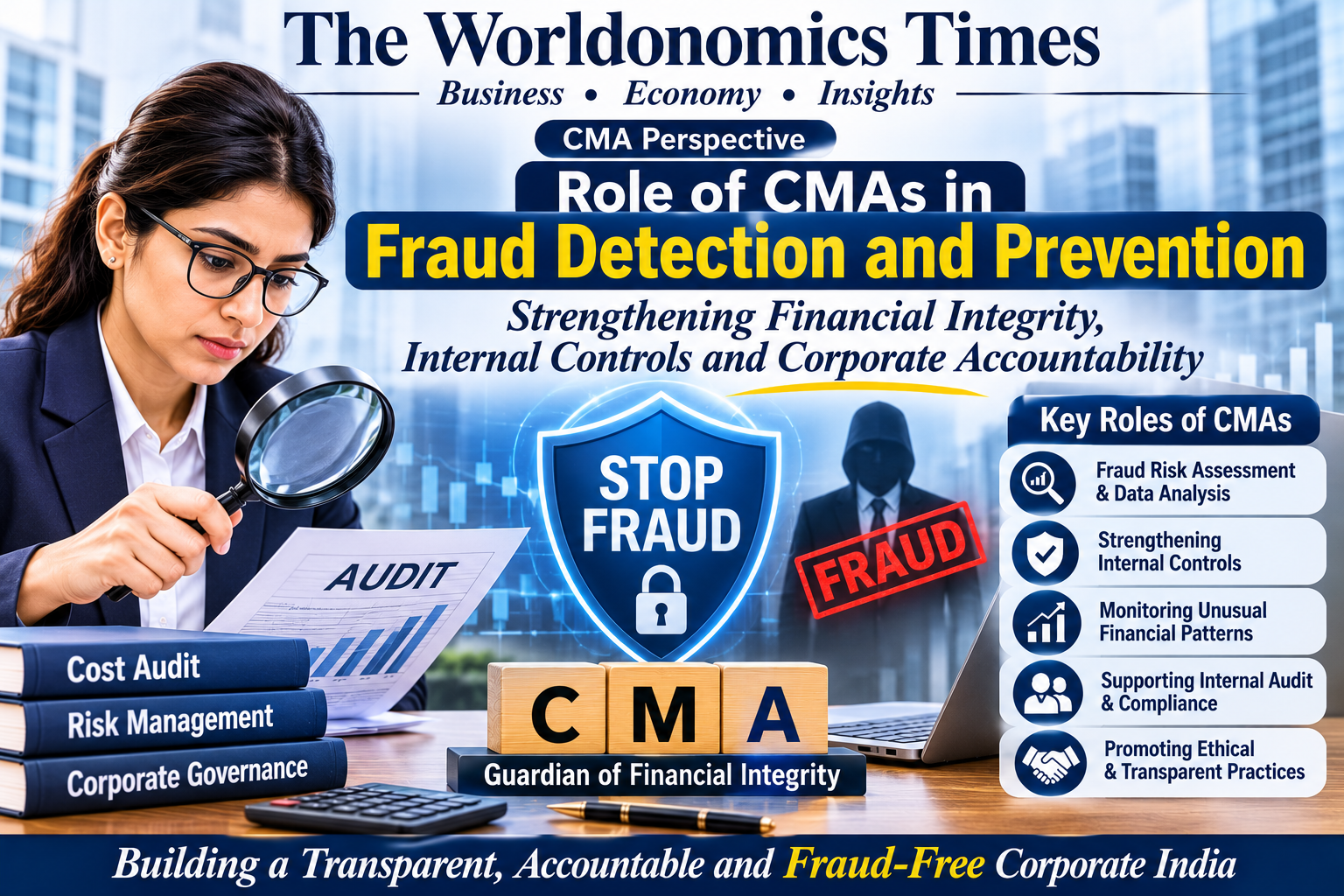
Strengthening Financial Integrity, Internal Controls and Corporate Accountability
By CMA Madhuri Kashyap
The Worldonomics Times | CMA Perspective
Introduction
Fraud is one of the major risks faced by modern businesses. Financial manipulation, false accounting entries, procurement irregularities, inventory theft, expense misreporting and misuse of organisational resources can cause significant financial losses and damage corporate reputation.
As businesses expand and financial transactions become increasingly complex, organisations need effective systems to identify suspicious activities and prevent financial misconduct. Cost and Management Accountants (CMAs) can play an important role in strengthening these systems through financial analysis, cost examination, internal controls and risk assessment.
Traditionally, CMAs have been associated with cost accounting, budgeting and cost audit. However, their analytical skills and understanding of business processes increasingly position them as valuable contributors to fraud risk management and corporate governance.
1. Understanding the Role of CMAs in Fraud Risk Management
Fraud prevention begins with understanding where an organisation is vulnerable. CMAs possess knowledge of financial records, cost structures, procurement processes, inventory systems and operational performance.
This enables them to help management identify areas where fraud risks may arise.
Common areas of exposure include:
- Manipulation of accounting and financial records.
- False or duplicate supplier invoices.
- Procurement and vendor-related irregularities.
- Inventory theft and misappropriation.
- Fictitious expenses and reimbursement claims.
- Unauthorised payments and financial transactions.
- Misreporting of production costs and operational data.
By examining financial information and business processes, CMAs can help organisations identify warning signs and strengthen preventive measures.
2. Financial Data Analysis and Identification of Unusual Patterns
Financial data analysis is an important tool in identifying possible irregularities. CMAs regularly work with budgets, cost statements, financial reports and operational information.
By comparing actual results with historical trends, budgeted figures and industry benchmarks, they can identify unusual variations that may require investigation.
For example, a sudden increase in material consumption without a corresponding rise in production may indicate wastage, inaccurate recording or possible inventory misuse.
Similarly, repeated payments to the same vendor, unusual expense claims or unexpected changes in operating costs may require closer examination.
Data analysis does not automatically establish fraud, but it can help identify exceptions and direct attention towards areas requiring further verification.
3. Strengthening Internal Financial Controls
Internal controls are designed to safeguard assets, improve the reliability of financial information and reduce opportunities for misconduct.
CMAs can contribute to reviewing and improving controls relating to:
- Purchase approvals and vendor selection.
- Inventory receipts, storage and issue.
- Payment authorisation procedures.
- Expense verification and reimbursement.
- Payroll and employee-related payments.
- Accounting entries and financial reporting.
- Budget monitoring and departmental accountability.
One important control principle is segregation of duties. For example, the same individual should not have unrestricted authority to initiate a purchase, approve it, receive the goods and authorise payment.
A properly designed control environment reduces the possibility of errors and makes fraudulent activities more difficult to conceal.
4. Role in Procurement and Inventory Fraud Prevention
Procurement and inventory management are particularly sensitive areas in manufacturing and trading organisations.
Irregularities may include inflated purchase prices, fictitious suppliers, duplicate invoices, unauthorised purchases, stock manipulation and unexplained material shortages.
CMAs can analyse purchase price variations, material consumption patterns, inventory turnover and stock reconciliation reports.
They may also help review procurement procedures, supplier documentation and material movement records.
For manufacturing organisations, comparing standard material consumption with actual consumption can highlight unusual differences that deserve further investigation.
These measures help businesses protect resources and improve operational accountability.
5. Supporting Internal Audit and Risk Assessment
Internal audit is an important mechanism for evaluating internal controls and identifying weaknesses in business processes.
CMAs can contribute to risk-based internal audit assignments by examining financial transactions, cost records, operational procedures and compliance systems.
Their work may involve:
- Identifying high-risk business processes.
- Reviewing financial and operational controls.
- Examining unusual transactions.
- Evaluating compliance with internal policies.
- Reporting control weaknesses.
- Recommending corrective measures.
Internal audit and fraud investigation are not identical. Internal audit evaluates controls and risk management, while a specific fraud investigation may require specialised procedures, evidence preservation and appropriate professional expertise.
CMAs should work within their competence and applicable professional requirements, coordinating with legal, forensic and investigation specialists when necessary.
6. Technology, Artificial Intelligence and Fraud Analytics
Digital transformation has created new opportunities for detecting suspicious financial activities.
Modern organisations generate large volumes of transaction data through Enterprise Resource Planning systems, accounting software, banking platforms and procurement applications.
CMAs with knowledge of data analytics can help examine this information more efficiently.
Useful tools and techniques include:
- Automated transaction monitoring.
- Duplicate invoice detection.
- Exception and variance reporting.
- Data visualisation dashboards.
- Trend and ratio analysis.
- Artificial intelligence-assisted anomaly detection.
For example, analytics tools can flag repeated payments, unusual transaction timings or vendors sharing common details. Such alerts require human review and verification before any conclusion is reached.
Technology can strengthen fraud prevention, but it must be supported by reliable data, appropriate access controls and professional judgement.
7. Promoting Ethical Culture and Corporate Governance
Fraud prevention is not only a matter of technology and accounting procedures. It also depends on organisational culture.
Companies need transparent policies, ethical leadership, effective reporting mechanisms and accountability at every level.
CMAs can support this environment by promoting financial discipline, accurate reporting and compliance with organisational policies.
They can also contribute to awareness programmes, control reviews and management reporting that encourage responsible conduct.
An effective whistleblower mechanism, protection against retaliation and timely investigation of credible complaints are important elements of a strong governance framework.
8. Opportunities for CMA Professionals
The growing focus on financial transparency, regulatory compliance and risk management is creating opportunities for CMA professionals in several areas.
These include:
- Internal audit and control assessment.
- Cost and operational audit.
- Financial risk management.
- Compliance and governance support.
- Forensic accounting support, with appropriate specialised training.
- Fraud risk assessment and analytics.
- Management reporting and process improvement.
Professional development in forensic techniques, data analytics, information systems and risk management can further strengthen a CMA’s capabilities in this field.
Conclusion
Fraud prevention is essential for protecting organisational assets, maintaining investor confidence and strengthening corporate governance. CMAs can make a valuable contribution through financial analysis, cost examination, internal control assessment and risk-based monitoring.
Their understanding of financial and operational processes enables them to identify unusual patterns, highlight control weaknesses and recommend preventive measures.
As businesses become more technology-driven and interconnected, CMA professionals will have an increasingly important role in promoting financial integrity and responsible corporate practices.
A strong organisation does not merely detect financial irregularities after they occur; it builds systems, controls and an ethical culture that prevent them. CMAs can be important partners in creating that culture of transparency and accountability.