As the final quarter of the 2026 calendar year accelerates, the Ministry of Corporate Affairs (MCA) and the Central Board of Direct Taxes (CBDT) have rolled out a series of aggressive regulatory updates. Aimed at streamlining corporate restructuring, opening global capital avenues, and consolidating compliance forms, the notifications issued in late October and early November 2026 require immediate attention from CFOs, company secretaries, and tax practitioners.
For finance teams, keeping pace with these statutory changes is no longer a year-end audit exercise. The integration of real-time reporting portals means that missing a newly introduced form or misinterpreting a notification can halt capital raising, block structural mergers, or invite immediate scrutiny from the tax department. Here is a deep dive into the three most critical MCA and CBDT updates from November 2026 and how they reshape the corporate compliance landscape.
1. The NPO Merger Framework: Income-tax (Eighth Amendment) Rules, 2026
Historically, the amalgamation or merger of Non-Profit Organizations (NPOs), charitable trusts, and Section 8 companies has been a grey area under Indian tax law. When two trusts merged, assessing officers frequently invoked Section 115TD of the Income Tax Act, levying a heavy “accreted tax” (tax on maximum marginal rate on the net assets) by treating the merger as a cessation of charitable activities, even if the transferee entity was also a registered charity.
The November 2026 Fix: To resolve this prolonged litigation trap, the CBDT notified the Income-tax (Eighth Amendment) Rules, 2026, which officially came into effect on November 5, 2026. This amendment formally introduces Rule 189A and the accompanying Form 112A, providing a codified, tax-neutral pathway for the merger of registered charitable institutions.
Practical Impact: Under the new framework, if an NPO merges into another NPO holding similar charitable objects and valid Section 12AB/80G registrations, the transferor trust must file Form 112A electronically before the assessing officer within 60 days of the merger scheme’s approval. For tax practitioners and trustees, this is a monumental relief. Form 112A acts as a statutory shield against Section 115TD accreted tax demands. However, finance teams must ensure that the asset valuation reports and the alignment of the charitable objects strictly match the newly prescribed formats in Rule 189A. Any discrepancy in the declared “net asset transfer” can still trigger tax liabilities.
2. Opening Global Capital: MCA Notification on Permissible Jurisdictions
For years, Indian startups and unlisted public companies seeking foreign capital had to rely on complex structures like Depository Receipts (ADRs/GDRs) or externalize their holding companies (flipping) to list on foreign exchanges. Direct listing was a heavily restricted frontier.
The November 2026 Fix: Following up on the groundwork laid out in the Companies (Amendment) Act, the MCA issued a landmark notification on November 3, 2026, activating the framework for unlisted public Indian companies to issue and list their equity instruments directly on stock exchanges in permissible foreign jurisdictions. Currently, the International Financial Services Centre (IFSC) at GIFT City, Ahmedabad, serves as the primary gateway under this notification.
Practical Impact: This is a game-changer for growth-stage enterprises and their legal teams. An unlisted public company can now access global pools of capital in foreign currency without the crippling compliance burden of a dual listing (listing in India first). However, the compliance guardrails are strict. Companies opting for this route must file specific declarations regarding their beneficial ownership and must strictly adhere to the updated Indian Accounting Standards (Ind AS) for consolidated reporting. Finance chiefs of ambitious startups must now evaluate the cost of compliance at GIFT City against the valuation benefits of accessing international institutional investors directly.
3. The MCA V3 Portal Consolidation: E-CHNG and E-CON Forms
The MCA V3 portal rollout has been an ongoing journey to transition company filings from PDF-based attachments to web-based, data-driven forms. Until now, corporate restructuring or basic board changes required filing a disjointed web of forms—DIR-12 for directors, SH-7 for capital alteration, and INC-27 for status conversion.
The November 2026 Fix: To drastically reduce filing friction, the MCA has introduced the proposed consolidation of structural forms, rolling out the new E-CHNG (Electronic Change) and E-CON (Electronic Conversion) master forms in early November 2026.
Practical Impact:
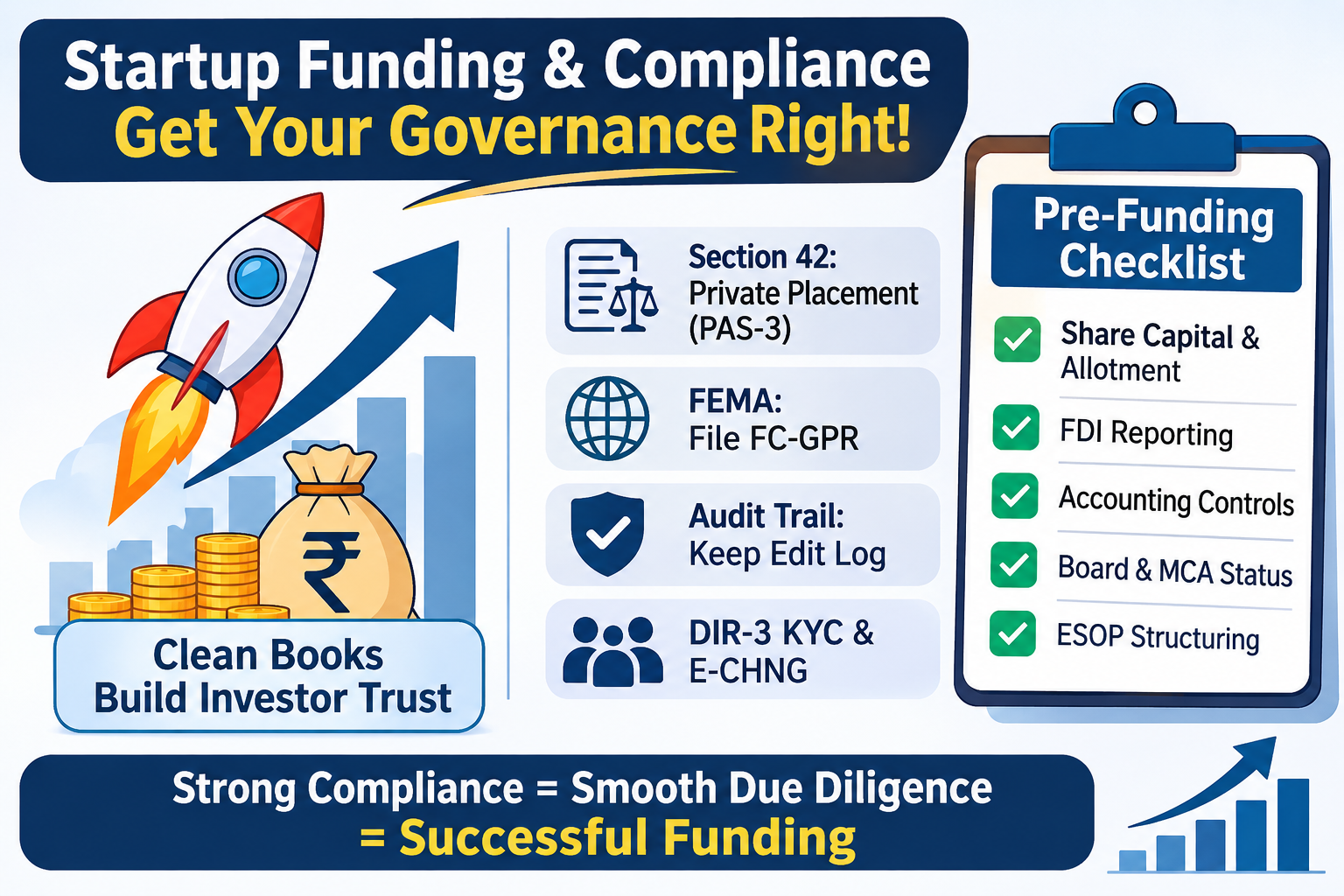
- E-CHNG Form: This unified web form replaces the standalone DIR-12, DIR-3 KYC, and SH-7. If a company holds an Extraordinary General Meeting (EGM) to increase its authorized capital and appoint a new director, the company secretary no longer files multiple forms. E-CHNG captures the entire event in a single workflow, cross-verifying the Director Identification Number (DIN) and capital fee payment in real-time.
- E-CON Form: This form consolidates the previously cumbersome processes of converting a Private Limited company to a Public Limited company, or converting an LLP into a Company.
For corporate governance teams, this consolidation reduces the risk of missing linked filings. However, because these are dynamic web forms, an error in data entry (such as a mismatched PAN or digital signature token) will prevent the form from generating the final Challan. Professionals must shift from “filling out PDFs offline” to managing live data validation on the MCA portal.
Immediate Action Plan for Finance Teams
The regulatory updates of November 2026 share a common theme: they demand proactive, tech-enabled compliance. Here is how your team should adapt:
| Regulatory Update | Effective Date / Notification | Immediate Action Required for Corporate Teams |
| NPO Mergers & Amalgamations | Nov 5, 2026 (Income-tax Eighth Amendment Rules) | Adopt Form 112A protocols for any upcoming trust/Section 8 mergers to protect against Sec. 115TD tax demands. |
| Direct Overseas Listing | Nov 3, 2026 (MCA Notification) | Evaluate GIFT City IFSC listing benefits; ensure capital tables and beneficial ownership records are clean and compliant. |
| MCA Form Consolidation | Nov 2026 (E-CHNG and E-CON rollout) | Train secretarial staff on the live-validation mechanics of the new master web forms to prevent portal lockout during urgent board changes. |
Waiting for the financial year to end before addressing these statutory shifts will result in procedural deadlocks. By integrating these November 2026 updates into your immediate compliance calendar, you ensure that your corporate restructuring, capital-raising efforts, and day-to-day governance remain seamless, legally sound, and future-proof.
Author Bio: Vivek Kumar is a qualified Cost and Management Accountant (ACMA) and B.Com (Account Honours) graduate with extensive experience in statutory and tax audits, direct and indirect taxation, and ROC/MCA corporate compliances. Alongside his practice, he mentors CA, CMA, and CS aspirants and designs exam-oriented test series to bridge practical industry expertise with academic preparation. (Email. Id- cmavivek2026@gmail.com)