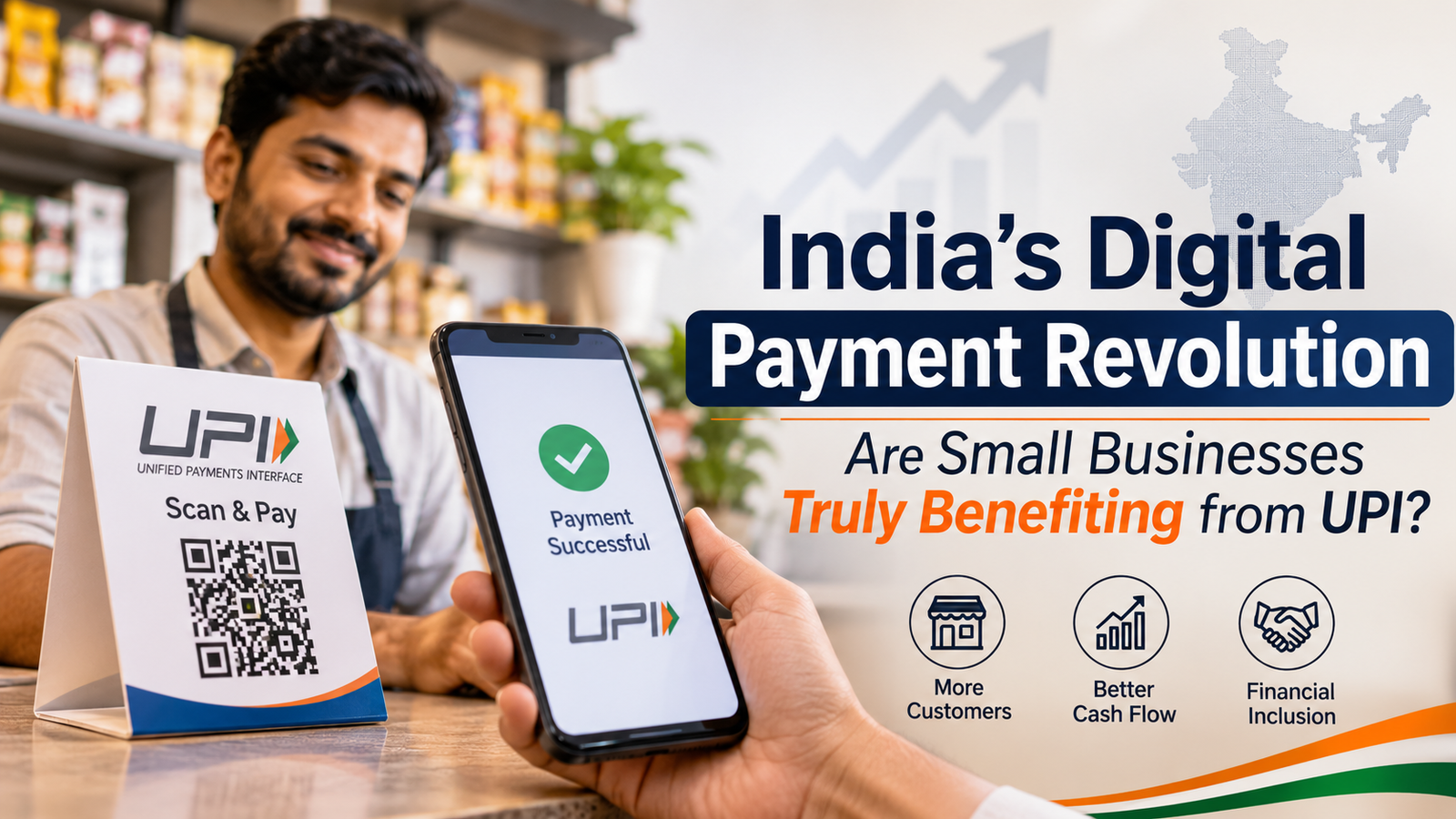
India’s digital payment ecosystem has undergone a remarkable transformation over the past decade. From neighbourhood grocery stores and roadside vendors to restaurants and small enterprises, the familiar UPI QR code has become an integral part of everyday business transactions.
Launched in 2016 by the National Payments Corporation of India (NPCI), the Unified Payments Interface (UPI) has simplified money transfers by enabling instant bank-to-bank payments through mobile applications. However, beyond convenience and technological advancement, an important economic question deserves attention: Is UPI genuinely improving the financial position of India’s small businesses, or is it simply changing how they receive payments?
1. UPI’s Growth: From a Payment Facility to Economic Infrastructure
UPI has developed into one of the world’s largest real-time digital payment systems. Its interoperability allows customers to transfer money across participating banks and payment applications without requiring traditional card infrastructure.
According to NPCI’s official statistics, UPI processed approximately 25.47 billion transactions worth ₹31.53 lakh crore in October 2026, demonstrating the enormous scale of India’s digital payment ecosystem.
The expansion of QR-code acceptance has also brought digital payments closer to smaller commercial establishments, including businesses in semi-urban and rural areas.
This transformation is significant because digital payment infrastructure is no longer limited to large retailers and organised businesses. It has become accessible to enterprises operating with relatively modest financial resources.
2. How UPI Is Changing Small Business Economics
The most important contribution of UPI is its ability to reduce the barriers associated with accepting digital payments.
Lower infrastructure costs: Unlike conventional card-based payment systems, UPI QR codes generally do not require merchants to purchase expensive point-of-sale machines. This makes digital payment acceptance more accessible to micro-enterprises and small retailers.
Improved cash-flow management: Instant transfers directly into bank accounts reduce dependence on physical cash collection and frequent bank deposits. Merchants can also monitor incoming payments more conveniently.
Better financial record-keeping: Digital transactions create electronic records that can support sales reconciliation, bookkeeping and financial planning. For small businesses transitioning from informal accounting practices, this represents an important improvement.
Greater customer accessibility: Customers increasingly expect digital payment options. By accepting UPI, small businesses can accommodate cashless customers and potentially avoid losing transactions simply because customers do not carry sufficient cash.
These benefits are not merely technological. They can improve operational efficiency and reduce certain administrative difficulties associated with traditional cash-based transactions.
3. What Does the Government’s Research Reveal?
An important assessment comes from the Department of Financial Services (DFS), Ministry of Finance, through its 2026 report titled Socio-Economic Impact Analysis of Incentive Scheme for Promotion of RuPay Debit Card and Low-Value BHIM-UPI Transactions (P2M).
The independent study, conducted in consultation with NPCI, covered 10,378 respondents across 15 states, including 2,199 merchants.
Its findings provide useful evidence of UPI’s impact on small businesses:
- 94% of surveyed small merchants reported adopting digital payments.
- 72% expressed satisfaction with digital payments.
- 57% reported increased sales following digital payment adoption.
- 37% reported improvements in business efficiency.
The study also highlighted faster transactions, improved record-keeping and operational convenience as important benefits.
These findings suggest that UPI is contributing to measurable improvements in business operations. However, reported increases in sales should not automatically be interpreted as equivalent increases in profits. Higher sales do not necessarily mean higher margins or improved business profitability.
4. The Hidden Challenges: Convenience Does Not Guarantee Profitability
Despite its advantages, UPI adoption does not eliminate the financial difficulties faced by small businesses.
One major concern is digital infrastructure reliability. Poor internet connectivity, failed transactions and technical disruptions can interrupt business operations, particularly in rural and semi-urban markets.
Cybersecurity is another significant issue. Fake payment screenshots, fraudulent payment requests and impersonation scams can expose merchants to financial losses.
Furthermore, accepting digital payments does not automatically improve financial management. Many small business owners still require guidance in maintaining accounting records, reconciling bank statements and understanding taxation and compliance requirements.
There is also an important distinction between receiving digital payments and becoming financially stronger. A merchant may process hundreds of UPI transactions every day but continue to struggle with inventory costs, rent, working capital shortages and limited profit margins.
5. The New MDR Framework: Balancing Affordability and Sustainability
An important development in September 2026 was the introduction of a revised Merchant Discount Rate (MDR) framework for specified merchant transactions.
According to the Ministry of Finance, person-to-person UPI transactions remain free. Merchant payments up to ₹2,000 and qualifying small-merchant transactions under the zero-MDR framework also remain free.
The government estimates that approximately 96% of merchant transactions will remain unaffected. MDR will apply to specified merchant transactions above ₹2,000, with a standard rate of 0.4% under the announced framework.
This development highlights an important economic consideration: maintaining digital payment infrastructure requires investment in technology, cybersecurity, banking networks and transaction processing.
The challenge is to ensure that the payment ecosystem remains financially sustainable without creating an unnecessary cost burden for small merchants.
6. UPI and the Formalisation of India’s Small Business Economy
Perhaps UPI’s most significant long-term contribution lies in its potential to support the formalisation of small businesses.
Digital transaction histories can provide financial institutions with additional information about business activity and cash flows. This may help small enterprises establish a more verifiable financial profile when seeking formal credit.
However, digital payment records alone cannot establish complete business profitability or guarantee loan eligibility. Proper bookkeeping, financial statements, tax compliance and responsible borrowing remain essential.
For India’s MSME sector, combining digital payments with formal accounting practices and accessible institutional credit could create stronger opportunities for sustainable expansion.
7. What Needs to Improve?
To ensure that UPI contributes to genuine business growth, several priorities deserve attention:
- Infrastructure development: Reliable internet connectivity and payment system availability must improve across rural and semi-urban regions.
- Financial literacy: Small merchants need greater awareness of digital accounting, transaction reconciliation and cybersecurity.
- Affordable payment infrastructure: Payment-related costs must remain transparent and proportionate to business capacity.
- Better credit access: Financial institutions should explore responsible cash-flow-based lending models for small enterprises.
- Stronger fraud protection: Faster complaint resolution, merchant awareness and effective fraud-prevention mechanisms are essential to maintaining trust.
Conclusion: Beyond Digital Transactions to Business Empowerment
India’s UPI revolution has successfully transformed the way small businesses receive payments. It has improved transaction convenience, expanded digital participation and created opportunities for better financial record-keeping.
However, the real success of this transformation should not be measured only through transaction volumes or QR-code installations.
The more meaningful question is whether small businesses are becoming more profitable, financially organised and capable of accessing formal credit.
UPI has made digital payments accessible. The next challenge is making digital adoption economically valuable for every small business.
For India to build a truly inclusive digital economy, the focus must gradually shift from transaction growth to business productivity, financial sustainability and long-term economic empowerment.