Introduction
When investors analyse a company’s financial statements, operating profit is one of the most closely examined figures.
It helps assess how efficiently a company generates profits from its business operations. However, different companies may calculate and present operating profit differently, making comparisons difficult.
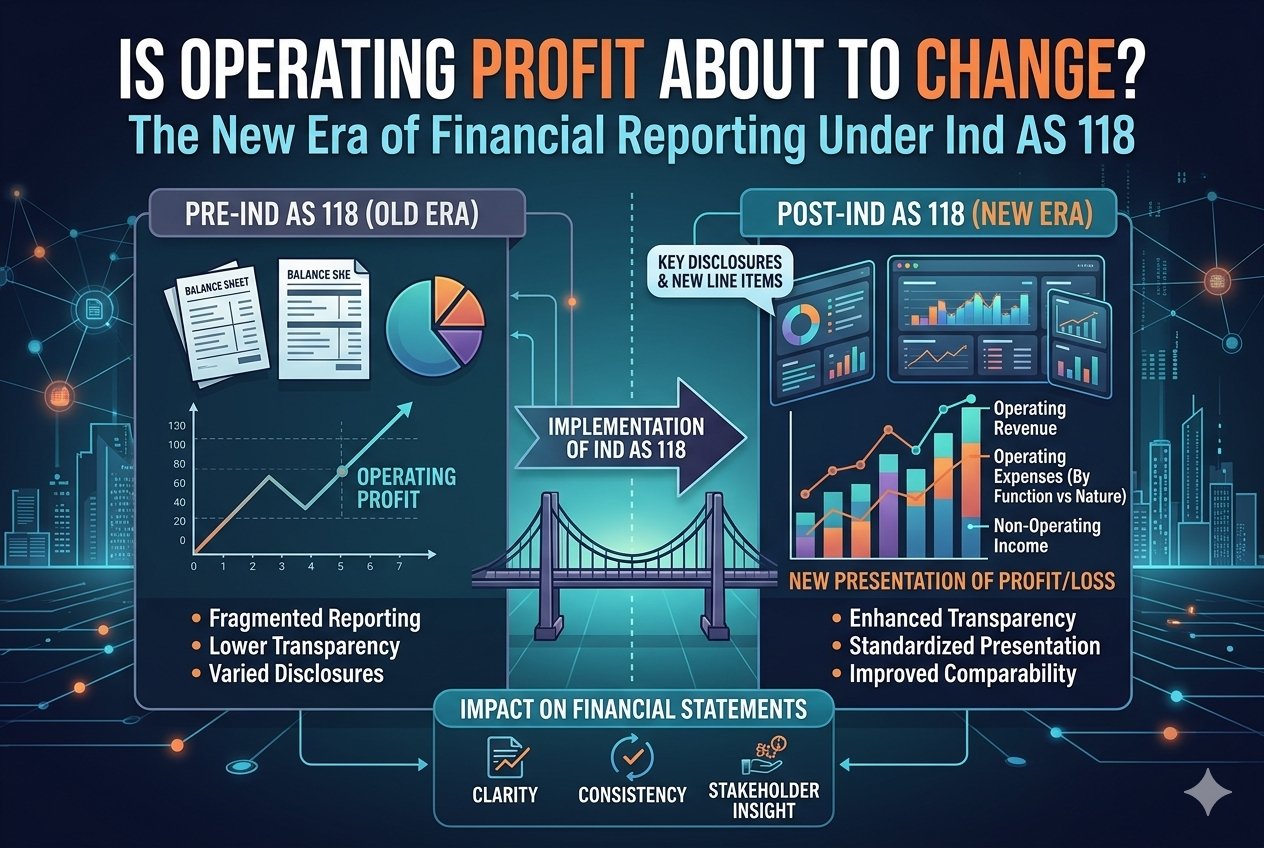
To address this challenge, a significant transformation in financial reporting is approaching through IFRS 18 and its proposed Indian counterpart, Ind AS 118.
The development could change how companies communicate their financial performance to investors, analysts and other stakeholders.
Why Is a Change Needed?
Under the existing financial reporting framework, companies have considerable flexibility in presenting certain subtotals in the statement of profit and loss.
As a result, similarly placed businesses may present different versions of operating profit and other performance measures.
This creates difficulties for investors attempting to compare profitability across companies and industries.
The objective of the new framework is to improve consistency, transparency and comparability.
Understanding Ind AS 118
Ind AS 118, Presentation and Disclosure in Financial Statements, is proposed to replace Ind AS 1.
It is based on IFRS 18, issued by the International Accounting Standards Board in April 2024.
The proposed Indian standard is expected to apply from 1 April 2027, subject to the prescribed notification process.
Globally, IFRS 18 becomes effective for annual reporting periods beginning on or after 1 January 2027.
Five Important Changes to Understand
1. New Categories in the Statement of Profit and Loss
Income and expenses will be classified into defined categories:
- Operating activities
- Investing activities
- Financing activities
- Income taxes
- Discontinued operations
This structure is intended to provide a clearer picture of different sources of financial performance.
2. Defined Operating Profit Subtotal
One of the most significant changes is the introduction of a defined operating profit subtotal.
This will improve comparability by reducing differences arising from companies using their own definitions of operating profit.
3. Management-Defined Performance Measures
Companies often communicate performance through measures such as adjusted EBITDA or adjusted operating profit.
The new framework introduces specific disclosure requirements for Management-Defined Performance Measures (MPMs).
Companies will need to explain these measures and reconcile them with the relevant IFRS-defined subtotals.
4. Better Classification of Expenses
The framework strengthens requirements relating to the presentation and disclosure of operating expenses.
Depending on which approach provides the most useful information, expenses may be presented by nature, by function or through a combination, subject to the standard’s requirements.
5. Improved Aggregation and Disaggregation
Companies will need to provide more meaningful information by grouping similar items and separately presenting material items where necessary.
This aims to prevent important financial information from getting lost within excessively broad headings.
What Does This Mean for Indian Companies?
The proposed changes could require more than modifications to the financial statement format.
Companies may need to:
- Review their existing chart of accounts.
- Reassess the classification of income and expenses.
- Upgrade accounting and ERP systems.
- Review management performance indicators.
- Strengthen internal reporting controls.
- Prepare comparative financial information for transition.
The proposed changes to Schedule III of the Companies Act, 2013, will also be important for alignment with the new reporting framework.
Impact on Investors and Financial Analysts
For investors, standardised operating profit reporting could make financial analysis more meaningful.
It may become easier to compare the operating performance of companies that previously used different presentation approaches.
Financial analysts will also need to reassess their valuation models, historical comparisons and performance benchmarks.
However, a change in presentation does not automatically mean that a company’s underlying profitability has increased or decreased.
This distinction is particularly important when analysing financial statements across transition periods.
The Role of Accountants, Auditors and Finance Professionals
The transition creates new responsibilities for finance teams and auditors.
Accountants will need to understand the classification requirements, prepare appropriate reconciliations and ensure that financial statements provide meaningful disclosures.
Auditors will need to examine the consistency of accounting policies, supporting documentation and management judgements.
For management accountants, the development also highlights the importance of integrating financial reporting with internal performance measurement.
Conclusion: Financial Reporting Is Moving Beyond Numbers
Financial statements are not merely documents prepared to fulfil regulatory requirements. They are important communication tools that influence investment decisions, corporate strategy and market confidence.
The transition towards Ind AS 118 represents an important step towards making financial reporting more transparent, comparable and decision-useful.
As companies prepare for this transformation, the challenge will not simply be to comply with a new accounting standard, but to rethink how they communicate financial performance.
Because better financial reporting does not necessarily change the business behind the numbers; it changes how clearly the world understands those numbers.