Economic growth has traditionally been measured through investment, industrial production, infrastructure development and profitability. But as climate change, environmental degradation and resource scarcity become increasingly important global concerns, another question is gaining attention:
Can the financial system become a powerful instrument for building a sustainable economy?
This is where Green Finance enters the picture.
Green finance is no longer just an environmental concept. It is emerging as an important part of modern banking, investment, corporate strategy and economic policymaking.
For a developing economy like India, it presents both an opportunity and a responsibility.
What Exactly Is Green Finance?
Green finance refers to financial activities that support projects, businesses and investments contributing to environmental sustainability.
It involves directing financial resources towards activities that help reduce environmental damage, improve energy efficiency and promote sustainable development.
Some important examples include:
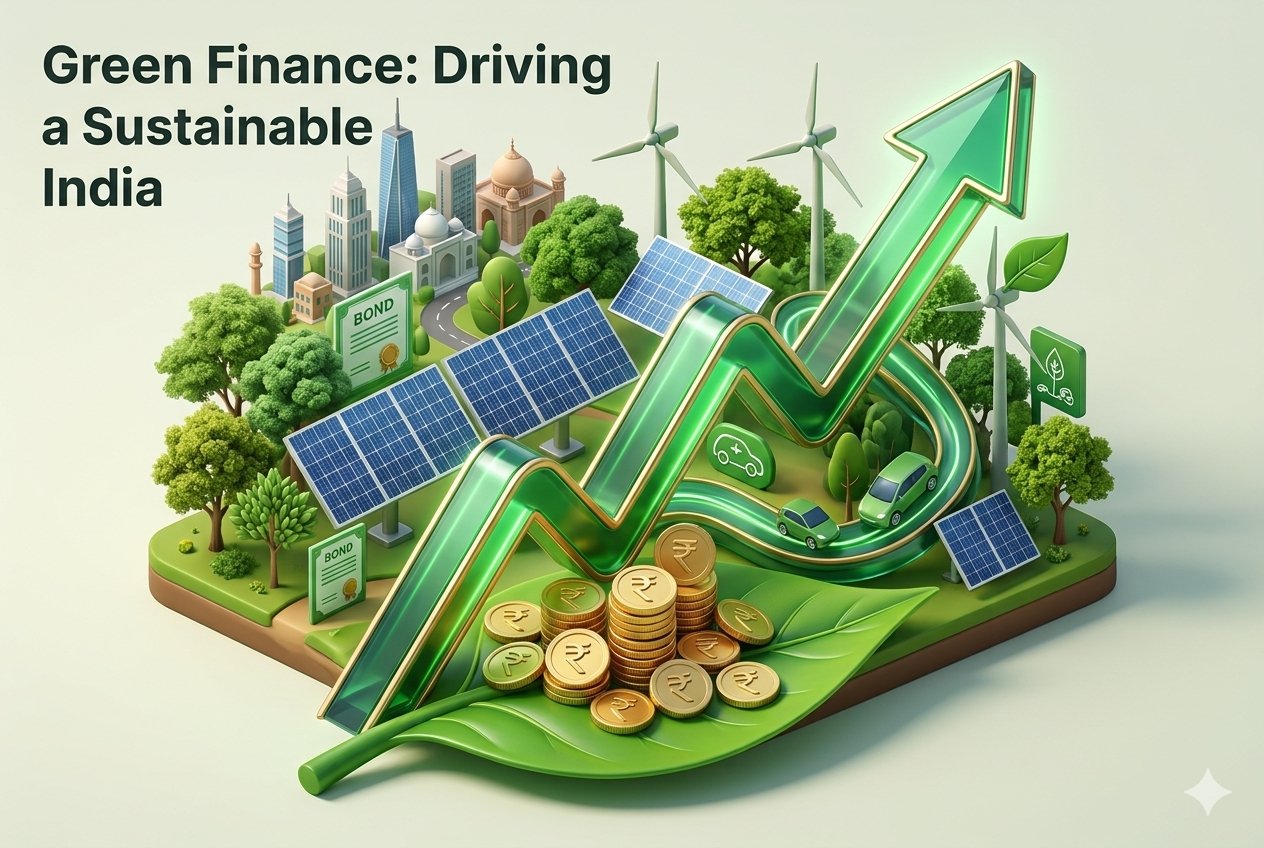
- Financing solar and wind energy projects.
- Funding electric vehicle infrastructure.
- Supporting energy-efficient manufacturing.
- Investing in sustainable agriculture.
- Developing green buildings and cleaner transportation systems.
- Financing water conservation and waste management projects.
In simple terms, green finance connects the power of money with the objective of protecting the environment.
Why Does Green Finance Matter for India?
India is one of the world’s fastest-growing major economies. Its development requires significant investment in infrastructure, manufacturing, transportation and energy.
However, economic expansion must also address environmental sustainability.
India has committed to achieving net-zero emissions by 2070 and expanding its non-fossil fuel energy capacity.
Meeting these ambitions requires substantial financial resources.
Government funding alone cannot meet every requirement. Banks, financial institutions, investors, corporations and international financial organisations must also participate.
Green finance can help bridge this investment gap by directing capital towards environmentally responsible economic activities.
Green Bonds: Turning Environmental Goals into Investment Opportunities
One of the most recognised instruments of green finance is the Green Bond.
A green bond is a debt instrument through which funds are raised specifically to finance or refinance eligible environmental projects.
Governments, financial institutions and corporations can issue green bonds to attract investors interested in supporting sustainable development.
For investors, these instruments provide an opportunity to participate in environmental projects while earning returns according to the bond’s terms.
For businesses and governments, they can provide an additional source of funding for sustainable infrastructure.
However, transparency is essential. Investors must be able to understand where the funds are being utilised and whether the intended environmental objectives are being achieved.
The Role of Banks and Financial Institutions
Banks are not merely intermediaries between depositors and borrowers. They also influence how capital flows through the economy.
By developing suitable green lending products, financing renewable energy projects and assessing environmental risks, financial institutions can encourage businesses to adopt more sustainable practices.
For example, a manufacturing company planning to replace energy-intensive machinery with energy-efficient equipment may require significant capital investment.
Green financing can help support such a transition.
Similarly, financial institutions can support electric mobility, sustainable infrastructure and responsible agricultural practices.
The objective is to make sustainable investment financially accessible and commercially viable.
The Challenges: Is Green Finance Really Green?
Despite its potential, green finance faces several important challenges.
1. Greenwashing
Some companies may present themselves as environmentally responsible without providing sufficient evidence of their actual environmental performance.
This can mislead investors and weaken confidence in sustainable investments.
2. High Initial Investment
Renewable energy, cleaner technology and sustainable infrastructure can require substantial upfront capital.
Smaller businesses may struggle to access affordable financing.
3. Lack of Standardisation
Different organisations may use different criteria to classify activities as environmentally sustainable.
Consistent definitions, credible reporting and transparent evaluation are essential.
4. Measuring Environmental Impact
Raising funds for a green project is only the beginning. Businesses must also demonstrate whether the investment has actually delivered the promised environmental benefits.
Without proper monitoring, green finance risks becoming a marketing exercise rather than a meaningful economic transformation.
What Does This Mean for Finance Professionals?
The growing importance of green finance is also changing the responsibilities of finance professionals.
Their role is no longer limited to evaluating profitability, liquidity and financial risk.
They increasingly need to understand environmental risks, sustainability disclosures, responsible investment and the financial implications of climate-related developments.
Cost accountants, financial analysts, auditors and investment professionals can contribute by evaluating project costs, assessing financial viability, monitoring the utilisation of funds and strengthening reporting transparency.
This creates an opportunity for the finance profession to become an important contributor to sustainable economic development.
The Road Ahead: Profitability and Sustainability Must Work Together
Green finance should not be viewed as a conflict between environmental responsibility and economic profitability.
Instead, it should encourage businesses to identify opportunities where financial returns and environmental benefits can support each other.
India needs investment that creates employment, strengthens infrastructure, supports innovation and protects natural resources.
Achieving this balance will require responsible financial institutions, transparent corporate reporting, informed investors and effective regulation.
Conclusion
Money has always influenced the direction of economic development. The question now is whether it can also influence the quality and sustainability of that development.
Green finance offers an opportunity to redirect capital towards a cleaner, more resilient and environmentally responsible economy.
For India, the challenge is not simply to raise more green funds, but to ensure that every investment creates measurable and meaningful progress.
Because the future of finance should not be measured only by the returns it generates, but also by the future it helps create.
Green finance is not just about financing a greener planet; it is about building an economy where growth and sustainability move forward together.