Introduction: A New Generation of Indian Investors
India’s financial markets are witnessing a remarkable transformation. Investing, once considered an activity largely associated with financially established individuals, has increasingly become accessible to ordinary households, young professionals and first-time investors.
With the growth of digital trading platforms, mobile applications, financial content creators and simplified account-opening processes, participating in the stock market has become easier than ever.
A few taps on a smartphone can now provide access to equities, mutual funds and complex financial instruments such as Futures and Options (F&O).
But this growing participation raises an important question:
Are Indians becoming more financially aware, or are they simply becoming more comfortable taking financial risks?
The distinction between investing and speculation has never been more important.
1. India’s Changing Investment Landscape
The expansion of digital infrastructure and financial services has significantly changed how individuals participate in financial markets.
Investors today have access to multiple investment avenues, including:
- Equity Markets: Investing in listed companies to participate in their long-term growth.
- Mutual Funds: Investing through professionally managed and diversified portfolios.
- Exchange-Traded Funds (ETFs): Accessing diversified market exposure through exchange-traded instruments.
- Government Securities: Investing in government-backed debt instruments.
- Derivatives: Using Futures and Options for hedging, trading and managing market exposure.
This wider choice has created opportunities for wealth creation and portfolio diversification.
However, accessibility alone does not guarantee financial understanding. The ability to purchase a financial product should not be confused with the ability to understand its risks.
2. Investing vs Speculating: Understanding the Difference
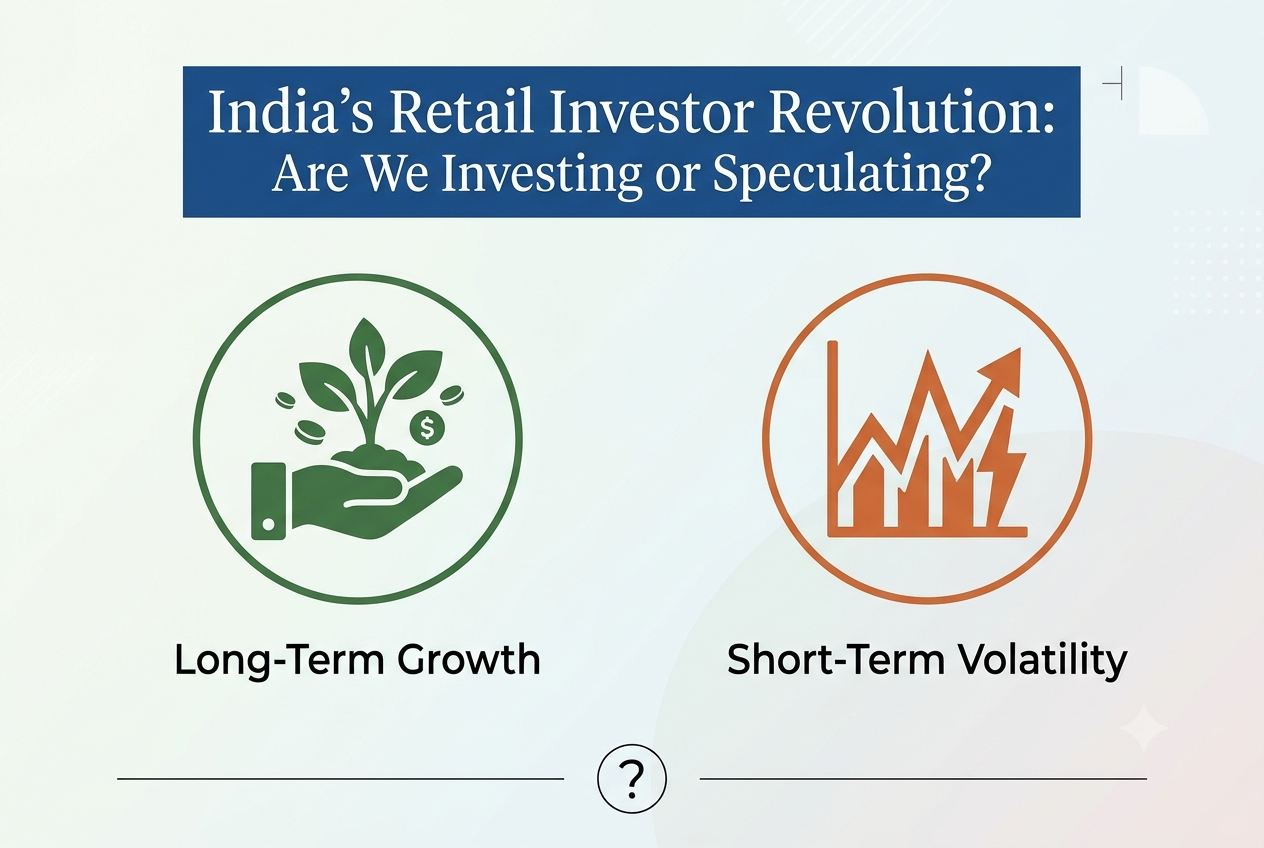
One of the biggest challenges in today’s financial environment is the growing confusion between investing and short-term speculation.
Although both involve financial markets, their objectives and approaches are different.
Investing generally involves allocating money to financial assets with the objective of achieving returns over time. It requires understanding the underlying asset, evaluating risk and aligning investments with financial goals.
Speculation, on the other hand, involves taking positions primarily to benefit from anticipated short-term price movements. It often carries greater uncertainty and may involve substantial financial risk.
Consider two individuals:
The first invests in a fundamentally strong company after studying its business model, financial performance and growth prospects.
The second purchases an options contract based on a prediction that the market will move in a particular direction within a few hours.
Both are participating in financial markets, but their objectives, time horizons and risk exposures are significantly different.
The problem arises when speculative trading is mistaken for a reliable wealth-creation strategy.
3. The Warning Behind India’s F&O Trading Losses
The growing popularity of derivatives trading has brought investor risk into sharper focus.
According to the Securities and Exchange Board of India (SEBI), its August 2026 study on the profitability of individual traders in the Equity Derivatives Segment for FY 2025–26 revealed some concerning findings:
- 87.7% of individual traders incurred net losses in the equity derivatives segment.
- Aggregate net losses amounted to approximately ₹91,685 crore.
- The average net loss per individual trader was approximately ₹1.17 lakh.
- Individual participation in the segment declined by 18% compared with FY 2024–25.
These findings highlight the financial challenges associated with derivatives trading.
However, an important distinction must be made: these statistics relate specifically to individual participants in the equity derivatives segment. They should not be interpreted as the loss rate of all Indian stock market investors or long-term equity investors.
The findings nevertheless raise an important concern about financial awareness, risk management and the growing attraction of short-term trading.
4. Why Are Individuals Attracted to Short-Term Trading?
Several behavioural and technological factors influence the growing interest in speculative trading.
1. The Attraction of Quick Returns
The possibility of earning substantial returns within a short period can make trading appear more attractive than conventional long-term investment approaches.
However, the possibility of higher returns also comes with the possibility of significant losses.
2. Social Media Influence
Financial content on social media has made market information more accessible. However, investment decisions based on unverified tips, unrealistic return claims and incomplete information can expose individuals to unnecessary risks.
3. Fear of Missing Out (FOMO)
When investors see others discussing profits or celebrating successful trades, they may feel pressured to participate without adequately understanding the underlying risks.
4. Misunderstanding Leverage
Derivatives allow participants to gain exposure to larger positions with a relatively smaller initial margin or premium. While this can increase capital efficiency, it can also magnify financial losses.
5. Emotional Decision-Making
Fear, greed, overconfidence and the desire to recover previous losses can influence trading decisions. Without discipline, even an informed participant can make financially damaging choices.
5. Financial Literacy: The Missing Link
Financial literacy is not simply about knowing how to open a trading account or purchase shares.
It involves understanding financial products, evaluating risk, identifying suitable investment opportunities and making decisions based on financial objectives.
A financially aware investor should understand:
- The relationship between risk and return.
- The difference between equity investing and derivatives trading.
- The importance of diversification.
- The impact of transaction costs and taxation.
- The role of investment horizons and liquidity requirements.
- The importance of avoiding decisions driven by market rumours or emotions.
Financial education must therefore move beyond explaining how to invest and focus equally on understanding when, why and how much risk to take.
6. The Role of Regulation and Investor Protection
A growing financial market requires not only greater participation but also stronger investor awareness and appropriate safeguards.
SEBI has undertaken several measures aimed at addressing excessive speculation and improving the functioning of the equity derivatives market.
Its research also provides an important reminder that market participation should be accompanied by an understanding of financial risks.
However, regulation alone cannot eliminate investment losses. Individuals must also take responsibility for their financial decisions.
Investors should read product disclosures, understand contractual obligations, verify information and avoid treating market participation as a guaranteed source of income.
Financial institutions, educational institutions and professional bodies also have an important role in promoting responsible investment behaviour.
7. Building Wealth Requires More Than Market Participation
The objective of investing should not simply be to participate in every market opportunity.
It should be to build financial security over time.
A disciplined approach involves:
- Setting clear financial goals.
- Maintaining an adequate emergency fund.
- Selecting investment products according to risk tolerance.
- Diversifying investments appropriately.
- Reviewing portfolio performance periodically.
- Avoiding excessive borrowing and leverage.
- Maintaining patience during market volatility.
Long-term wealth creation is generally a process of informed decisions, consistency and discipline rather than repeated attempts to predict short-term market movements.
Conclusion: From Market Participation to Financial Responsibility
India’s retail investor revolution represents an important development in the country’s financial ecosystem.
Greater access to financial markets can encourage savings, investment and participation in economic growth.
However, the real success of this transformation should not be measured merely by the number of trading accounts opened or the volume of transactions executed.
It should also be measured by how effectively individuals understand financial products, manage risks and make informed decisions.
The stock market should be approached as a platform for informed financial participation, not as a shortcut to instant wealth.
The real investment revolution will begin when financial awareness grows faster than the desire for quick returns.
Because entering the market is easy, but understanding the market is what makes the difference.
Investing is not about chasing every opportunity; it is about making the right financial decisions with knowledge, patience and discipline.