By The Worldonomics Times
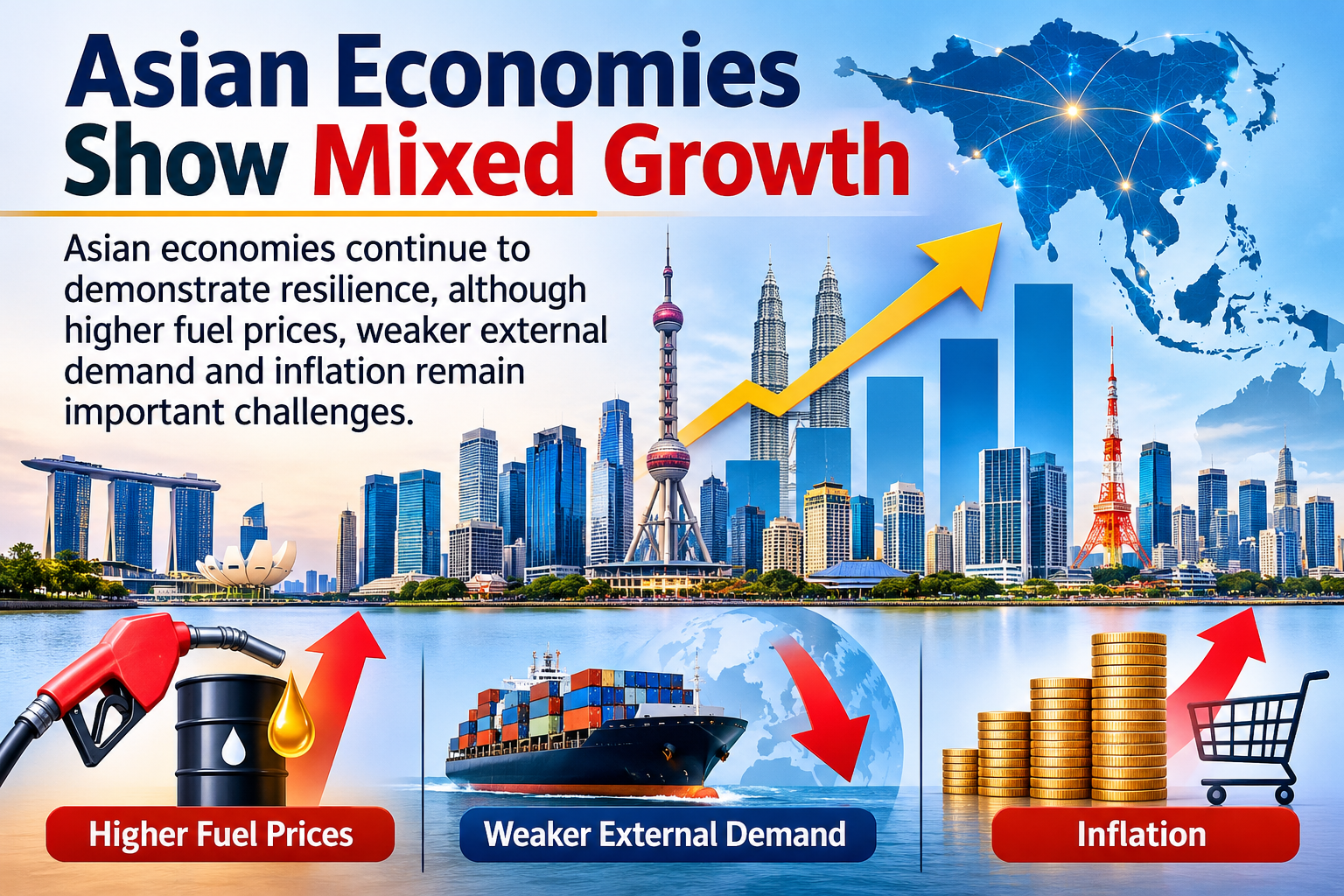
Asian economies continue to demonstrate resilience despite a challenging international environment marked by higher fuel prices, weaker external demand, inflationary pressures and geopolitical uncertainty. While several countries are benefiting from strong technology investment, expanding exports and domestic consumption, others are experiencing slower growth because of rising import costs, subdued consumer spending and changing global trade conditions.
Asia remains one of the most important contributors to global economic expansion. However, the region’s performance is becoming increasingly uneven, with differences in industrial structure, energy dependence, domestic demand and trade exposure influencing the outlook for individual economies.
Regional Growth Remains Resilient but Uneven
According to the International Monetary Fund’s October 2026 Regional Economic Outlook, economic growth in Asia and the Pacific is projected to ease from 5% in 2025 to 4.8% in 2026 and 4.4% in 2027. Despite this moderation, the region is expected to contribute approximately 68% of global economic growth in 2026.
The IMF identifies three major forces shaping the regional outlook: the energy shock associated with conflict in the Middle East, the expansion of artificial intelligence-related investment, and changes in international trade following tariff increases.
These developments are creating different outcomes across countries. Economies with strong technology manufacturing and export industries are benefiting from growing demand for semiconductors and digital infrastructure. Meanwhile, countries heavily dependent on imported energy or traditional exports are facing greater pressure from higher production and transportation costs.
China Faces Domestic Demand Challenges
China remains a central force in the Asian and global economy because of its extensive manufacturing sector, large consumer market and position in international supply chains.
However, its economic outlook continues to face challenges. Weak domestic consumption, difficulties in the property sector and uncertainty surrounding international trade are affecting business confidence and investment.
The IMF projects China’s economic growth at 4.5% in 2026. Although exports and technology-related industries continue to provide support, policymakers face the task of strengthening household consumption and addressing structural weaknesses in the property market.
China’s economic performance is particularly important for neighbouring economies that depend on its demand for raw materials, intermediate goods, machinery and consumer products. A slowdown could therefore affect manufacturers and exporters throughout Asia.
India Maintains a Strong Growth Outlook
India continues to be among the region’s stronger-performing major economies. Domestic consumption, infrastructure investment, services exports and expanding industrial activity are supporting economic growth.
The Asian Development Bank’s September 2026 outlook projected India’s GDP growth at 7% for the 2026 financial year ending March 2027. Resilient household consumption, healthy investment and strong services exports are expected to offset some of the pressure from higher energy costs and weaker monsoon conditions.
India’s large domestic market provides an important source of demand, reducing its dependence on external markets compared with some export-oriented economies. However, higher crude oil prices can increase the import bill, raise transportation expenses and create inflationary pressure.
Maintaining investment momentum, improving infrastructure and strengthening manufacturing competitiveness will remain important for sustaining India’s growth in the coming years.
Southeast Asia Benefits from Trade and Investment
Southeast Asian economies are experiencing varied but generally resilient economic conditions. Countries such as Vietnam and Malaysia are benefiting from manufacturing investment, export diversification and their growing roles in regional supply chains.
Indonesia continues to receive support from domestic consumption and investment, while Thailand and the Philippines face different combinations of external demand, tourism performance and domestic economic challenges.
The Asian Development Bank projected developing Southeast Asia’s growth at 4.7% in 2026, with a modest improvement from its earlier forecast. However, the outlook differs across individual countries. Higher food and energy costs, uncertainty in international trade and uneven domestic demand remain important risks.
The region’s ability to attract foreign investment and develop manufacturing, tourism and digital services will influence its longer-term economic performance.
Japan and South Korea Follow Different Growth Paths
Japan and South Korea illustrate the differences in economic performance among advanced Asian economies.
South Korea is benefiting from strong global demand for semiconductors and artificial intelligence-related products. Its position in the technology supply chain has supported industrial production and exports, although future performance will depend on continued demand and international market conditions.
Japan, in contrast, is facing pressure from higher energy import costs and weaker consumer spending. Preliminary figures released on November 16 showed that Japan’s economy contracted at an annualised rate of 0.1% in the July–September quarter. Consumer spending weakened, while business investment remained comparatively strong, supported by digital demand.
As a major energy importer, Japan is particularly vulnerable to increases in international oil prices. A weaker yen can further increase the domestic cost of imported fuel and other commodities.
Energy Prices and Inflation Create Additional Pressure
Higher fuel prices are among the most significant challenges facing Asian economies. Many countries in the region depend on imported crude oil, natural gas and other energy resources to support manufacturing, transportation and electricity generation.
Rising energy costs increase expenses for businesses and can eventually affect food prices, consumer goods and household budgets. Countries with limited fiscal resources may find it difficult to provide broad subsidies without placing additional pressure on government finances.
The Asian Development Bank expects developing Asia and the Pacific to record inflation of 4.2% in 2026. Although inflationary conditions differ across countries, elevated energy prices and climate-related disruptions remain important risks.
Policymakers must therefore balance inflation control with the need to sustain economic activity. Targeted support for vulnerable households, improved energy efficiency and investment in alternative energy sources can help reduce the impact of external price shocks.
Technology and Regional Trade Offer New Opportunities
Despite economic pressures, technology investment is creating important growth opportunities across Asia. Demand for semiconductors, data centres, artificial intelligence infrastructure and digital services is supporting exports and attracting investment.
The region also benefits from increasingly diversified supply chains. Businesses seeking alternatives to concentrated manufacturing networks are considering additional production locations across Southeast Asia and South Asia.
However, the benefits are not equally distributed. Economies with reliable infrastructure, skilled workers, competitive production costs and stable regulatory environments are better positioned to attract investment.
Improving regional trade connectivity and reducing barriers to services trade could also strengthen economic integration. The IMF estimates that reducing restrictions on services trade could raise the region’s long-term GDP by close to 1%.
The Worldonomics Times View
Asian economies remain an important engine of global growth, but their performance increasingly reflects different domestic conditions and exposure to international risks. Strong technology demand and investment are supporting some countries, while higher fuel prices, weaker external demand and inflation are creating difficulties for others.
For India, the current environment presents opportunities to attract manufacturing investment, expand exports and strengthen its position in regional supply chains. Achieving these gains will require continued infrastructure development, improvements in productivity and policies that encourage investment and innovation.
Across the region, governments must focus on economic diversification, energy security, stronger domestic demand and regional cooperation. Businesses will also need to adapt to changing trade patterns and manage costs more carefully.
Asia’s long-term economic prospects remain significant. However, sustaining growth will depend on how effectively individual economies respond to external shocks while building stronger and more balanced foundations for future development.