By The Worldonomics Times
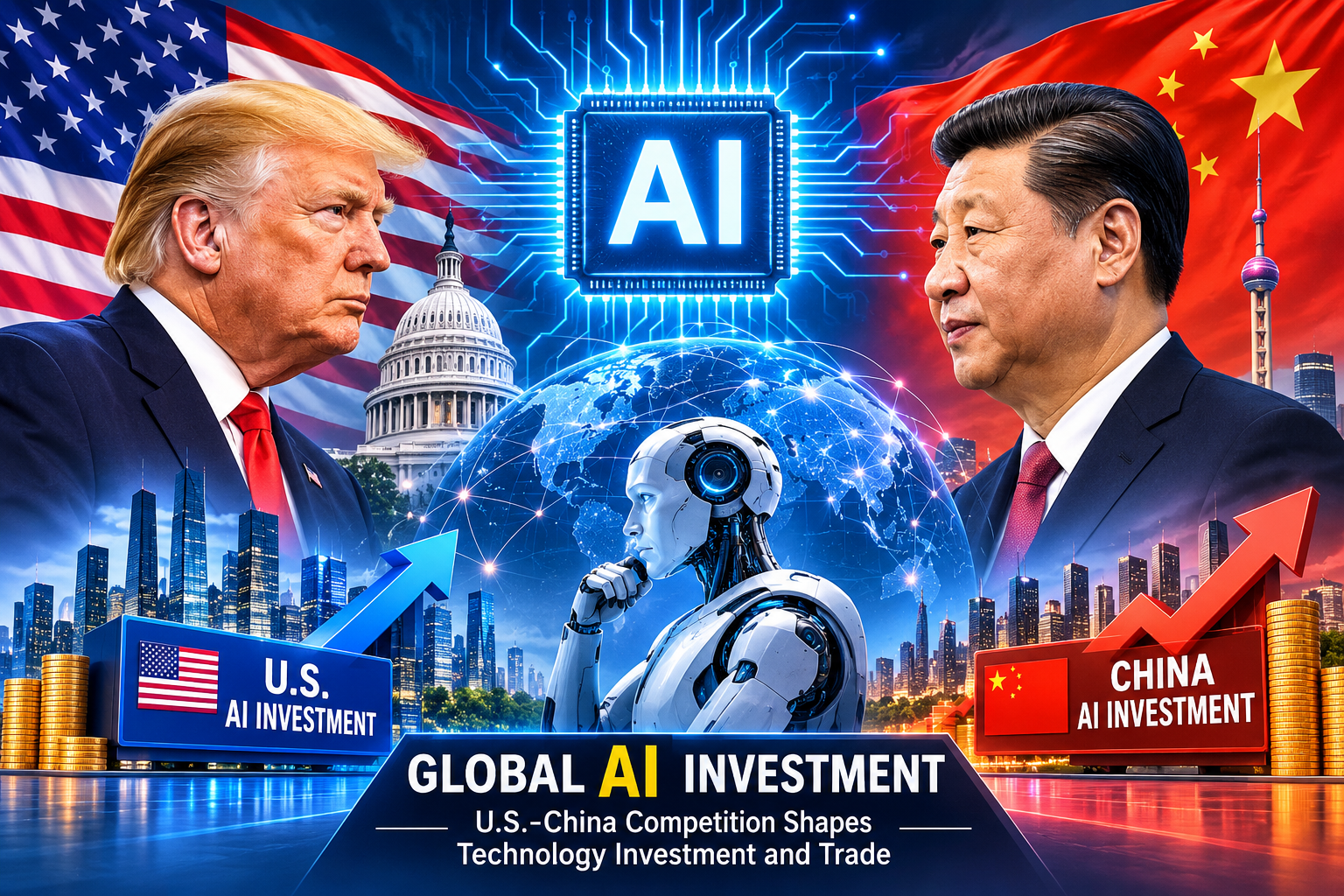
Artificial intelligence has become a major driver of global investment, technological innovation and international trade. The United States and China are competing to strengthen their positions in AI research, advanced semiconductors, data centres and digital infrastructure. Their rivalry is influencing the decisions of technology companies, investors and governments across the world.
The competition extends beyond the development of AI software. Access to advanced chips, computing capacity, energy and skilled workers is increasingly important to national economic strategies. As both countries seek to strengthen their domestic technology industries, international businesses are adjusting supply chains and investment plans to respond to changing trade rules.
The result is a global technology environment offering significant opportunities for investment while creating new regulatory and geopolitical uncertainty.
United States and China Compete for AI Leadership
The United States has a strong position in AI research, semiconductor design, cloud computing and the development of advanced AI models. Major American technology companies are investing heavily in data centres, specialised processors and computing infrastructure to meet growing demand from businesses and consumers.
The country’s technology ecosystem benefits from established research institutions, venture capital markets and leading software and cloud-service providers. These strengths have helped attract investment in generative AI, automation, enterprise software and high-performance computing.
China is pursuing its own strategy to strengthen domestic AI capabilities. Its technology companies and research institutions are developing AI models, robotics, semiconductor technologies and large-scale computing systems. Government policies also encourage greater technological self-reliance and reduced dependence on foreign suppliers.
The two countries have different advantages. The United States retains significant influence in advanced chip design and global cloud services, while China has a large manufacturing base, substantial engineering capacity and access to considerable electricity resources. Their competition is encouraging investment across the wider technology industry.
Semiconductor Investment Becomes a Strategic Priority
Advanced semiconductors are essential to artificial intelligence because they provide the computing power required to train and operate sophisticated models.
The United States is seeking to expand domestic chip manufacturing and strengthen its semiconductor supply chain. In July 2026, the US National Institute of Standards and Technology reported an additional $100 billion investment commitment by Taiwan Semiconductor Manufacturing Company, taking its announced planned investment in the United States to $265 billion. The programme includes additional advanced semiconductor fabrication and packaging facilities in Arizona.
China is also investing in domestic semiconductor manufacturing, chip design and alternative computing technologies. These efforts are intended to improve its ability to develop and operate AI systems despite restrictions on access to some advanced foreign processors.
The expansion of semiconductor investment could increase global manufacturing capacity and create opportunities for equipment suppliers, construction companies and technology-service providers. However, competition over production equipment, intellectual property and access to advanced chips is also making international supply chains more complicated.
Export Controls Increase International Trade Uncertainty
Technology restrictions have become a central part of the US-China AI competition.
The United States has introduced export controls intended to limit China’s access to certain advanced processors and computing technologies. These controls are designed to prevent sensitive American technology from being used in applications that Washington considers a national security risk.
On November 16, 2026, the US Commerce Department announced new restrictions addressing remote access to advanced AI chips and servers through overseas data centres. The measures introduce additional licensing requirements for certain chip shipments involving Singapore, Malaysia, Indonesia, Thailand and Brazil. Overseas data centres providing significant computing capacity to companies in restricted countries must also meet new licensing and compliance requirements.
These rules have implications beyond the United States and China. Semiconductor distributors, cloud-service providers and data-centre operators in third countries may face additional checks on customers, ownership structures and the intended use of computing equipment.
China has criticised US technology restrictions and is developing its own regulatory measures. A proposed Chinese framework announced in October 2026 would introduce controls on the export of certain advanced AI models and related technologies, while distinguishing between access to AI services and the transfer of underlying technology.
These developments demonstrate how AI competition is increasingly influencing international trade regulations and business decisions.
AI Infrastructure Attracts Global Investment
The AI boom is creating investment opportunities well beyond software development and semiconductor manufacturing.
Technology companies are expanding data centres, cloud-computing networks and specialised hardware facilities. These projects require substantial investment in processors, servers, cooling systems, electricity generation and telecommunications infrastructure.
According to the International Data Corporation (IDC), global spending on AI infrastructure reached $121.4 billion in the second quarter of 2026, an increase of 53% compared with the same period in 2025. IDC raised its full-year 2026 forecast to approximately $521 billion, reflecting sustained demand for computing capacity and higher infrastructure costs.
Energy availability is becoming particularly important. Data centres require reliable electricity, and the expansion of AI computing is increasing demand for power generation, grid upgrades and energy storage. Countries with affordable electricity, reliable connectivity and predictable regulations are therefore competing to attract new investment.
Implications for International Businesses and Emerging Economies
The competition between the United States and China is influencing where companies manufacture, source components and establish technology operations.
Some businesses are diversifying production across several countries to reduce dependence on individual suppliers and manage geopolitical risks. This creates opportunities for economies in Southeast Asia, India and other emerging markets to attract semiconductor-related manufacturing, electronics production and data-centre investment.
However, tighter export controls can also increase compliance costs, delay shipments and restrict access to certain technologies. Companies operating internationally must increasingly consider trade regulations, customer verification and restrictions on technology transfers when planning their investments.
The broader economic impact will depend on whether countries can maintain international cooperation while addressing legitimate security concerns. Excessive fragmentation could increase production costs and slow the spread of technology, while predictable rules could support investment and innovation.
Implications for India
India has an opportunity to benefit from the expansion of global AI investment while developing its own technology capabilities.
The government’s IndiaAI Mission, with an approved outlay of approximately ₹10,372 crore, is supporting computing infrastructure, research, start-ups and the development of domestic AI models. By June 2026, shared computing capacity under the initiative had expanded to more than 45,000 GPUs.
India is also attracting investment in data centres. Government figures indicate that installed data-centre power capacity reached approximately 1.57 GW by August 2026. Nearly $70 billion in investment was underway, with a further $90 billion in announced projects.
These developments could strengthen India’s position in cloud computing, AI services, software development and digital infrastructure. Opportunities may also emerge in electronics manufacturing, semiconductor assembly, engineering services and specialised technology support.
Nevertheless, India must address challenges involving skilled talent, reliable electricity, advanced computing access, research funding and domestic semiconductor capabilities. Maintaining balanced relationships with major technology partners will also be important for preserving access to international markets and investment.
The Worldonomics Times View
Competition between the United States and China in artificial intelligence is becoming a defining feature of the global technology economy. Both countries are investing heavily in computing infrastructure, advanced chips and research, while government policies increasingly influence where companies can manufacture, invest and provide digital services.
This competition is accelerating innovation and creating commercial opportunities across several industries. At the same time, export restrictions, investment controls and supply-chain uncertainty are making international business more complex.
The future of AI investment will depend not only on software and algorithms but also on access to semiconductors, energy, infrastructure and skilled workers. Countries that can combine these resources with stable investment policies will be better positioned to participate in the expanding AI economy.
For India, the opportunity lies in strengthening domestic capabilities while remaining connected to international technology and investment networks. Continued investment in research, manufacturing, digital infrastructure and workforce development can help the country secure a more significant role in the global AI ecosystem.
Ultimately, the US-China AI competition will continue to influence international investment and trade. Its wider economic impact will depend on whether technological rivalry encourages innovation and productive investment or leads to deeper fragmentation of global markets.