By The Worldonomics Times
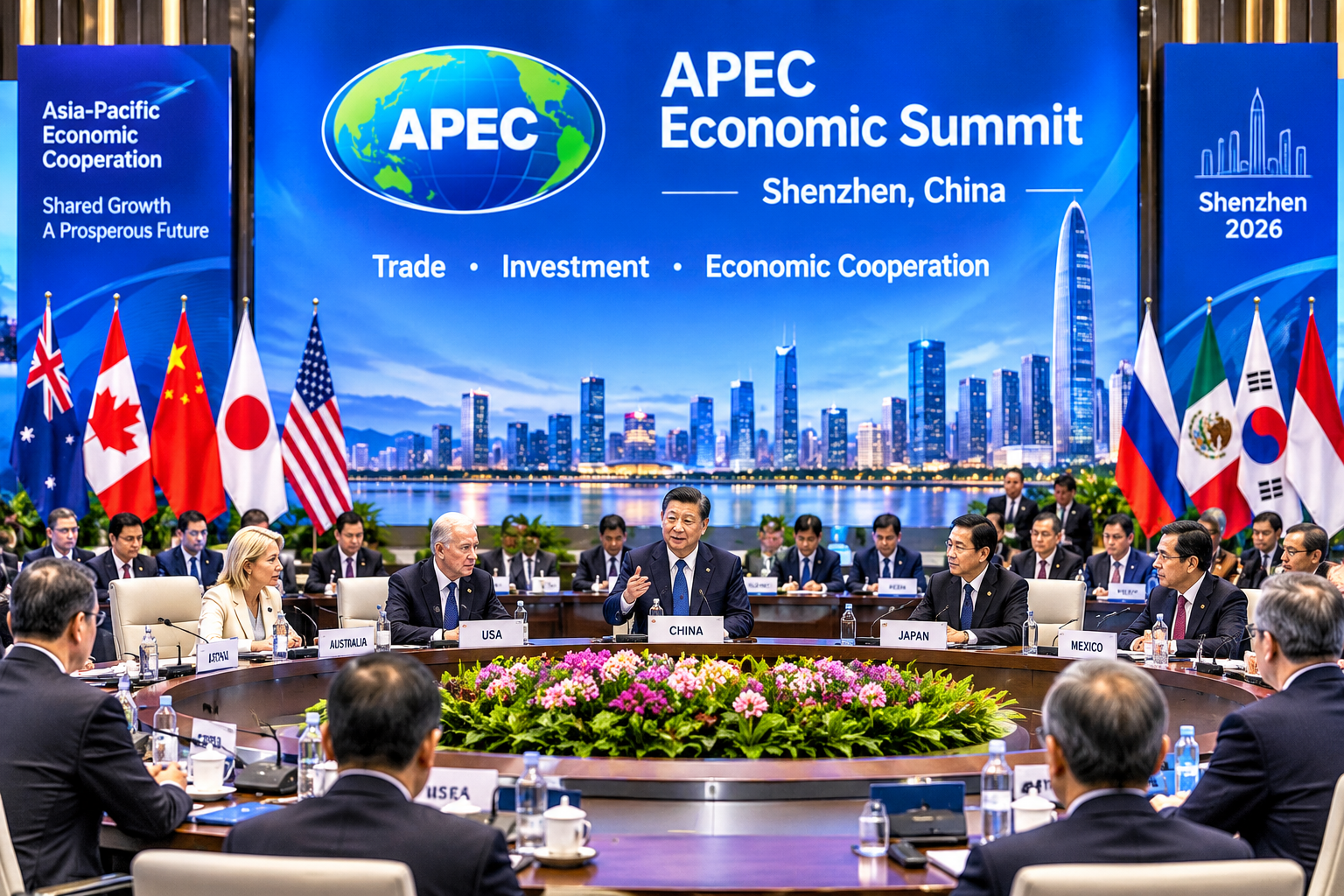
Global political leaders, senior government representatives and business executives have gathered in Shenzhen, China, for the 2026 Asia-Pacific Economic Cooperation (APEC) Economic Leaders’ Meeting and its associated business summit. The discussions are taking place at a time when international trade faces growing uncertainty from geopolitical tensions, protectionist policies, supply-chain disruptions and rapid technological change.
The 33rd APEC Economic Leaders’ Meeting is scheduled for November 18–19 under the theme “Building an Asia-Pacific Community to Prosper Together.” The accompanying APEC CEO Summit, held from November 17–18, has brought together political and business representatives to discuss regional investment, trade, innovation and sustainable development. Chinese President Xi Jinping is chairing the leaders’ meeting.
The gathering is particularly important because the Asia-Pacific region remains one of the world’s most significant centres of manufacturing, international trade, technology investment and economic growth.
Shenzhen Becomes a Centre for Global Economic Dialogue
Shenzhen’s selection as the host city reflects China’s ambition to highlight the importance of innovation, manufacturing and international business cooperation.
The city is a major technology and industrial centre, with strong connections to electronics, telecommunications, advanced manufacturing and digital services. Its role in China’s economic development makes it a suitable location for discussions about the future of regional trade and investment.
The APEC CEO Summit has attracted more than 2,000 representatives from 21 APEC economies and 13 non-APEC economies. Participants include representatives from 115 Fortune Global 500 companies, alongside international organisations and business associations.
Discussions have covered regional connectivity, artificial intelligence, digital transformation, sustainable development and opportunities for expanding international investment.
The participation of major international companies demonstrates that businesses continue to view the Asia-Pacific region as an important destination for investment, despite uncertainty in the global economic environment.
Trade Openness and Protectionism Dominate Discussions
One of the central issues at the summit is the future of international trade.
Businesses operating across the Asia-Pacific are facing changing tariff policies, export restrictions and increasing competition between major economies. These developments have created uncertainty for manufacturers, exporters and international investors.
In his opening address at the APEC CEO Summit on November 18, Chinese President Xi Jinping called for free and open trade, opposition to protectionism and support for the rules-based multilateral trading system centred on the World Trade Organization.
He also emphasised the importance of maintaining stable international industrial and supply chains and expanding opportunities for trade and investment. His remarks came amid continuing disagreements between China and the United States over tariffs, advanced technology and access to semiconductor products.
APEC provides an important platform for addressing these issues through dialogue. However, its commitments are generally voluntary and reached through consensus rather than legally binding agreements. This means that the success of discussions will depend on whether participating economies translate common priorities into practical policy cooperation.
Investment and Regional Supply Chains Remain Priorities
Investment is another major focus of the Shenzhen summit.
Companies are increasingly reviewing their manufacturing locations and international supply arrangements in response to geopolitical tensions, rising production costs and changing trade regulations.
The Asia-Pacific region offers significant opportunities because it combines large consumer markets, established manufacturing centres, skilled workforces and expanding digital infrastructure.
APEC discussions are expected to support greater regional connectivity, encourage investment in infrastructure and improve the business environment for companies operating across borders.
The APEC Business Advisory Council has also called for open trade and investment, stronger supply-chain resilience and sustainable connectivity infrastructure. These priorities are important for businesses seeking predictable regulations and reliable access to international markets.
Artificial Intelligence and Digital Transformation Take Centre Stage
Technology is emerging as another major theme of APEC 2026.
Artificial intelligence, digital payments, cybersecurity, cloud computing and advanced manufacturing are transforming how companies operate and compete internationally.
The summit’s discussions include developing an open and inclusive AI innovation ecosystem, expanding digital-economy cooperation and improving the use of technology in areas such as healthcare, education and energy.
These developments are particularly relevant for the Asia-Pacific, where economies have different levels of technological development and regulatory approaches.
Greater cooperation could help businesses access new markets, improve productivity and develop common approaches to digital trade. At the same time, differences over data governance, cybersecurity, technology standards and access to advanced semiconductors remain potential obstacles.
The challenge for policymakers will be to encourage innovation while ensuring that digital development remains secure, inclusive and beneficial to businesses and consumers across the region.
Major Global Leaders and Business Executives Participate
The Shenzhen meeting has attracted significant international attention because of the participation of leaders from major global economies.
The gathering includes representatives from the United States, China, Russia, Japan, Canada, Mexico and several Southeast Asian economies. The presence of major political leaders alongside business executives creates opportunities for bilateral discussions on trade, investment and international relations.
The meeting is also taking place against the background of wider geopolitical tensions, including disagreements over technology exports, energy security and international conflicts.
Reuters has identified trade relations, artificial intelligence, rare-earth supplies and regional security as important issues surrounding the leaders’ discussions. These matters could influence the wider economic environment well beyond the Asia-Pacific region.
Although APEC focuses primarily on economic cooperation, political developments can influence its ability to achieve practical progress.
Implications for International Businesses and India
The outcomes of the Shenzhen summit could influence international businesses through changes in trade policy, investment priorities, technology cooperation and regional supply-chain development.
For companies operating in manufacturing, electronics, logistics, financial services and digital technology, greater economic cooperation could create new commercial opportunities. More predictable trade rules and improved connectivity would also help businesses manage cross-border operations.
India is not an APEC member, although it remains an important economic partner for several participating economies. India’s exclusion from the forum means it does not directly participate in APEC’s consensus-based decisions. Nevertheless, developments within the organisation can influence Indian exporters, investors and manufacturers.
Stronger regional cooperation could create opportunities for Indian companies in pharmaceuticals, engineering goods, information technology, electronics, renewable energy and logistics. India’s expanding manufacturing capabilities may also help international companies diversify supply chains beyond established production centres.
India can benefit by strengthening its bilateral trade relationships with APEC economies, improving infrastructure and developing competitive manufacturing capabilities. Cooperation in digital services, technology and regional connectivity could further support its economic engagement with the Asia-Pacific.
The Worldonomics Times View
The 2026 APEC Economic Summit in Shenzhen represents an important opportunity for global leaders and business executives to discuss the future of international economic cooperation.
Trade openness, investment, supply-chain resilience and technological innovation are central to the discussions because these issues will influence the competitiveness of economies over the coming years.
However, achieving meaningful progress will require more than political statements. Governments must work towards predictable trade policies, transparent investment regulations and stronger cooperation on digital and industrial development.
The participation of major business leaders also highlights the importance of private-sector investment in supporting economic growth. Companies need stable operating conditions, reliable infrastructure and access to international markets to expand their activities.
For India, the summit offers an opportunity to observe regional developments and strengthen economic engagement with participating economies, even without direct membership in APEC.
Ultimately, the success of the Shenzhen summit will depend on whether participating economies can convert their discussions into practical cooperation. Stronger trade relationships, sustainable investment and responsible technological development will be essential for building a more resilient and prosperous Asia-Pacific economy.