By The Worldonomics Times
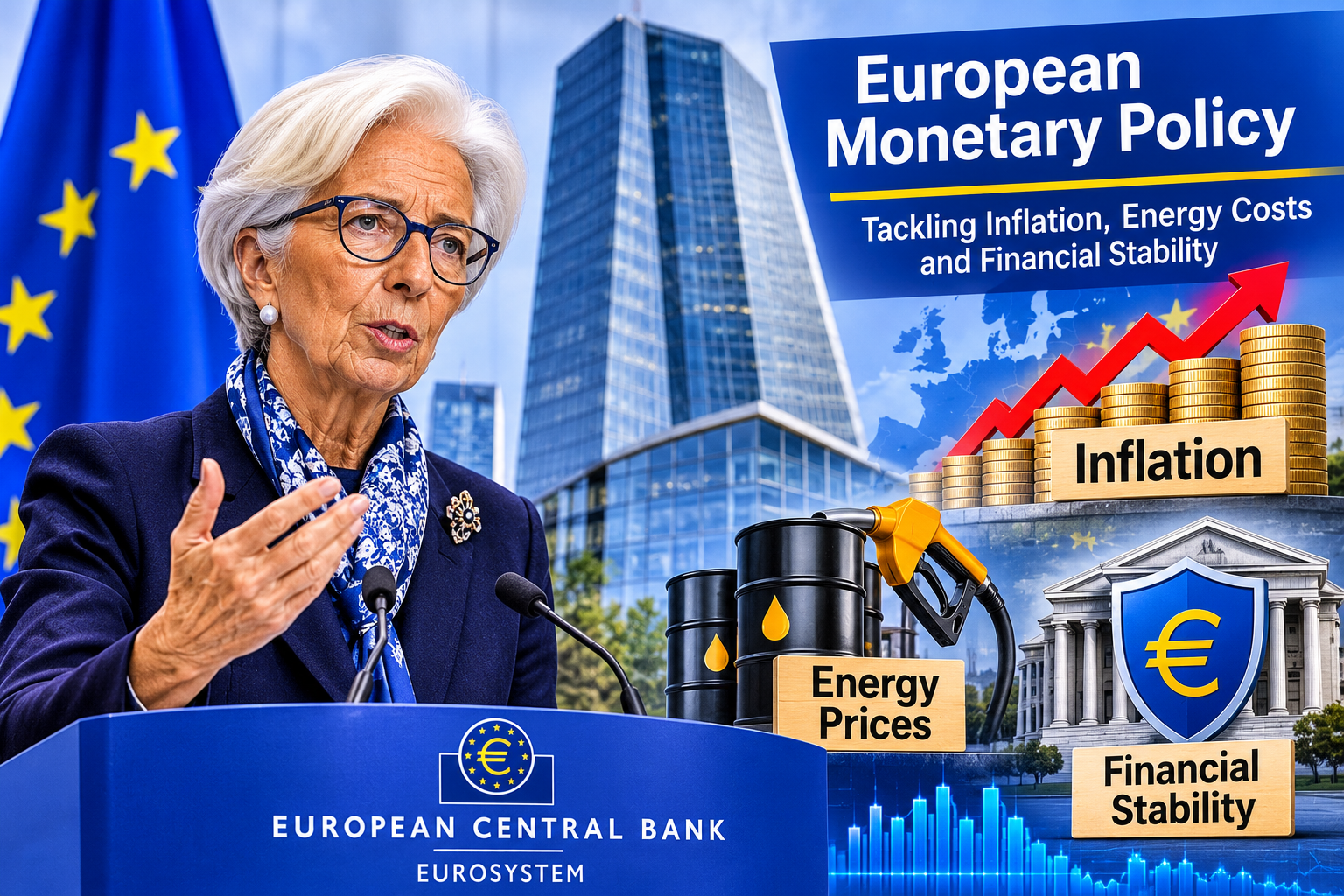
The European Central Bank (ECB) is facing a challenging monetary policy environment as rising energy prices, persistent inflation and financial market uncertainty complicate the economic outlook across the euro area. Although underlying inflation has remained relatively stable, renewed increases in energy costs are creating fresh pressure on households, businesses and policymakers.
The central bank must balance its primary objective of maintaining price stability with the need to avoid unnecessarily weakening economic growth. At the same time, concerns about government borrowing costs, financial market valuations and vulnerabilities in the non-bank financial sector are adding to the complexity of its decisions.
These developments are particularly important because monetary policy in the euro area influences borrowing costs, investment, trade and financial conditions across the wider global economy.
ECB Maintains a Cautious Interest Rate Approach
At its October 29, 2026, monetary policy meeting, the ECB Governing Council decided to keep its three key interest rates unchanged.
The deposit facility rate remained at 2.50%, the main refinancing operations rate at 2.65% and the marginal lending facility rate at 2.90%.
The decision reflected the uncertainty surrounding the energy shock and its potential impact on inflation and economic growth. The ECB indicated that higher energy prices could push inflation upwards while simultaneously weakening economic activity by increasing production costs and reducing household purchasing power.
The central bank has maintained a data-dependent approach, meaning that future decisions will depend on incoming inflation figures, wage developments, financial conditions and the broader economic outlook. It has also avoided committing to a predetermined interest rate path.
Market expectations nevertheless point towards the possibility of further tightening. A Reuters poll published on November 12 found that all 71 economists surveyed expected a 0.25 percentage-point increase in the deposit rate at the ECB’s December meeting. However, this remains an expectation rather than an announced policy decision.
Rising Inflation Creates Fresh Challenges
Inflation has become one of the ECB’s most immediate concerns.
According to Eurostat’s preliminary estimate, euro area annual inflation increased to 4.0% in October 2026, compared with 3.8% in September. Energy prices were the main source of pressure, with annual energy inflation reaching 20.8%, up from 18.9% in the previous month.
Services inflation also increased slightly to 3.3%, while food, alcohol and tobacco inflation reached 1.6%. Inflation excluding energy remained at approximately 2.3%, suggesting that the renewed increase in headline inflation was largely concentrated in energy-related costs.
The distinction between headline and underlying inflation is important for monetary policy. A temporary increase in energy prices may not necessarily require an immediate interest rate response. However, if higher energy and transportation costs spread into wages, services and other consumer prices, inflation could become more persistent.
The ECB is therefore monitoring whether the energy shock creates wider price increases across the economy.
Energy Prices and Geopolitical Tensions Affect the Outlook
Energy-market uncertainty is another major challenge for European policymakers.
The continuing conflict in the Middle East has disrupted international energy flows and increased uncertainty surrounding oil and natural gas supplies. Higher transportation, shipping and insurance costs have added to pressure on European businesses.
The European Commission’s Autumn 2026 Economic Forecast, published on November 17, highlighted the continuing disruption to energy flows through the Strait of Hormuz. It noted that higher freight and insurance costs, refining constraints and elevated gas prices were contributing to inflationary pressure.
The European Commission projected euro area inflation of 3.2% in 2026 and 3.1% in 2027, while economic growth was forecast at 1.2% in both years.
Higher energy prices can affect manufacturing, transportation, electricity generation and household spending. Businesses may pass increased operating expenses to consumers, while households may reduce discretionary spending to manage higher utility and fuel bills.
For the ECB, the challenge is that monetary policy cannot directly restore disrupted energy supplies. Interest rate increases can reduce demand and limit broader inflationary effects, but they cannot resolve the underlying supply problems.
Financial Stability Risks Remain Under Observation
Apart from inflation, financial stability has become an increasingly important concern for the ECB.
In a November 16 address, ECB Vice-President Boris Vujčić highlighted three areas of vulnerability: artificial intelligence-related market exposures, government debt markets and risks within the non-bank financial sector.
Rapid investment in AI infrastructure has increased the exposure of financial markets to technology companies. Large AI and cloud-computing businesses are increasingly using debt financing to fund infrastructure expansion. If investor expectations become excessively optimistic or projected returns fail to materialise, market valuations could adjust sharply.
Government debt markets present another challenge. Higher borrowing requirements and concerns about public debt sustainability have contributed to rising long-term bond yields in several major economies. This can increase government financing costs and place additional pressure on highly indebted euro area countries.
Non-bank financial institutions, including investment funds and private credit providers, also require attention. Their growing exposure to leveraged investments and less liquid assets could amplify market stress if investors suddenly withdraw funds or asset prices decline.
These developments demonstrate why financial stability cannot be assessed through banking conditions alone. Risks can spread between banks, investment funds, government bond markets and technology-related businesses.
Economic Growth and Monetary Policy Trade-offs
The ECB must also consider the consequences of tighter monetary conditions for economic activity.
Higher interest rates increase borrowing costs for households and businesses. Companies may postpone expansion plans, while consumers may delay property purchases and other major spending decisions.
The ECB’s latest Economic Bulletin reported that financing conditions had tightened. Corporate borrowing costs had increased, bank lending growth had slowed and demand for mortgages had weakened.
The European Commission’s November forecast also indicates that euro area growth will remain moderate. Its projection of 1.2% growth in 2026 and 2027 highlights the difficulty of managing inflation without placing excessive pressure on an already modest recovery.
If the ECB tightens policy too aggressively, investment and employment could weaken. If it responds too slowly to persistent inflation, household purchasing power and business confidence could suffer for longer.
Implications for International Markets and India
European monetary policy has implications well beyond the euro area.
Changes in ECB interest rates can influence international capital flows, currency markets, bond yields and investment decisions. Higher European interest rates may make euro-denominated assets more attractive to international investors, although actual capital movements also depend on exchange-rate expectations and economic conditions.
For India, developments in Europe matter because the European Union is an important trading and investment partner. Higher European energy and financing costs can affect demand for Indian exports, particularly engineering goods, textiles, chemicals, pharmaceuticals and manufactured products.
European businesses facing higher borrowing costs may also reconsider investment plans and international expansion. This could influence foreign investment opportunities in India.
Currency movements are another consideration. Changes in the euro’s value against the US dollar and Indian rupee can affect export competitiveness, import costs and the value of cross-border transactions.
Indian policymakers and businesses will therefore need to monitor European inflation, interest rate decisions and financial market conditions as part of their broader assessment of the international economic environment.
The Worldonomics Times View
The European Central Bank faces a complex policy environment in which inflation, energy security, economic growth and financial stability are closely connected.
The recent rise in euro area inflation demonstrates how international supply disruptions can create fresh price pressures even when underlying inflation remains comparatively stable. At the same time, financial market vulnerabilities involving government debt, AI-related investment and non-bank institutions require careful monitoring.
The ECB’s cautious, data-dependent approach reflects the difficulty of responding to these competing risks. Future interest rate decisions will need to consider whether higher energy costs remain temporary or begin influencing wages, services and broader inflation expectations.
European governments also have an important role in strengthening energy security, improving productivity, maintaining sustainable public finances and supporting investment.
For India and other international trading partners, European monetary policy will remain an important influence on trade, investment and currency movements.
Ultimately, the ECB’s challenge is to restore inflation towards its 2% medium-term target while preserving financial stability and supporting sustainable economic activity. Achieving this balance will be essential for maintaining confidence in the European economy and the wider international financial system.