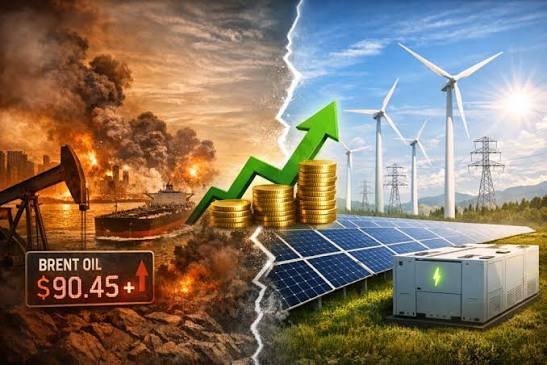
Renewable energy is becoming one of the most important areas of global investment as countries seek greater energy security, economic stability and environmental sustainability. Rising electricity demand, geopolitical uncertainty and concerns about dependence on fossil fuels are encouraging governments, businesses and institutional investors to accelerate the transition towards cleaner energy sources.
Solar power, wind energy, hydropower and battery storage are attracting significant capital, while investments in electricity transmission and modern grid infrastructure are becoming increasingly important. Although the renewable energy sector continues to offer substantial opportunities, changing government policies, financing costs and infrastructure limitations are influencing the pace and direction of investment.
Global Investment: A Changing Energy Landscape
The global energy transition continues to attract considerable financial resources. According to BloombergNEF, worldwide energy transition investment reached a record $2.3 trillion in 2025, an increase of 8% compared with the previous year. Renewable energy accounted for approximately $690 billion of this investment, although spending in the sector declined by 9.5% year-on-year.
The International Energy Agency’s World Energy Investment 2026 report also highlights how energy security concerns are influencing investment decisions across international markets. Governments are increasingly recognising that domestic renewable generation can reduce exposure to international fuel-price volatility and strengthen long-term energy independence.
However, the investment outlook is not uniform. Allianz Research estimated in November 2026 that renewable energy investment could decline from $690 billion in 2025 to approximately $665 billion in 2026. At the same time, investment in electricity networks and battery storage is expected to rise significantly. This indicates that the energy transition is increasingly focused on building complete and reliable power systems rather than expanding generation capacity alone.
Solar and Wind Energy Lead the Transition
Solar and wind power remain central to global renewable energy expansion. Falling technology costs, improved efficiency and supportive government policies have made these sources increasingly competitive with conventional electricity generation.
Solar energy is particularly attractive because it can be deployed across large utility-scale projects as well as residential and commercial rooftops. Businesses are investing in solar installations to reduce electricity expenses, improve energy independence and meet sustainability commitments.
Wind energy is also gaining importance, particularly in regions with favourable natural conditions and established infrastructure. Both onshore and offshore wind projects are contributing to the diversification of electricity supply.
Nevertheless, the International Energy Agency’s Renewables 2026 analysis forecasts an 11% decline in global renewable capacity additions during 2026, largely because of slower solar deployment in China. The report nevertheless projects that annual renewable capacity additions will average almost 800 gigawatts between 2026 and 2031, substantially above the 2020–2025 average. Solar photovoltaic technology is expected to account for approximately three-quarters of renewable capacity expansion over that period.
Battery Storage and Modern Electricity Grids
One of the most important developments in renewable energy investment is the growing importance of energy storage. Solar and wind generation depend on weather conditions and do not always produce electricity when demand is highest. Battery storage helps address this challenge by storing surplus electricity and supplying it when generation falls or consumption increases.
Investors are increasingly supporting projects that combine solar installations with battery systems. BloombergNEF reported that investment in solar and storage projects developed together reached a record $25 billion in the first half of 2026, nearly double the level recorded in the second half of 2025.
Electricity grids are equally important. Many countries need to modernise transmission networks, expand distribution infrastructure and introduce smarter systems capable of managing electricity from multiple renewable sources.
Without adequate grid capacity, renewable projects can face delays, electricity curtailment and lower financial returns. Consequently, transmission infrastructure and battery storage are becoming essential components of the global clean-energy investment strategy.
India: A Growing Renewable Energy Investment Destination
India is emerging as an important destination for renewable energy investment. Its growing electricity demand, expanding industrial sector and long-term clean-energy ambitions are creating opportunities in solar power, wind energy, battery storage and green infrastructure.
The country has established a target of 500 gigawatts of non-fossil-fuel power capacity by 2030. Achieving this ambition will require substantial financing, stronger transmission infrastructure and continued participation from domestic and international investors.
A Reuters report published in November 2026 highlighted plans by the Indian Renewable Energy Development Agency (IREDA) to establish partnerships with global banks, institutional investors and multilateral organisations to secure more affordable long-term financing. The initiative reflects the importance of reducing borrowing costs for renewable energy developers.
However, challenges remain. High financing expenses, land acquisition difficulties and inadequate transmission infrastructure can delay projects and affect their profitability. Addressing these issues will be critical to attracting further investment and accelerating India’s renewable energy expansion.
Challenges Facing Renewable Energy Investors
Despite strong long-term potential, renewable energy projects face several financial and operational challenges.
High initial capital requirements can make large-scale projects difficult to finance, particularly in developing economies where borrowing costs are comparatively high. Changes in government subsidies, electricity pricing regulations and investment incentives can also influence expected project returns.
Grid congestion, permitting delays, land availability and supply-chain disruptions create additional uncertainty. Offshore wind projects, in particular, can face higher construction costs and complex regulatory requirements.
Investors are therefore becoming more selective, prioritising projects with reliable revenue arrangements, strong infrastructure connections and predictable regulatory conditions.
The Worldonomics Times View
Renewable energy investment represents more than an environmental initiative; it is becoming a strategic economic priority. Countries that develop reliable clean-energy systems can strengthen energy security, attract industrial investment, create employment opportunities and reduce exposure to volatile fossil-fuel markets.
However, the next phase of the global energy transition will require more than investment in solar panels and wind turbines. Battery storage, modern electricity grids, efficient financing mechanisms and consistent government policies will determine whether renewable energy can deliver reliable power at scale.
India and other emerging economies have an important opportunity to attract international capital and develop competitive clean-energy industries. Success will depend on creating transparent regulations, improving infrastructure and making long-term project financing more accessible.
Ultimately, the future of renewable energy will be shaped not only by how much capital the world invests, but also by how effectively that investment is converted into affordable, reliable and sustainable electricity. The transition towards cleaner energy is a long-term economic transformation, and the countries that prepare early will be better positioned to benefit from it.