By The Worldonomics Times
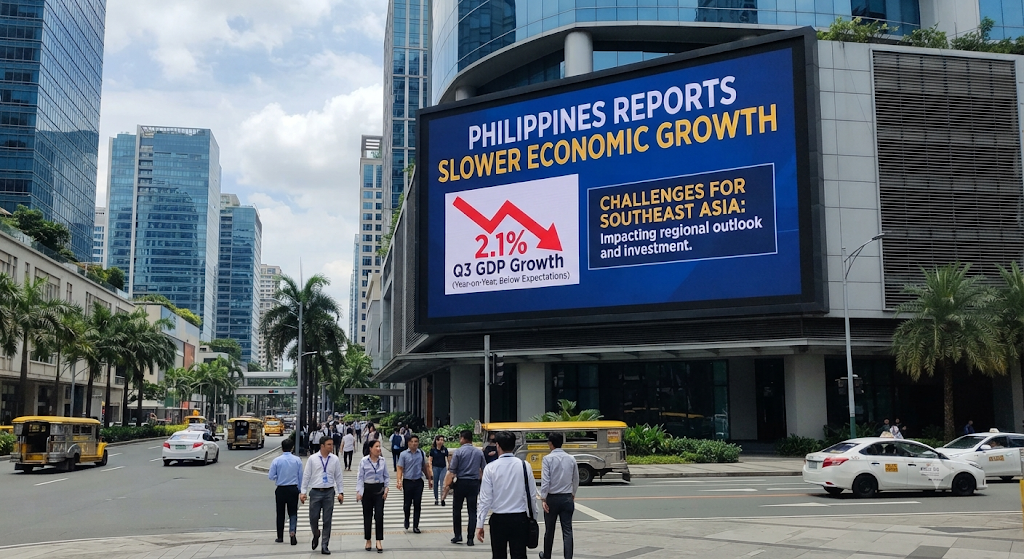
The Philippine economy recorded year-on-year growth of just 2.1% in the third quarter of 2026, falling short of market expectations and highlighting the economic challenges facing parts of Southeast Asia. The latest performance represents a further slowdown from the revised 2.4% growth recorded in the second quarter and the 4% expansion registered during the same period last year.
The figures point to growing pressure on household spending, agricultural production and business investment. Higher food and energy prices, weather-related disruptions and uncertainty surrounding public infrastructure projects have contributed to weaker economic activity. The slowdown also raises questions about the country’s ability to achieve its annual growth target.
Economic Growth Falls Below Expectations
According to the Philippine Statistics Authority (PSA), gross domestic product (GDP) increased by 2.1% year-on-year between July and September 2026. Economists surveyed by Reuters had expected growth of approximately 3%, making the actual result significantly weaker than anticipated.
On a seasonally adjusted quarter-on-quarter basis, the economy expanded by only 0.1%, compared with 0.6% in the previous quarter. The latest figures indicate that the slowdown is not limited to an annual comparison but is also visible in the economy’s recent momentum.
The third-quarter result was the weakest expansion in more than five years, excluding the pandemic period. It also brought average economic growth for the first nine months of 2026 to approximately 2.5%, considerably below the government’s full-year target of 3.5% to 4.5%.
Agriculture and Industry Weigh on Performance
One of the most significant concerns is the weakness in agriculture. PSA data show that agriculture, forestry and fishing contracted by 4.8% year-on-year during the third quarter. This decline reversed the sector’s expansion in the previous quarter and reflected the impact of adverse weather conditions on agricultural production.
The industrial sector also remained almost stagnant, recording a marginal contraction of 0.003%. In contrast, services expanded by 3.7%, making it the main source of economic growth during the period. Wholesale and retail trade, public administration, and financial services were among the important contributors.
The figures reveal an uneven recovery across the economy. While services continued to provide support, weakness in agriculture and industry limited overall growth and highlighted the need for stronger production across different sectors.
Household Spending Faces Higher Costs
Household consumption is an important driver of the Philippine economy, but rising living expenses are putting pressure on consumers.
Household final consumption expenditure grew by 2.4% in the third quarter, slower than the 4% expansion recorded in the same quarter of the previous year. Higher food, fuel, transportation and electricity costs have reduced the purchasing power of households, leaving less room for discretionary spending.
For many families, increased expenditure on essential goods and services can result in lower spending on retail products, leisure, travel and other non-essential activities. This can affect businesses that depend heavily on domestic consumer demand.
Government consumption, meanwhile, increased by 6.8%, providing some support to economic activity. However, stronger public spending alone may not be sufficient to compensate for weak private consumption and investment.
Investment and Infrastructure Development Remain Concerns
Business investment is another area requiring attention. Gross capital formation declined by 0.2% year-on-year during the third quarter, although this represented an improvement from the sharper contraction recorded in the previous quarter.
Delays in infrastructure implementation, uncertainty surrounding public projects and tighter financing conditions have affected investment activity. Public construction has remained particularly weak, limiting the contribution of infrastructure development to economic growth.
Infrastructure investment is important because it creates employment, improves transportation networks and supports productivity across industries. Delays in roads, ports, railways and other public projects can therefore affect both immediate economic activity and the country’s long-term competitiveness.
A stronger investment environment will require predictable government processes, effective project implementation and greater confidence among private-sector investors.
Regional Implications for Southeast Asia
The Philippines’ slowdown highlights the different growth conditions emerging across Southeast Asia. The region includes economies benefiting from strong manufacturing, technology exports and investment, while others are facing weaker domestic demand and higher import costs.
The Asian Development Bank’s July 2026 outlook projected developing Southeast Asia to grow by 4.6% in 2026, although it identified higher energy costs, supply disruptions and tighter financial conditions as important risks. It also noted that the Philippines faced pressure from delayed investment, softer private consumption and climate-related challenges.
These differences demonstrate that regional growth is not uniform. Economies with strong export industries and resilient domestic demand may be better positioned to withstand external shocks, while countries dependent on imported energy and vulnerable agricultural production can face greater difficulties.
Implications for India
The Philippine slowdown is relevant to India because both countries are part of the broader Asian economic environment and face exposure to international energy prices, trade conditions and global financial uncertainty.
Slower economic activity in the Philippines could affect demand for imported goods, technology services and industrial products. Indian companies operating in or trading with Southeast Asian markets may need to account for weaker consumer demand and more cautious business investment.
At the same time, economic differences across the region create opportunities for India to strengthen its trade and investment relationships. Cooperation in digital services, infrastructure, renewable energy, pharmaceuticals and manufacturing could support stronger commercial connections.
For India, the broader lesson is the importance of maintaining domestic demand, improving infrastructure delivery and reducing vulnerability to imported energy and commodity price shocks. Stronger regional partnerships can also help businesses diversify markets and supply chains.
The Worldonomics Times View
The Philippines’ 2.1% economic growth in the third quarter of 2026 is a warning that recovery remains vulnerable to rising costs, weak investment and climate-related disruptions. Although the services sector continues to provide support, declining agricultural output, subdued household consumption and limited industrial growth have restricted the economy’s overall performance.
The immediate priority should be to restore business confidence, improve agricultural resilience and accelerate productive infrastructure investment. Targeted support for vulnerable households and businesses can also help protect consumption while broader economic reforms take effect.
For Southeast Asia, the development underlines the importance of strengthening domestic demand, diversifying supply chains and improving resilience to external shocks. For India, it reinforces the value of regional cooperation and stable economic fundamentals.
Ultimately, sustainable growth requires more than short-term improvements in GDP. It depends on productive investment, reliable infrastructure, affordable essential goods and economic opportunities that benefit households and businesses across the country.