Introduction
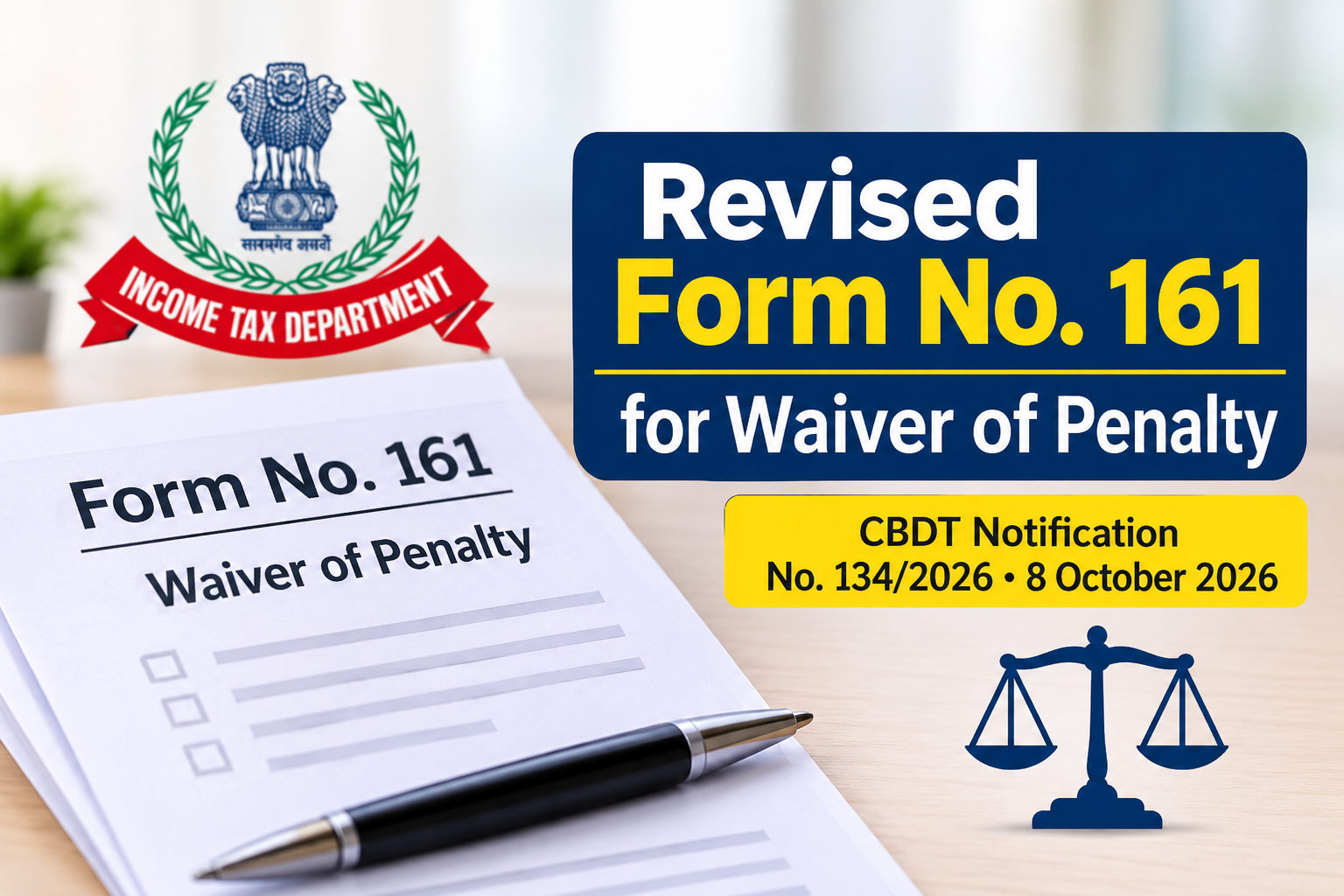
The Central Board of Direct Taxes (CBDT) has introduced an important procedural change by notifying the Income-tax (Sixth Amendment) Rules, 2026, vide Notification No. 134/2026 dated 8 October 2026. Through this amendment, CBDT has prescribed a revised Form No. 161 for filing applications seeking waiver of penalty under Section 440(2) of the Income-tax Act, 2025.
The amendment is significant for taxpayers as well as tax professionals because it provides a prescribed mechanism for approaching the competent income-tax authority for waiver of penalty, subject to the conditions laid down under the law.
Penalty provisions under income-tax legislation are intended to ensure compliance and discourage tax evasion. However, there may be circumstances where taxpayers face genuine difficulties or circumstances beyond their control, resulting in penal consequences. The waiver mechanism provides an opportunity to seek appropriate relief in eligible cases.
Background and objective of the amendment
The revised Form No. 161 should be viewed in the context of the amendments made to Section 440 by the Finance Act, 2026.
Earlier, the immunity mechanism under Section 440 was restricted and did not extend to cases involving misreporting of income. The Finance Act, 2026 expanded the scope of the provision by allowing eligible taxpayers to seek waiver of penalty even in specified cases of misreporting, subject to payment of additional income-tax in lieu of penalty.
This is an important change because taxpayers can now consider an alternative to prolonged penalty litigation by accepting the assessed income, paying the prescribed amounts and complying with the statutory conditions. TAX CONCEPT+1
Key changes introduced through revised Form No. 161
The revised form has been structured into two principal parts:
1. Part A – Personal Information
The applicant is required to provide:
- Full name of the taxpayer.
- Permanent Account Number (PAN).
- Complete postal address.
- Mobile number and email ID.
2. Part B – Assessment and payment details
This part requires comprehensive particulars relating to the assessment or reassessment order, including:
- Relevant tax year.
- Section under which the assessment or reassessment order was passed.
- Document Identification Number (DIN).
- Date of the order and date of service.
- Due date for payment as per the notice of demand.
- Total assessed income and details of under-reported income.
- Tax and interest payable on the assessed income.
- Additional income-tax payable in lieu of penalty.
- Details of challans through which the requisite amounts have been deposited.
An important feature is that the form separately identifies under-reported income arising from different categories of misreporting under Section 439(11), as well as under-reporting not arising from misreporting. lawspedia.in+1
Financial implications: How much additional tax is payable?
One of the most significant aspects of the amendment is the prescribed additional income-tax payable in lieu of penalty.
| Nature of under-reporting | Additional income-tax |
|---|---|
| Misreporting covered under Section 439(11)(a) to (f) | 100% of tax payable on under-reported income |
| Misreporting covered under Section 439(11)(g) | 120% of tax payable on under-reported income |
In addition to the above, the taxpayer must pay the tax and interest payable on the assessed income within the period specified in the notice of demand.
Thus, the revised mechanism provides a structured alternative to penalty proceedings, but the taxpayer must carefully evaluate the additional financial liability before opting for this route. TAX CONCEPT+1
Time limit and procedural requirements
Section 440(2) prescribes an important statutory deadline for filing the application:
- The application must be filed within one month from the end of the month in which the assessment or reassessment order is received by the assessee.
- No appeal should have been filed against the relevant assessment or reassessment and penalty order.
- The applicant must undertake not to file an appeal before expiry of the prescribed appeal period.
- The application must be duly verified by the assessee or an authorised person.
Further, the Assessing Officer is required to pass an order accepting or rejecting the application within three months from the end of the month in which the application is received. In case of proposed rejection, the assessee must be given an opportunity of being heard. No waiver or immunity is available if proceedings under Chapter XXII have already been initiated. TAX CONCEPT+1
Relief from penalty and prosecution
An important benefit of Section 440 is that it provides relief beyond merely waiving the penalty.
Upon fulfilment of the prescribed conditions, the Assessing Officer shall grant:
- Waiver of penalty levied under Section 439.
- Immunity from initiation of prosecution proceedings under Sections 478 and 479.
This provision can provide considerable relief to taxpayers who prefer to settle their tax liabilities rather than pursue prolonged litigation, provided they satisfy all statutory requirements. TAX CONCEPT+1
Practical implications for Chartered Accountants and tax professionals
The revised Form No. 161 makes it essential for tax professionals to carefully examine the assessment order, penalty order, computation of under-reported income and applicable additional income-tax before advising clients.
In particular, professionals should:
- Verify the correct classification of under-reported income under Section 439(11).
- Reconcile the tax and interest liability with the demand notice.
- Calculate the additional income-tax payable in lieu of penalty.
- Ensure that the entire prescribed amount is deposited within the applicable demand period.
- Monitor the one-month application deadline.
- Evaluate the financial implications of opting for waiver instead of pursuing an appeal.
The decision should be taken after comparing the potential benefits of waiver with the legal merits and available grounds of appeal.
Conclusion
The introduction of revised Form No. 161 through Notification No. 134/2026 is a significant step towards streamlining the penalty waiver mechanism under the Income-tax Act, 2025. By extending the benefit to specified cases of misreporting, the Finance Act, 2026 has broadened the scope of relief available to taxpayers.
The revised form provides a structured mechanism for disclosure of assessment particulars, computation of additional income-tax and verification of statutory conditions. It also reinforces the importance of timely compliance and informed decision-making.
For Chartered Accountants and tax practitioners, this development offers an important opportunity to guide taxpayers towards an appropriate resolution of penalty-related matters while ensuring compliance with the new tax framework.
Reference: CBDT Notification No. 134/2026 dated 8 October 2026 – G.S.R. 871(E), Income-tax (Sixth Amendment) Rules, 2026.