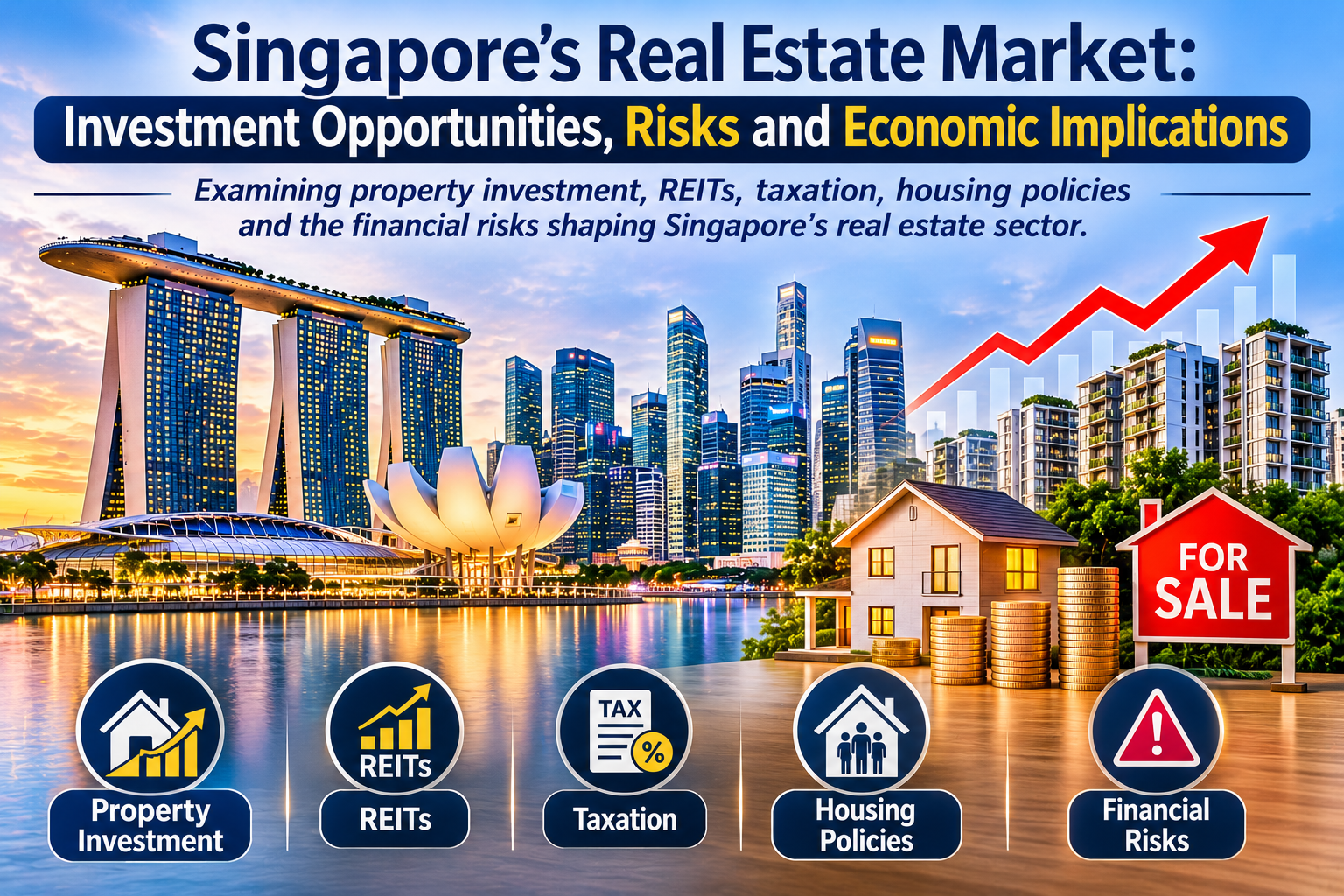
Examining property investment, REITs, taxation, housing policies and the financial risks shaping Singapore’s real estate sector.
Introduction
Real estate is one of the important parts of Singapores economy and investment landscape. Singapore has built a property market that includes residential housing, commercial offices, industrial facilities, logistics infrastructure and retail properties.
For investors Singapore provides a well-developed legal system, clear property regulations and access to a major financial centre.
However real estate investment also requires amounts of capital has financing costs involves taxation and carries market risks.
Understanding these factors is essential for investors who evaluate Singapores property market.
Structure of Singapores real estate market
Singapores property market can be divided broadly into four segments.
- Residential property
This includes condominiums, landed properties and public housing that is developed by the Housing and Development Board (HDB).
- Commercial property
Office buildings, retail centres and business premises fall within this category.
- Industrial property
Factories, warehouses, logistics facilities and industrial buildings support manufacturing and distribution activities.
- Specialised real estate
Hotels, healthcare facilities, data centres and other specialised assets provide investment opportunities.
Each category has demand drivers, regulatory considerations and financial characteristics.
Residential property performance
Singapores residential property market is influenced by household income, interest rates, housing supply, population trends and government policies.
According to the Urban Redevelopment Authority private residential property prices increased by 3.3 percent during 2025.
Private residential rents increased by 1.9 percent over the year while the rental index declined by 0.5 percent in the fourth quarter of 2025.
URA also reported an expected pipeline of 57,000 private residential units, including executive condominiums over the coming years.
Urban Redevelopment Authority (URA)
These figures illustrate the importance of examining both price movements and supply conditions when assessing investment opportunities.
Singapores REIT market
One of Singapores significant contributions to international real estate investment is its Real Estate Investment Trust (REIT) market.
A REIT is an investment vehicle that holds income-generating real estate assets and distributes income to investors according to requirements.
Investors can obtain exposure to properties without directly purchasing an entire building.
Singapores REIT market includes investments in:
- Shopping malls.
- Office buildings.
- Properties.
- Logistics facilities.
- Hospitality assets.
- Healthcare properties.
- Data centres.
According to the REIT Association of Singapore the country had 39 listed REITs and property trusts with a market capitalisation of S$100 billion as of September 2026.
REITAS – REIT Association of Singapore
This illustrates the importance of Singapore as a REIT centre.
How REITs create investment opportunities
REITs provide investors with access to property portfolios.
Of investing substantial capital in one property investors can purchase units in a listed REIT.
Potential benefits include:
- Diversification across properties.
- Access to property management.
- Regular distributions, subject to performance.
- Liquidity through stock exchange trading.
- Exposure to property markets.
However REIT distributions are not guaranteed.
Their performance depends on income, occupancy, operating expenses, financing costs, asset valuations and market conditions.
Financing and interest-rate exposure
Real estate is generally a capital- industry.
Property developers and REITs often depend on borrowing to finance acquisitions and construction.
When interest rates rise borrowing costs can. Reduce profitability.
For REITs refinancing risk is particularly important because debt maturities may require financing at different interest rates.
Investors should examine:
- Loan-to-value ratios.
- Interest coverage ratios.
- Debt maturity schedules.
- Fixed versus floating interest rates.
- Income growth.
- Occupancy levels.
These indicators provide insight into the stability of property investments.
Taxation and regulatory considerations
Singapores property market is supported by a developed taxation framework.
Property investors must consider stamp duties, property taxes, income tax and other transaction-related obligations.
Additional Buyers Stamp Duty and other property-related measures can influence the cost of acquisition for buyers.
The rules differ according to property type, buyer status and applicable exemptions.
Therefore investors should obtain advice before undertaking cross-border property investments.
Risks, in Singapores property market
Despite its established legal environment the property market is exposed to several risks.
Market valuation risk: Property prices may decline when demand weakens or market conditions change.
Interest-rate risk: Interest-rate risk means higher borrowing costs can reduce investment returns.
Risk: Rental risk means lower occupancy and weaker rental demand can affect cash flows.
Risk: Regulatory risk means changes in property taxes foreign ownership rules and housing policies can influence investment decisions.
Currency risk: Currency risk means international investors may face exchange-rate fluctuations when converting returns into their home currency.
Development risk: Development risk means construction delays, cost overruns and approval‑related issues can affect property projects.
Opportunities for institutional investors
Singapores real estate market offers chances for pension funds, insurance companies, asset managers and international REIT investors.
Logistics facilities, industrial properties, healthcare assets and data centres are especially relevant to changes in the economy.
Growth of e-commerce, digital infrastructure and regional supply chains may influence demand for property assets.
However investors must evaluate the underlying cash flows than rely only on expectations of capital appreciation.
Lessons for India
Indias real estate sector is expanding through development, commercial offices, logistics parks and infrastructure investment.
Singapores experience offers lessons in property transparency REIT structures, investor protection and professional asset management.
India can benefit from strengthening investment improving property‑related disclosures and encouraging efficient capital allocation.
Conclusion
Singapores real estate market combines demand, commercial development and sophisticated investment structures.
Singapores REIT industry provides a channel, for connecting property assets with capital markets.
However successful property investment requires evaluation of rental income, valuation, debt, taxation and regulatory risks.
About Author:-
CMA Vivek Kumar (ACMA), an Associate Member of ICMAI and B.Com (Accounting Honours) graduate, is an author, finance professional, and Founder of VK Chartered Academy (www.cacmacstestseries.com). He specializes in statutory and tax audits, taxation, financial reporting, GST advisory, and corporate compliance. He also mentors CA, CMA, and CS aspirants through structured academic guidance and exam-oriented test series, bridging practical industry expertise with professional education. Email: cmavivek2026@gmail.com