Introduction
Artificial Intelligence (AI) is no longer merely a technological innovation used to automate repetitive tasks. It is increasingly becoming an integral part of organisational decision-making, financial analysis and risk management. The emergence of generative AI and agentic AI has further expanded its potential, enabling systems not only to process information but also to execute multi-step tasks with limited human intervention.
For accounting and finance professionals, this transformation presents both opportunities and challenges. The traditional role of finance professionals is gradually evolving from transaction processing towards strategic analysis, business advisory and risk assessment.
From Traditional Automation to Agentic AI
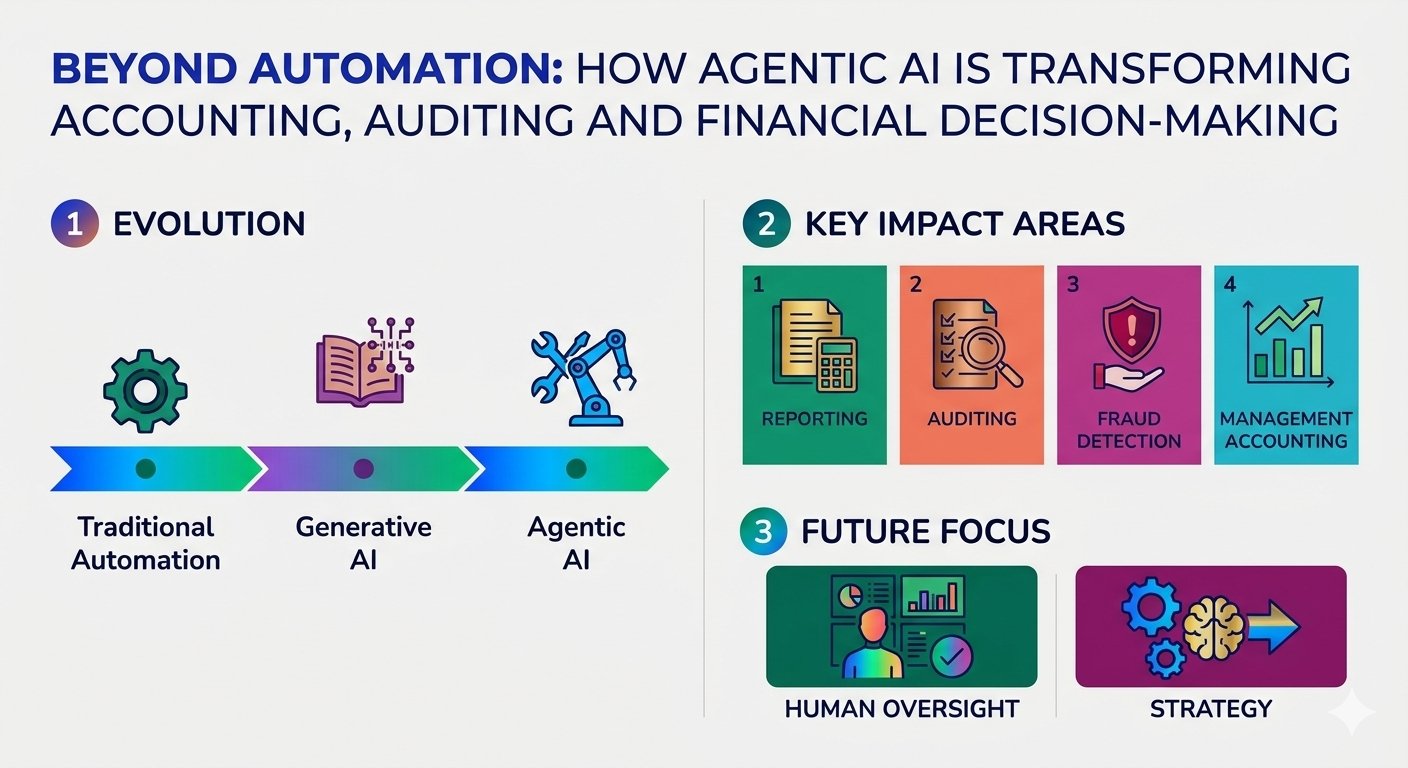
Traditional automation primarily focuses on executing predefined instructions, such as processing invoices, reconciling bank statements and generating financial reports. Generative AI extends these capabilities by interpreting information, summarising documents and assisting in analytical tasks.
Agentic AI represents a further development. It can plan workflows, use connected tools, evaluate intermediate outcomes and undertake subsequent actions based on predefined objectives and permissions.
For example, an AI-enabled financial system could identify an unusual transaction, examine supporting documents, compare the transaction with historical patterns and flag potential irregularities for human review.
Such capabilities can significantly improve the efficiency of accounting and financial operations.
Transformation of Accounting and Auditing
AI is expected to influence several important areas of accounting and auditing.
1. Financial Reporting: AI can assist in analysing large volumes of financial information, identifying inconsistencies and preparing preliminary financial statements. This may reduce manual effort and improve reporting efficiency.
2. Internal and External Auditing: AI-powered analytical tools can examine entire transaction populations rather than relying exclusively on traditional sampling approaches. Unusual journal entries, duplicate payments and suspicious transaction patterns can be identified for further investigation.
3. Fraud Detection: Machine learning algorithms can identify abnormal transaction behaviour by comparing current activities with historical patterns. This can strengthen internal controls and support forensic investigations.
4. Management Accounting: AI can facilitate budgeting, forecasting, variance analysis and scenario planning. Management accountants can use these insights to provide more informed recommendations to business leadership.
Opportunities for Finance Professionals
The growing adoption of AI does not necessarily eliminate the importance of accounting professionals. Instead, it changes the nature of their responsibilities.
Finance professionals will increasingly be required to interpret AI-generated information, evaluate financial risks, exercise professional judgement and communicate strategic recommendations.
Cost and Management Accountants, in particular, can utilise AI to improve cost estimation, profitability analysis, resource allocation and performance measurement.
The competitive advantage will increasingly belong to professionals who combine accounting knowledge with technological understanding and analytical capabilities.
Challenges and Ethical Considerations
Despite its potential, AI adoption involves significant risks.
First, inaccurate or incomplete data can produce misleading outputs. Secondly, AI-generated conclusions may lack transparency, making it difficult to understand the reasoning behind certain recommendations.
Data privacy, cybersecurity, algorithmic bias and unauthorised access to confidential financial information are additional concerns.
Another important consideration is accountability. An organisation cannot transfer its statutory or professional responsibilities to an AI system. Financial statements, audit conclusions and regulatory disclosures must remain subject to appropriate human oversight.
Therefore, organisations should establish clear AI governance policies, access controls, validation mechanisms and audit trails.
The Way Forward
The future of finance will depend on the effective collaboration between human expertise and intelligent technologies.
Organisations should invest in AI literacy, employee training, reliable data infrastructure and responsible technology governance. Finance professionals should develop competencies in data analytics, digital auditing, cybersecurity and strategic financial management.
Conclusion
AI is transforming the financial profession from a largely transaction-oriented function into a technology-enabled strategic discipline. Agentic AI may further accelerate this transformation by supporting complex financial workflows and decision-making.
However, technology must complement, rather than replace, professional judgement, ethical responsibility and human accountability.
The future finance professional will not simply be someone who understands numbers, but someone who can interpret data, challenge technological outputs and convert financial intelligence into meaningful business decisions.