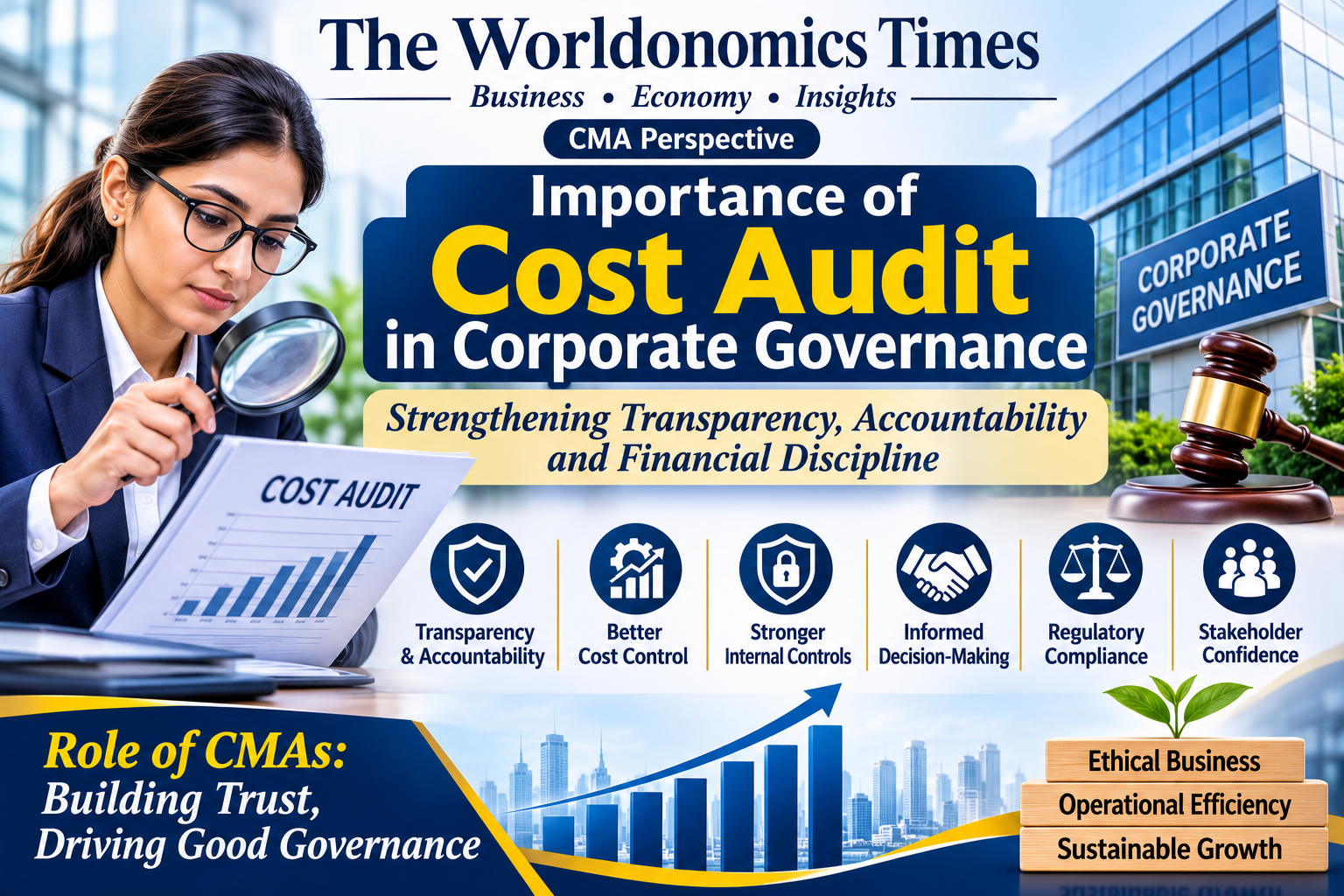
Strengthening Transparency, Accountability and Financial Discipline in Modern Corporations
By CMA Madhuri Kashyap
The Worldonomics Times | CMA Perspective
Introduction
Corporate governance is the foundation of a transparent, accountable and responsible business organisation. In today’s competitive corporate environment, stakeholders expect companies to maintain financial discipline, use resources efficiently and follow applicable laws and regulations. While financial audits examine the fairness of financial statements, cost audits provide valuable insights into the cost structure, operational efficiency and utilisation of resources.
Cost audit is an important area of professional practice for Cost and Management Accountants (CMAs). It helps organisations examine cost records, evaluate cost accounting systems and identify opportunities for improving operational performance. Beyond regulatory compliance, cost audit can support better management decisions and strengthen corporate governance.
1. Understanding Cost Audit
Cost audit refers to the systematic examination of cost records and related information maintained by an organisation. It helps assess whether cost accounting records have been properly maintained and whether the information reflects the relevant cost of production, services or operations.
In India, cost audit is governed by the applicable provisions of the Companies Act, 2013, particularly Section 148, along with the Companies (Cost Records and Audit) Rules, 2014, as amended from time to time.
The law requires specified classes of companies engaged in prescribed sectors and activities to maintain cost records and, where applicable, obtain a cost audit. The applicability depends on the nature of business and prescribed turnover thresholds and exemptions.
A cost audit is conducted by a qualified Cost Accountant appointed in accordance with the applicable legal provisions.
2. Promoting Transparency and Accountability
Transparency is one of the essential principles of good corporate governance. Companies must maintain reliable information about their financial and operational activities.
Cost audit strengthens transparency by examining cost records relating to materials, labour, overheads, production and services. It helps identify inconsistencies, weaknesses in documentation and areas where cost information requires improvement.
Reliable cost information enables management to understand how resources are being used and whether operational expenditure is justified.
It also strengthens accountability by encouraging departments to maintain proper records and explain significant variations in costs.
3. Improving Cost Control and Operational Efficiency
An organisation’s profitability depends not only on revenue generation but also on efficient cost management.
Cost audit helps identify excessive material consumption, avoidable wastage, inefficient production processes, underutilised capacity and abnormal operating expenses.
For example, a manufacturing company may experience increasing production costs despite stable sales. A cost audit can help examine whether the increase is due to higher raw material prices, inefficient machine utilisation, labour productivity issues or rising overheads.
By identifying the reasons behind cost variations, cost auditors can provide useful observations and recommendations for management consideration.
4. Strengthening Internal Control Systems
Effective internal controls protect organisational resources and help prevent errors, irregularities and misuse.
Cost audit can complement internal control systems by examining procedures relating to material procurement, inventory management, production, labour utilisation and cost allocation.
It may help identify weaknesses such as:
- Inadequate inventory monitoring.
- Unusual material consumption.
- Incorrect cost allocation.
- Inconsistent production records.
- Weak documentation and reporting procedures.
- Lack of proper review of cost variations.
These observations can help management improve processes and strengthen financial discipline.
5. Supporting Better Management Decisions
Management decisions are only as effective as the information on which they are based. Cost audit contributes to better decision-making by improving the reliability and usefulness of cost information.
Cost data can help management evaluate product profitability, production efficiency, pricing decisions, capacity utilisation and resource allocation.
For instance, product-wise cost analysis can help a company identify which products contribute positively to profitability and which require operational improvement.
Cost audit findings can therefore support strategic decisions relating to production planning, procurement, pricing and business expansion.
6. Enhancing Regulatory Compliance
Regulatory compliance is a significant responsibility of corporate management. Failure to maintain prescribed records or comply with statutory requirements can lead to legal consequences and reputational risks.
In India, companies covered by the applicable provisions of Section 148 of the Companies Act, 2013, and the relevant Cost Records and Audit Rules must comply with the prescribed requirements.
Cost auditors play an important role in examining the relevant cost records and reporting in accordance with the applicable framework.
A sound cost compliance system helps companies maintain proper documentation, improve reporting discipline and reduce the risk of non-compliance.
7. Protecting Stakeholder Interests
Corporate governance is not limited to protecting the interests of shareholders. It also concerns employees, customers, suppliers, lenders, regulators and society.
Reliable cost information can help stakeholders better understand an organisation’s operational efficiency and cost structure.
In sectors where cost information has wider public or regulatory relevance, proper cost records and audit can contribute to greater accountability.
Cost audit can also encourage responsible resource utilisation by highlighting wastage, inefficiencies and opportunities for improvement.
8. Role of CMAs in Modern Cost Audit
The role of CMAs in cost audit is evolving with changing business practices and technology.
Modern cost auditors increasingly need to understand enterprise resource planning systems, data analytics, automated production processes and digital documentation.
They can use analytical tools to examine large volumes of cost data, identify unusual patterns and highlight areas requiring further review.
Their responsibilities require technical knowledge, professional independence, analytical ability and a clear understanding of the relevant legal and professional standards.
By combining traditional cost accounting expertise with digital capabilities, CMAs can make cost audit more effective and relevant to modern organisations.
9. Cost Audit as a Tool for Sustainable Corporate Growth
Sustainable growth requires businesses to balance profitability with efficient resource utilisation and responsible operations.
Cost audit can help companies identify energy inefficiencies, excessive material consumption, production losses and avoidable operating expenditure.
Such insights can encourage better utilisation of resources, support process improvement and contribute to long-term cost competitiveness.
When management treats cost audit as an opportunity for improvement rather than merely a statutory obligation, it can become a valuable instrument of corporate development.
Conclusion
Cost audit is an important mechanism for strengthening corporate governance, improving cost transparency and promoting operational accountability. It provides management with valuable information about cost structures, resource utilisation and business efficiency.
For CMA professionals, cost audit represents an important responsibility and an opportunity to contribute to better corporate practices. Their expertise helps organisations improve cost records, strengthen internal controls and make informed management decisions.
As Indian businesses expand and corporate governance expectations continue to evolve, the importance of reliable cost information will remain significant.
Cost audit is not merely a statutory compliance requirement; it is a powerful instrument for transparency, accountability, operational efficiency and sustainable corporate growth.