Introduction
Corporate governance has evolved from being a formal requirement to becoming a fundamental pillar of sustainable business performance. In an increasingly interconnected business environment, stakeholders expect companies to demonstrate transparency, accountability, ethical conduct and responsible decision-making.
The growing complexity of corporate structures, financial transactions and related-party arrangements has made regulatory oversight more significant than ever.
A company may comply with several statutory filing requirements and still face governance failures if its internal controls, disclosure practices and decision-making mechanisms are ineffective.
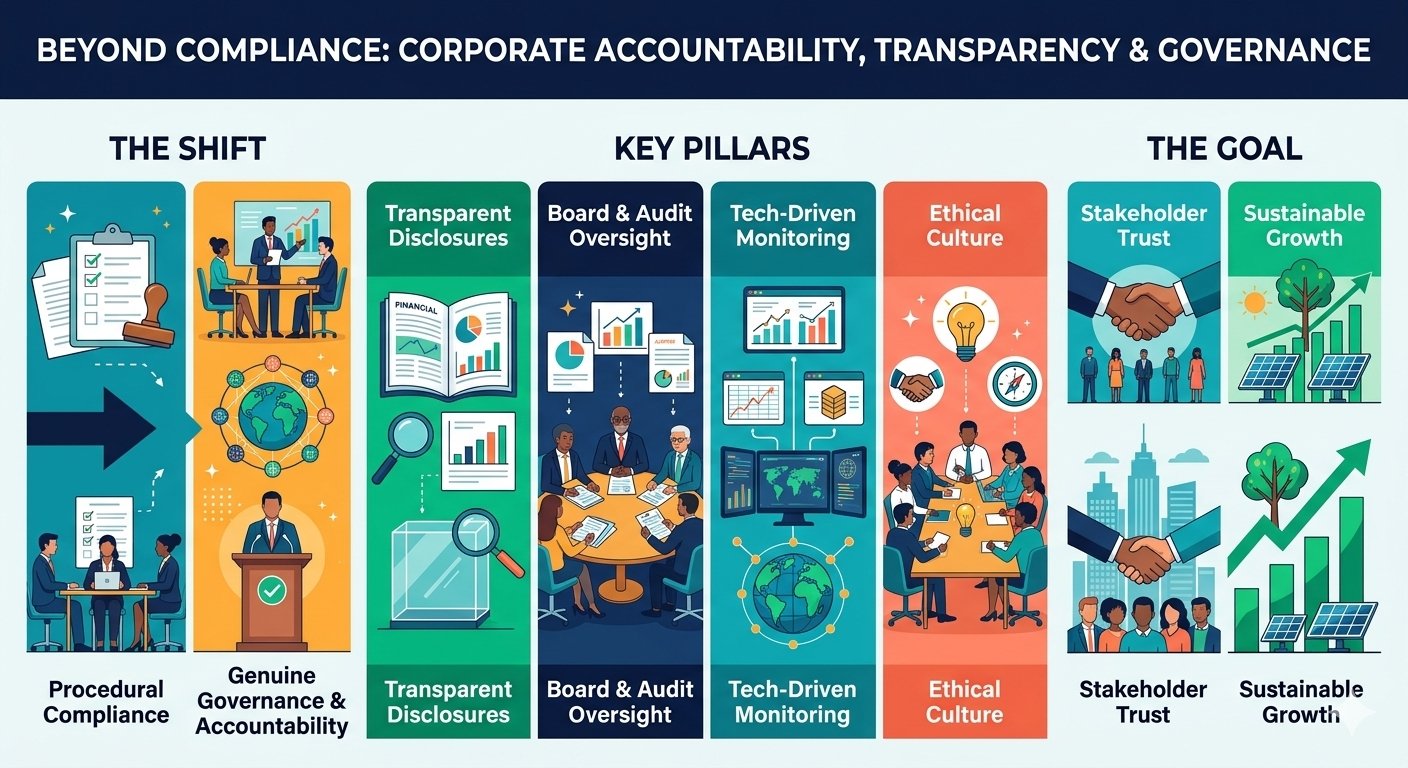
This highlights the need to move beyond procedural compliance towards a culture of genuine corporate accountability.
Compliance Versus Corporate Governance
Compliance generally refers to adherence to applicable laws, regulations, rules and statutory requirements. Corporate governance, on the other hand, encompasses the broader framework through which companies are directed, controlled and held accountable.
The Companies Act, 2013 provides an important legislative framework for corporate governance in India.
Provisions relating to directors’ duties, board meetings, related-party transactions, internal financial controls, statutory audit and disclosure requirements collectively seek to promote responsible corporate management.
However, governance cannot be measured merely by the number of forms filed or resolutions passed. The quality of disclosures, authenticity of transactions and effectiveness of internal controls are equally important.
Emerging Governance Challenges
Several developments are reshaping the corporate governance landscape.
1. Complex Corporate Structures: Multiple subsidiaries, associate companies and interconnected business arrangements can make it difficult to identify the ultimate beneficiaries of transactions. Transparent disclosures and effective monitoring mechanisms are therefore essential.
2. Related-Party Transactions: Transactions between related entities may create conflicts of interest and opportunities for diversion of resources. Appropriate approvals, disclosures and independent scrutiny are necessary to protect stakeholder interests.
3. Financial Reporting Irregularities: Misrepresentation of financial information, inappropriate recognition of revenue, concealment of liabilities and inadequate disclosures can undermine investor confidence.
4. Board Accountability: The role of independent directors and audit committees has become increasingly important. Their responsibility extends beyond attending meetings to critically evaluating management decisions, financial disclosures and risk-management systems.
5. Technology and Governance: Digital financial records, artificial intelligence and data analytics provide new opportunities for identifying irregularities. At the same time, they create additional cybersecurity, data protection and accountability challenges.
Role of Regulatory Authorities
Regulatory authorities play a crucial role in ensuring that companies operate within the prescribed legal framework.
In India, the Ministry of Corporate Affairs, through the Registrar of Companies and other authorised mechanisms under the Companies Act, 2013, oversees corporate compliance and takes appropriate action where statutory requirements are not fulfilled.
The statutory framework provides mechanisms for examination of company information, inspection of books and papers, inquiry and investigation, subject to the applicable legal provisions.
Sections 206, 210 and 217 of the Companies Act, 2013, among other provisions, form part of the framework dealing with inspection, inquiry and investigation.
These mechanisms are important not merely for identifying violations but also for strengthening corporate discipline and protecting public interest.
Effective regulatory supervision should be supported by reliable information, inter-agency coordination, timely action and appropriate procedural safeguards.
Technology-Driven Corporate Investigations
The increasing volume of corporate information makes technology an important component of regulatory supervision.
Data analytics can help identify unusual financial trends, inconsistent statutory disclosures, suspicious related-party transactions and discrepancies between reported financial information and available records.
For example, a company reporting continuous business expansion while simultaneously demonstrating persistent financial distress may warrant further examination of its financial position and underlying transactions.
However, analytical indicators should be treated as triggers for examination rather than conclusive evidence of wrongdoing. Every finding must be supported by documentary evidence and evaluated in accordance with applicable law.
Building a Stronger Governance Framework
Companies should adopt a proactive approach to corporate governance.
The following measures can strengthen corporate accountability:
- Establish robust internal financial controls and periodic independent reviews.
- Ensure transparent disclosures of related-party transactions and beneficial ownership.
- Strengthen the independence and effectiveness of audit committees.
- Develop effective whistle-blower and grievance-redressal mechanisms.
- Adopt technology-based compliance monitoring and risk assessment.
- Promote ethical leadership and accountability at every organisational level.
Conclusion
Corporate governance should not be viewed as a statutory obligation that ends with the submission of annual returns and financial statements. It should be embedded in the organisational culture and reflected in everyday business decisions.
The future of corporate accountability will depend on the combined effectiveness of responsible management, independent oversight, technological innovation and regulatory supervision.
Ultimately, a well-governed company is not merely one that complies with the law, but one that earns the confidence of investors, employees, regulators and society through transparency, integrity and responsible conduct.