Introduction
The global business environment is undergoing a significant transformation as sustainability becomes an essential component of corporate strategy. Traditionally, organisational performance was evaluated primarily through financial indicators such as revenue, profitability, return on investment and cash flows.
However, increasing environmental concerns, climate-related financial risks and changing stakeholder expectations have expanded the definition of business performance.
Environmental, Social and Governance (ESG) considerations are now influencing investment decisions, corporate reputation, risk management and long-term business sustainability.
The emerging challenge is no longer simply to make sustainability commitments, but to demonstrate measurable progress through reliable reporting and accountability.
Understanding ESG and Corporate Sustainability
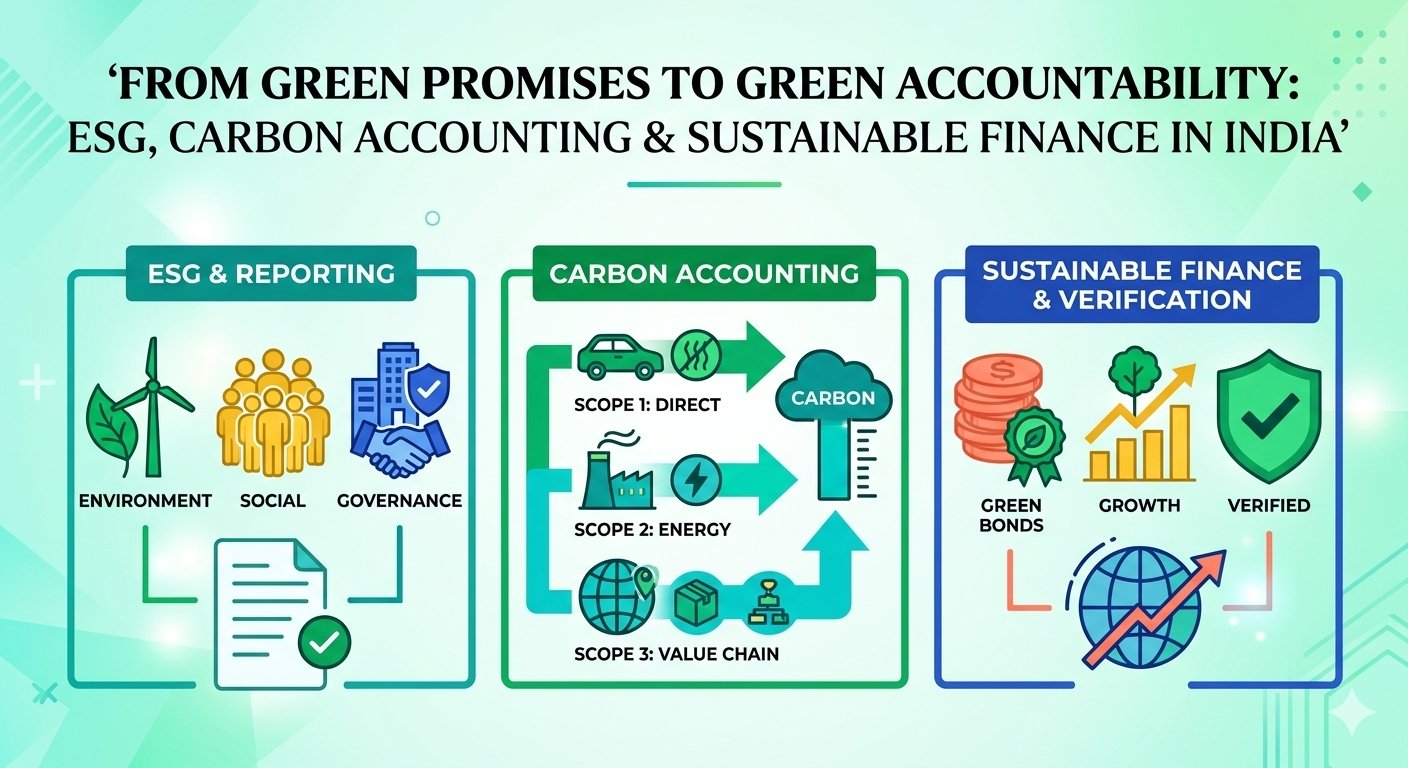
ESG represents three interconnected dimensions of responsible business conduct.
Environmental: Focuses on energy consumption, carbon emissions, waste management, water conservation and the efficient utilisation of natural resources.
Social: Covers employee welfare, workplace safety, diversity, human rights, customer protection and community development.
Governance: Relates to board accountability, ethical business practices, transparency, internal controls and responsible corporate decision-making.
Together, these dimensions provide a broader understanding of how an organisation creates value while managing its impact on society and the environment.
The Changing Landscape of Sustainability Reporting in India
India has witnessed an increasing emphasis on sustainability disclosures through regulatory and institutional initiatives.
The Securities and Exchange Board of India (SEBI) introduced the Business Responsibility and Sustainability Report (BRSR) framework for specified listed entities, replacing the earlier Business Responsibility Report framework.
The BRSR framework seeks to improve the quality and comparability of disclosures relating to environmental, social and governance performance.
At the international level, the International Sustainability Standards Board (ISSB) has issued IFRS S1 and IFRS S2, addressing general sustainability-related financial disclosures and climate-related disclosures respectively.
These developments indicate a gradual movement towards integrating sustainability-related risks and opportunities with conventional financial reporting.
Carbon Accounting: Measuring Environmental Impact
Carbon accounting is emerging as an important component of corporate sustainability management.
It involves measuring and reporting greenhouse gas emissions associated with business activities.
Emissions are generally classified into three categories:
- Scope 1: Direct emissions from sources owned or controlled by an organisation.
- Scope 2: Indirect emissions arising from the generation of purchased electricity, steam, heating and cooling.
- Scope 3: Other indirect emissions occurring across the organisation’s value chain, including suppliers, transportation and product use.
For organisations with complex supply chains, measuring Scope 3 emissions can be particularly challenging.
Nevertheless, reliable carbon accounting enables companies to identify emission-intensive activities, evaluate operational efficiency and develop measurable reduction strategies.
Green Finance and Carbon Markets
Green finance refers to financial activities that support environmentally sustainable projects and initiatives.
It includes green bonds, sustainability-linked financing and investments in renewable energy, energy efficiency and other climate-related projects.
Carbon markets also provide mechanisms through which eligible emission reductions or removals can be quantified and traded under applicable regulatory or voluntary frameworks.
India’s evolving carbon market framework, including the Carbon Credit Trading Scheme, reflects the growing importance of market-based mechanisms in supporting decarbonisation.
However, credible measurement, verification and transparent reporting are essential to ensure that environmental claims represent genuine outcomes.
The Risk of Greenwashing
One of the major challenges in sustainability reporting is greenwashing.
Greenwashing occurs when an organisation creates a misleading impression regarding its environmental performance through exaggerated claims, selective disclosures or unsupported sustainability commitments.
For example, a company may advertise itself as environmentally responsible without providing adequate information about its actual emissions, resource consumption or supply-chain practices.
Such practices can mislead investors, consumers and other stakeholders.
Independent verification, consistent reporting methodologies and reliable supporting documentation are therefore essential for maintaining the credibility of ESG disclosures.
Role of Cost and Management Accountants
Cost and Management Accountants can play a significant role in integrating sustainability with financial performance.
Their expertise in cost measurement, performance evaluation, budgeting and management reporting can support the development of sustainability-related performance indicators.
They can assist organisations in:
- Measuring environmental costs and resource consumption.
- Evaluating the financial implications of carbon emissions.
- Developing sustainability budgets and performance indicators.
- Assessing the economic viability of green investments.
- Integrating ESG parameters into management reporting.
This creates an opportunity to expand the traditional scope of cost accounting beyond financial costs towards environmental and social value creation.
The Way Forward
Organisations should move towards measurable sustainability targets supported by reliable data, transparent disclosures and effective internal controls.
Sustainability reporting should be integrated with corporate strategy rather than treated as an independent reporting exercise.
The adoption of appropriate reporting standards, technology-enabled data collection and independent assurance can strengthen stakeholder confidence.
Conclusion
The future of corporate sustainability will be determined not by the number of environmental commitments made by organisations, but by their ability to demonstrate measurable and verifiable outcomes.
India’s evolving sustainability reporting and green finance landscape presents significant opportunities for businesses and finance professionals.
The integration of ESG considerations with financial reporting can encourage responsible investment, improve resource efficiency and support long-term value creation.
Ultimately, the transition from green promises to green accountability will be essential for building a resilient, transparent and sustainable corporate economy.